Quick Answer
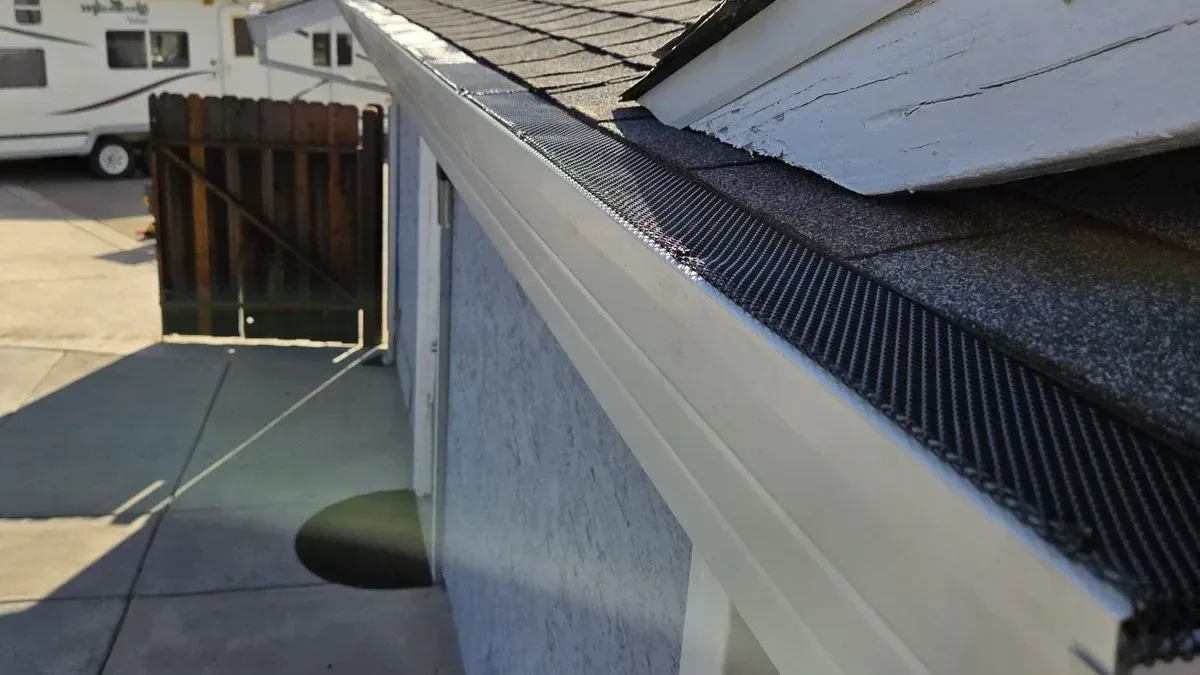
The best micro-mesh gutter guard micron size for Sacramento homes is roughly 275 to 550 microns. That range is fine enough to stop pine needles, oak catkins and shingle grit, but coarse enough that 20-to-40-micron pollen grains pass through and flush out the downspout instead of caking on the screen.
Ultra-fine mesh marketed at 50 microns sits at the same scale as the pollen itself. Under a valley oak in March, it bridges over, holds a film of pollen and silt through the dry summer, and sheets water over the lip in the first November storm. Also watch the units: a “50 mesh” screen is about 300 microns and works fine. A true 50-micron opening is six times finer.
In This Guide
- What a Micron Rating Actually Measures
- Gutter Guard Hole Size by Brand: What Manufacturers Publish
- What Lands on a Sacramento Roof, by Particle Size
- Why 50-Micron Mesh Clogs With Pollen
- The Best Micron Rating for Sacramento Gutter Guards
- Four Specs That Matter as Much as the Micron Number
- What to Ask Before You Buy
- Frequently Asked Questions
TL;DR: A micron is a thousandth of a millimeter. Pollen is 20–40 microns; pine needles are over 1,000. A gutter guard only has to stop the second group. The brands that publish a number cluster between 275 microns (LeafFilter) and 540 microns (Gutterglove), and Gutterglove says outright that smaller holes are worse for pollen. Buy in that range, confirm the unit is microns and not mesh count, and brush the screen once in late May. If you are comparing guard types rather than mesh sizes, start with our micro-mesh vs reverse-curve guide.
Micro-mesh gutter guard micron size is the one spec that separates a guard that stays clear for a decade from one that turns green and sheets water by its first Sacramento fall. Most buyers never see the number. When they do, the instinct is that smaller must be better. On a roof under valley oaks, it is not.
Sacramento is a canopy city. The City's Urban Forest Plan, adopted in June 2025, counts roughly one million trees inside city limits and a 19 percent canopy it intends to nearly double by 2045. Those trees, plus the ash, mulberry, sycamore and pine across Roseville, Folsom, Elk Grove and Citrus Heights, drop a spring pollen load that lands on every roof in the region between late February and June. Then the rain stops for five months, and whatever settled on your gutter guard stays there until the first storm tests it.
This guide explains the micron scale in plain terms, lists what each major manufacturer actually publishes, matches those numbers against real Sacramento debris sizes, and ends with the range we recommend and the questions to ask before you sign. It is a companion to our broader mesh gutter guards Sacramento guide, which covers materials and frames.
What a Micron Rating Actually Measures
A micron (micrometer, µm) is one thousandth of a millimeter, or about 1/25,000 of an inch. When a gutter guard manufacturer says its mesh is “275 microns,” they mean the clear opening between wires is 0.275 mm across. Anything larger than the opening stays on top. Anything smaller goes through with the water.
The complication is that the wire cloth industry has a second unit, mesh count, which is the number of wires per linear inch. A 30-mesh screen has 30 wires per inch in each direction. Mesh count tells you nothing about the opening until you also know the wire diameter, because thicker wire eats into the space between wires. That is why two “30 mesh” screens can have different openings, and why a marketing number with no unit attached is not a specification.
The ASTM E11 standard for test sieves gives the reference conversion. A No. 30 sieve has a 600-micron opening. No. 50 is 300 microns. To get down to a 50-micron opening you need a No. 270 sieve, which is laboratory-grade cloth used for sizing powders, not rainwater. Market-grade gutter mesh uses slightly heavier wire than a test sieve, so a commercial 30-mesh gutter screen lands closer to 540 microns, which is exactly the figure Gutterglove publishes.
Mesh Count vs. Opening Size — Why “50” Needs a Unit
Opening width in microns for standard test-sieve mesh counts (ASTM E11). A 50-mesh screen and a 50-micron screen are six sieve sizes apart.
Keep this chart in mind when you read product listings. We found at least one national brand advertising “316L stainless steel 50 or 30 micro mesh” with no unit at all. Read as mesh count, those are 300-micron and 540-micron screens, both fine for Sacramento. Read as microns, the 50 would be laboratory sieve cloth. The listing does not say which, and that ambiguity is where most of the “50 micron” talk on installer websites comes from.
Gutter Guard Hole Size by Brand: What Manufacturers Actually Publish
We pulled the figures below from each manufacturer's own website in September 2026, not from review sites. Where a brand does not state a number, we say so, because that is useful information on its own. Sacramento homeowners searching for gutter guard hole size will find plenty of third-party claims; these are the ones the companies put their names on.
| Brand / Product | Published Opening | Mesh Count | Other Published Specs |
|---|---|---|---|
| LeafFilter | 275 microns | Not stated | “Surgical grade” stainless mesh, uPVC frame, built-in pitch; claims shingle grit cannot pass |
| Gutter Guard by Gutterglove (Home Depot) | 540 microns | 30 mesh (30×30 per sq. in.) | Meets ANSI/ARCSA 63-2013 rainwater-harvesting pre-filter standard; “about 99% of the time” roof grit will not clog it |
| Gutterglove Pro / LeafBlaster Pro | 540–550 microns | 30 mesh standard | Same 30-mesh weave as above; FAQ states it is “more effective than smaller hole sizes at keeping out pollen” |
| Leaf Solution | 440 microns | 42 mesh | 57% open area, rated to 60 gallons per minute; Xtreme model also offered in 18 mesh for high flow |
| MasterShield | Not published | Not published | 304 stainless with copper alloy woven in; describes a “right-sized aperture” but gives no figure |
| HomeCraft | Not published | Not published | 304 stainless mesh, raised-diamond pattern, powder-coated aluminum frame |
| Raptor (DIY) | Not published on site | Not published on site | V-Bend stainless micro-mesh; retail listings cite 30 mesh |
| All Weather Armour ArmourGuard | “50 or 30 micro mesh” | Unit not stated | 316L stainless; the number could be mesh count or microns |
Two things stand out. First, every brand that publishes an opening size lands between 275 and 550 microns. Nobody selling a professionally installed micro-mesh guard publishes 50 microns. Second, the one company with the deepest Northern California roots made the choice explicit. Gutterglove was started by a tree-care and gutter-cleaning operator, was headquartered in Roseville until it moved to Tennessee in 2021, and says on its history page that its 2003 stainless micro-mesh came out of “lessons learned” from cleaning millions of feet of gutters. Its FAQ answer to “will pollen clog the gutter guards” is that 30 mesh “is more effective than smaller hole sizes at keeping out pollen.” That is a manufacturer telling you finer is worse.
For a broader look at how these brands compare on price, warranty and installation, see our best gutter guard brands comparison and the LeafFilter alternative guide.
What Lands on a Sacramento Roof, by Particle Size
A micron number only means something next to the debris it has to handle. Here is what actually arrives on a Sacramento-area roof over a year, sorted by size, with the sources for each figure.
- Pollen, 20–40 microns. A 2023 paper in ACS Earth and Space Chemistry measured live oak pollen at 28 microns, ryegrass at 25 and giant ragweed at 17. Pine pollen is the outlier at 50–80 microns because each grain carries two air sacs (PalDat, University of Vienna palynological database).
- Valley silt and dust, 2–50 microns. The USDA soil texture system defines silt as 2 to 50 microns and sand as anything above 50. Sacramento sits in a farmed floodplain; summer north winds and Delta breezes put that silt on every roof.
- Fine sand and shingle grit, 50 microns and up. Roof granules that shed off asphalt shingles are sand-sized and larger. Both LeafFilter (275µ) and Gutterglove (540µ) publish that their mesh stops them.
- Oak catkins, sycamore fuzz, cottonwood seed. Stringy spring debris in the 1–3 mm range that slips through perforated screens. Covered in our best gutter guards for oak trees guide and the cottonwood fluff guide.
- Pine needles, 1,000+ microns thick. The foothill problem from Granite Bay to Auburn. Any micro-mesh in the range above stops them; see our pine needle gutter guard guide.
- Leaves, acorns, sweetgum balls. The bulk-volume debris every guard type stops. Size is not the problem; weight and stem entanglement are.
Sacramento Roof Debris vs. Mesh Openings
Particle size ranges (horizontal bars) against the openings of a 50-micron, 275-micron, 440-micron and 540-micron mesh (vertical lines). Scale 0–600 microns.
The chart makes the design problem obvious. Everything a gutter guard exists to stop lives at the right side of the scale or off it entirely. Everything that is harmless to a gutter, and that you want to pass through and flush away, lives at the far left. A 50-micron opening is drawn right through the middle of the pollen band. The 275-to-540-micron openings sit comfortably above all of it while still catching sand-sized grit and everything bigger.
The timing makes it worse here than in a wetter climate. Kitty Bolte, a horticulturist at the UC Davis Arboretum, told local reporters in March 2026 that oaks and ripgut brome grass are the region's main spring offenders, peaking in March, with pines following in early June. NOAA's 1991–2020 climate normals then give Sacramento under half an inch of rain, combined, from June through September. Pollen that lands on a screen in April is still on that screen in October. Our Sacramento pollen season guide covers the full calendar.
Why 50-Micron Mesh Clogs With Pollen (Do Small Micron Gutter Guards Clog?)
Yes, small-micron gutter guards clog, and they do it on the surface rather than inside the trough. Two separate mechanisms are at work, and both get worse as the opening shrinks toward pollen size.
Mechanism 1: Bridging
A particle does not have to be bigger than an opening to block it. Filtration engineers use a rule of thumb that particles larger than roughly one-third of an opening will arch across it when two or three arrive together, the same way a few grains jam a salt shaker. Once a bridge forms, smaller particles pile on behind it and the opening is closed. This is how a coffee filter works, and it is exactly what you do not want a gutter guard to do.
Run the numbers for an oak pollen grain at 28 microns. Against a 50-micron opening it is 56 percent of the width, deep in bridging territory. Against LeafFilter's 275 microns it is 10 percent. Against Gutterglove's 540 it is 5 percent. At those ratios pollen behaves like dissolved material: it goes through with the first rain and leaves via the downspout. Add pine pollen at 50 to 80 microns and the 50-micron screen is not bridging, it is simply blocked.
Bridging Risk: Oak Pollen Grain as a Share of Each Mesh Opening
28-micron live oak pollen divided by the published opening. Above roughly one-third, grains can arch across the opening and seal it.
Mechanism 2: The Film
Bridging is the mechanical failure. The second failure is chemical. Pollen is not inert dust; oak and pine pollen grains carry oils and proteins, and when they sit wet on a screen for a few days they leave a sticky residue. Add the oil that leaches off asphalt shingles in a 100-degree Sacramento July, add valley silt, and the mesh grows a skin. MasterShield's own technical page notes that a patent in its portfolio critiques surface-tension guard designs because they “lose that property over time as pollen, oil, and scum accumulate on the surface.” That sentence is the whole problem in one line.
A finer mesh has more wire and less open area per square inch, so it holds that film better and gets sealed faster. Leaf Solution publishes 57 percent open area for its 440-micron weave. Ultra-fine sieve cloth in the 50-micron class runs closer to 30 percent open area on standard wire tables before any film forms. Cut the open area in half, coat it with pollen residue over a rainless summer, and the first atmospheric river in November hits a surface that behaves like a sheet of plastic. Water rides across it and off the front lip. It looks like your gutters are clogged; they are empty and dry underneath. Our roof valley overflow guide shows what that overshoot does at a valley.
What This Looked Like on a Fair Oaks Roof
A homeowner near the American River in Fair Oaks, under three heritage valley oaks, installed an aftermarket screen sold as “ultra-fine, blocks pollen.” By late May the top surface was a uniform yellow-green velvet. Nothing was inside the gutters, which was the selling point. Then the first real storm in November poured over the front edge along the entire south run, and water pooled against the foundation. When we pulled a section, the mesh underneath was dry: the screen had sealed. We replaced it with a 30-mesh-class stainless product, and the homeowner now brushes the screen once at the end of May. Two winters later, no overshoot. The Carmichael and Fair Oaks heritage oak guide covers what that canopy does to gutters year-round.
The Best Micron Rating for Sacramento Gutter Guards
The best micron rating for a gutter guard is the largest opening that still stops the smallest debris that would actually clog your gutter. In the Sacramento region that means stopping pine needles (over 1,000 microns), catkin stems and sweetgum spurs (1,000–3,000), and the sand-sized shingle grit that the 275-to-540-micron products are published to stop. Anything finer than that is filtering water, not protecting a gutter.
Here is how we match the range to the canopy when we quote gutter guard installation in Sacramento and the surrounding cities.
| Your Situation | Recommended Opening | Why |
|---|---|---|
| Heavy oak, ash or mulberry pollen (Fair Oaks, Carmichael, Land Park, Elk Grove) | 440–550 microns | Widest opening that still stops catkins and grit; least surface area for pollen film; the range Gutterglove chose specifically for pollen |
| Pine needles plus oak (Granite Bay, Loomis, Auburn, El Dorado Hills) | 275–550 microns | Needles are 1,000+ microns; any micro-mesh stops them. Choose by rain capacity and fire rating, not micron |
| Older asphalt roof shedding heavy grit (Citrus Heights, North Highlands, Rancho Cordova tract homes) | 275–440 microns | Finer end catches more granule fines; still 10× pollen size so no bridging |
| Steep roof or long valley runs (heavy-rain overshoot risk) | 440–550 microns with raised or V-bend mesh | More open area passes atmospheric-river volume; geometry breaks surface tension |
| Rainwater harvesting to a tank | Under 1,500 microns (any micro-mesh) | ANSI/ARCSA 63-2013 pre-filter threshold; Gutterglove publishes compliance at 540 |
Notice that nothing on that table calls for an opening under 275 microns. We have not found a Sacramento roof where a finer screen solved a problem the 275-to-550 range did not. What finer screens reliably do is create a new one.
Cost is not really a micron question. Professionally installed stainless micro-mesh in this range runs about $9 to $12 per linear foot from independent installers like us, versus roughly $17 to $25 per foot from national brands. Our gutter guard cost per linear foot guide breaks that down by home size.
Want the spec sheet, not a sales pitch? Ask us. We tell you the product and its published mesh opening before you sign, so you can check it against the manufacturer's page.
Four Specs That Matter as Much as the Micron Number
Once you are inside the right range, the micron figure stops being the deciding factor. These four specs separate a fine debris gutter screen that works for twenty years from one that works for two.
1. Open area percentage
Two screens with the same opening can have different amounts of open space depending on wire thickness. Higher open area means more water through and less surface for film to grip. Leaf Solution's 57 percent is a published benchmark; ask other manufacturers for theirs. If they only offer a gallons-per-minute figure, that is a usable proxy.
2. Mesh geometry
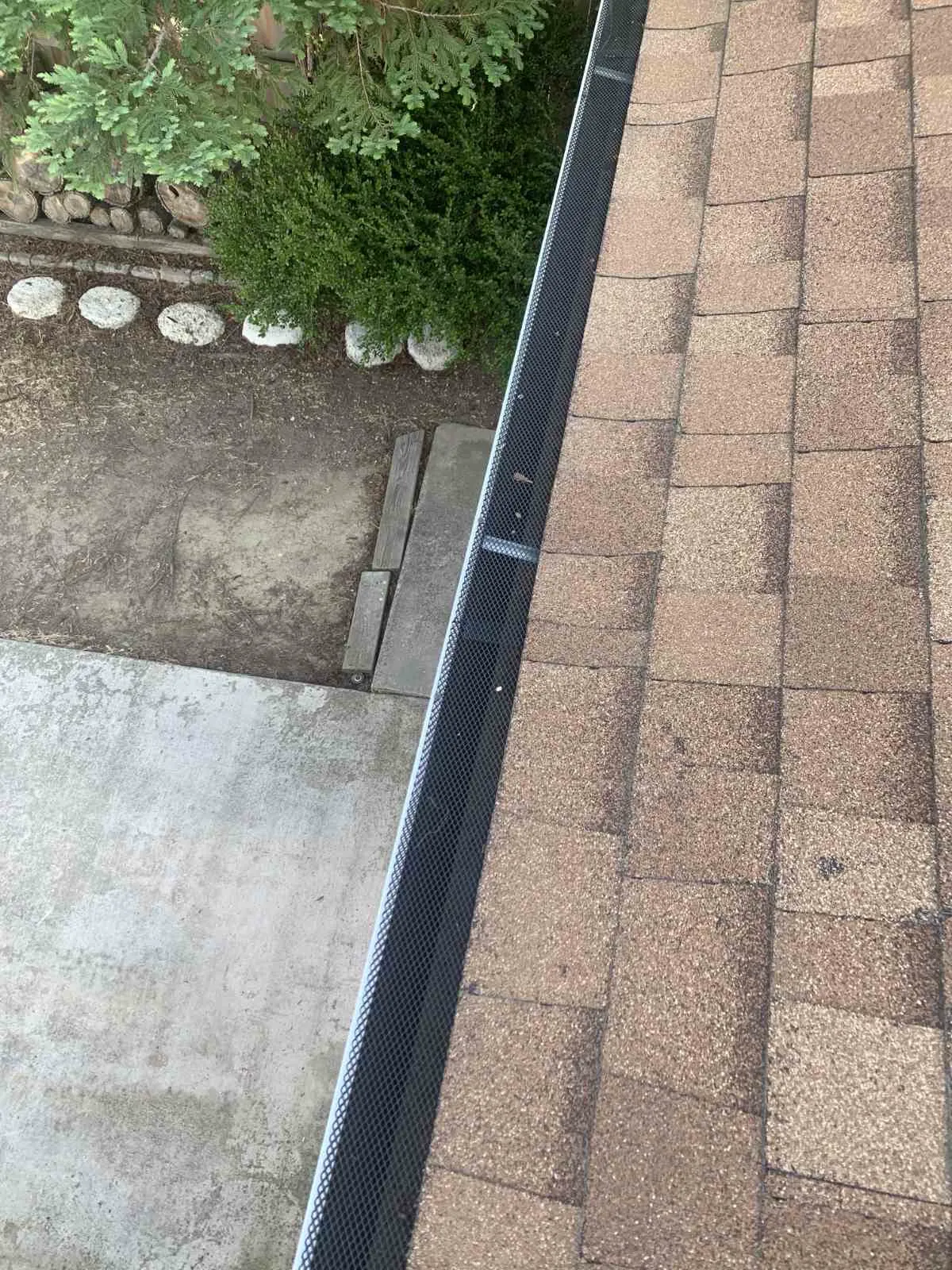
Flat mesh relies entirely on surface tension to pull water in. A V-bend, Z-bend, raised-diamond or corrugated profile lifts debris off the water path and gives rain multiple angles to break through. This is why Gutterglove, Raptor, HomeCraft and MasterShield all sell a shaped mesh rather than a flat one. In heavy Sacramento rain, geometry does more for overshoot than shaving microns ever will. Our best gutter guards for heavy rain guide goes deeper on capacity.
3. Pitch and frame
A screen installed dead flat holds pollen and water; one pitched with the roof lets wind and rain move debris toward the edge. The frame that sets that pitch, and how it fastens under the shingle or to the fascia, determines whether the guard stays put through summer expansion. Our gutter guard installation mistakes guide covers the ways a good product gets installed badly, and the gutter guard materials guide compares aluminum, steel and vinyl frames.
4. Fire rating, if you are in the foothills
For homes in a Fire Hazard Severity Zone from Folsom east, the mesh has to be non-combustible and ember-resistant regardless of micron rating. A finer mesh does not make a guard more fire-safe; the material and frame do. See our Class A fire-rated gutter guard comparison before choosing a product in those areas.
Pro Tip: The Late-May Brush
Even a correctly sized mesh collects a light pollen dusting in a big oak year. One pass with a soft brush or leaf blower in late May, after the oak and grass pollen is done, clears it before the summer heat bakes it on. That is the only micro-mesh maintenance most Sacramento homes need. The full routine is in our gutter guard maintenance and cleaning guide.
What to Ask Before You Buy
Five questions sort out real specifications from marketing in about two minutes. Bring them to any installer, including us.
- “What is the published opening in microns, and where is it published?” The answer should be a number between roughly 275 and 550 and a manufacturer page you can open. “Surgical-grade micro-mesh” is not a number.
- “Is that microns or mesh count?” If the answer is “50,” this question decides whether you are looking at a 300-micron screen or a 50-micron one.
- “What is the open area or flow rating?” Any published percentage or gallons-per-minute figure beats none.
- “Is the mesh flat or shaped?” Shaped mesh handles Sacramento's atmospheric-river bursts better at every micron size.
- “What does the warranty say about pollen?” Most no-clog warranties cover the gutter, not the screen surface. Ask what happens if the mesh itself seals over.
If you are still deciding between micro-mesh and cheaper screen or foam products, our foam vs brush vs snap-in screen comparison explains why those products fail on Sacramento debris for reasons that have nothing to do with microns. Homeowners in the north suburbs can also start with gutter guard installation in Roseville, Folsom, Elk Grove or Citrus Heights.
Frequently Asked Questions
What micron gutter guard is best for pollen?
For pollen-heavy yards, a micro-mesh opening in the 275 to 550 micron range performs best. Pollen grains are only 20 to 40 microns across (oak is about 28), so they pass straight through an opening that size and wash out the downspout instead of bridging across it. Gutterglove states on its own FAQ that its 30-mesh screen (about 540 microns) is more effective than smaller hole sizes at keeping out pollen, and LeafFilter publishes 275 microns. Openings near 50 microns are the same scale as the pollen itself and cake over.
Do small micron gutter guards clog?
Yes. Very fine mesh clogs on the surface rather than inside the gutter. When an opening is only two to three times the size of a pollen grain, the grains arch across it and lock in place, a process filtration engineers call bridging. Add Sacramento Valley silt, roof oil and a dry summer with no rain to rinse the screen, and a 50-micron mesh can be sealed by the first fall storm, sheeting water over the front edge. Mesh in the 275 to 550 micron range lets that fine material through and stays open.
How small are micro mesh gutter guard holes?
The major micro-mesh brands that publish a figure fall between roughly 275 and 550 microns, which is 0.275 to 0.55 millimeters. LeafFilter publishes 275 microns. Gutter Guard by Gutterglove publishes 540 microns on a 30-mesh weave. Leaf Solution publishes 440 microns on a 42-mesh weave with 57 percent open area. MasterShield, HomeCraft and Raptor do not publish a micron figure on their websites, so you have to ask the installer for the spec sheet.
Is a lower micron rating always better for a gutter guard?
No. A lower micron rating blocks smaller particles, but a gutter guard is not a water filter. Its job is to keep out debris that would clog the gutter while passing water and fine material that flushes harmlessly. Below about 200 microns the mesh starts trapping pollen and silt on its surface, loses open area, and holds a water film that sheets over the lip in heavy rain. The sweet spot for Sacramento roofs is fine enough to stop roof grit and pine needles but coarse enough to pass pollen: roughly 275 to 550 microns.
What is the difference between 50 mesh and 50 micron?
They are very different sizes. Mesh count is the number of wires per inch; micron is the width of each opening. A 50-mesh screen has openings of about 300 microns under the ASTM E11 sieve standard. A true 50-micron opening would be roughly a 270-mesh laboratory sieve, about six times finer. Some gutter guard listings print a number like 50 or 30 without saying whether it is mesh or microns, so always ask which unit the manufacturer means.
Will pollen still get into my gutters with micro-mesh guards?
Some will, and that is the correct outcome. Pollen that passes through a 275 to 550 micron opening suspends in rainwater and exits through the downspout; it does not build up into a clog the way leaves and catkins do. What you want to avoid is pollen collecting on top of the mesh. A quick brush of the guard surface in late May, after Sacramento oak and grass pollen finishes, keeps the screen clear for the first fall storm.
Buy the Range, Not the Smallest Number
The micron rating on a micro-mesh gutter guard is worth understanding precisely because the intuition is backwards. Smaller is not better. The manufacturers who publish their numbers, including the one that grew up cleaning gutters in this valley, converged on 275 to 550 microns for a reason: it stops everything that clogs a Sacramento gutter and passes everything that does not.
Confirm the unit, confirm the number is published, favor a shaped mesh with high open area, and give the screen one brush at the end of pollen season. Do that and the guard you install this fall will still be shedding oak leaves and passing March pollen a decade from now.
Micro-Mesh Sized for Sacramento Canopy
Sacramento Gutter Guard installs stainless-steel micro-mesh in aluminum frames across Sacramento, Elk Grove, Roseville, Folsom and Citrus Heights. We tell you the product and its published mesh opening before you sign, and every install is backed by our Workmanship Guarantee.