Quick Answer
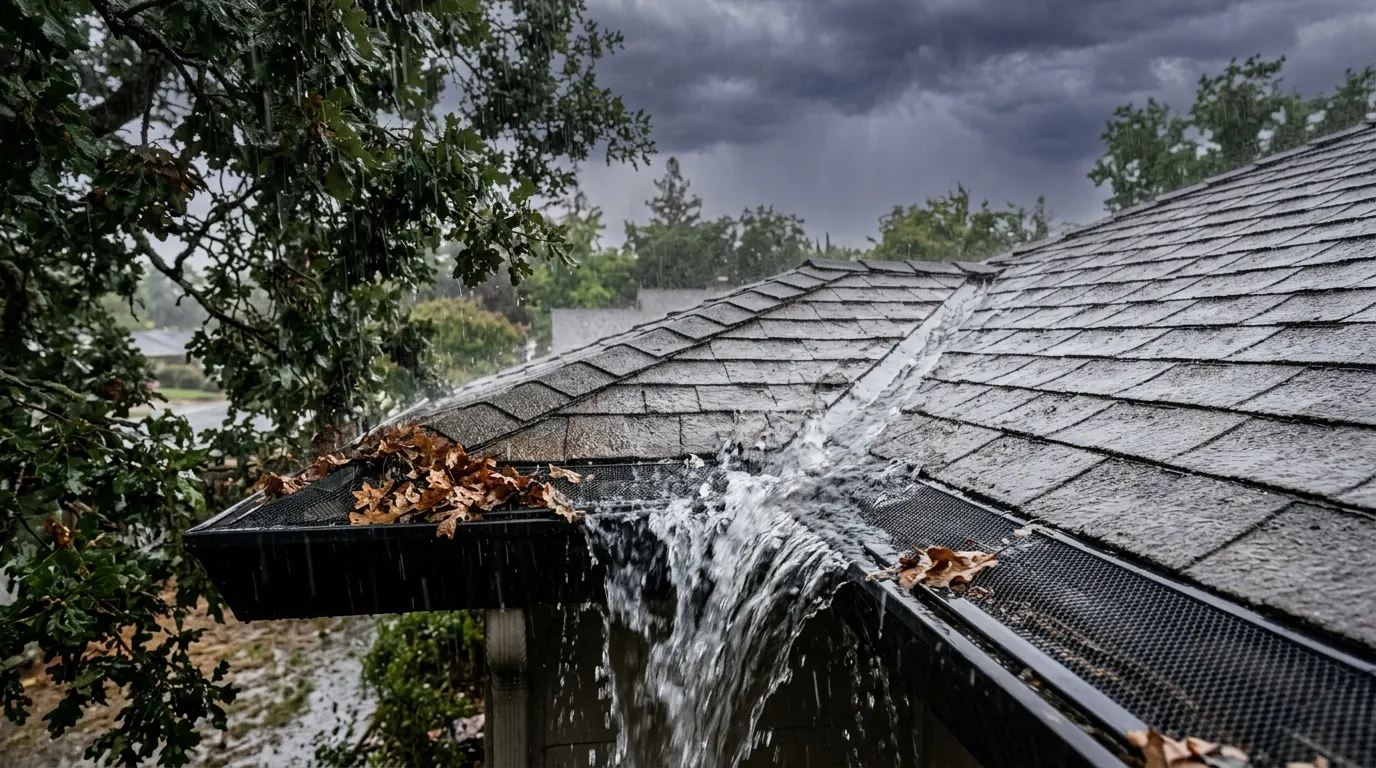
Gutter guards roof valley overflow happens because the guard does not change the gutter's catch capacity at high-flow points. Roof valleys concentrate water from two roof planes into one channel, delivering 2-3x the volume a straight gutter run handles. During a Sacramento storm above 1 inch per hour, that concentrated flow hits the guarded gutter at high velocity and shoots straight over the outer edge -- guard or no guard.
The fix for most Sacramento homes costs $24-$80 in materials: add splash guards ($3-$8 each) at every active valley junction on top of the existing gutter guard system, or upgrade to roof valley diverters ($15-$35 each) for steeper roofs and atmospheric river conditions. Replacing the guards entirely almost never solves the problem.
Sacramento homeowners who paid $2,000-$5,000 for premium gutter guards expect their overflow problems to be over. Then January arrives. The first atmospheric river dumps 2 inches of rain in a few hours, and water shoots off the roof valley like the gutter guards aren't even there. Landscaping gets carved up. Stains run down the siding. The phone calls start.
Here's the truth most installers won't tell you upfront: gutter guards solve debris problems, not capacity problems. They keep oak leaves, pine needles, and sweetgum balls out of the channel so water can flow freely once it's inside. But at roof valley junctions, the issue is not debris -- it's sheer volume and velocity arriving in one concentrated stream. No guard on the market changes the size of the gutter mouth or the speed at which water enters.
Sacramento sees 20.1 inches of average annual rainfall, with 80% of it concentrated between November and March (NOAA Western Regional Climate Center). And atmospheric river events regularly push hourly intensities past 1 inch per hour, with peak bursts hitting 2 inches per hour during the strongest storms (National Weather Service Sacramento). That is the exact load profile that breaks valley junctions on guarded gutter systems. If your gutters are already overflowing in heavy rain, this is almost certainly where it's happening.
TL;DR: Gutter guards stop debris but not valley overflow. Roof valleys concentrate 2-3x the water volume of straight runs, exceeding even 6-inch gutter capacity during Sacramento atmospheric rivers. The combined fix -- gutter guards plus splash guards or valley diverters at active valleys -- handles both problems for $24-$80 in materials. Replacing your existing guards rarely solves anything.
Why Gutter Guards Don't Stop Valley Overflow
Every gutter guard sold in Sacramento -- micro-mesh, reverse-curve, screen, or foam -- exists to solve one problem: keeping debris out of the gutter. None of them change the physical capacity of the gutter itself, and none of them change the speed at which water arrives at a valley junction. That distinction matters more than most homeowners realize until they watch a storm pour over their newly installed guards.
The Capacity Math That Breaks Valley Junctions
A standard 5-inch K-style gutter handles approximately 1.2 gallons of water per foot per minute, while a 6-inch handles about 2.0 gallons per foot per minute (Gutter Supply capacity specifications). That math works fine along straight roof runs where water arrives evenly distributed across many feet of gutter. At a valley junction, the entire runoff from two roof planes funnels into perhaps 6-12 inches of gutter all at once.
Velocity, Not Just Volume
The other half of the problem is speed. Water traveling down a roof valley accelerates because the V-shaped channel is steeper than either of the two roof planes feeding it. By the time it reaches the gutter, it's moving fast enough to skip the entry zone entirely. Imagine pouring a bucket quickly into a narrow cup -- the water overshoots. That's exactly what happens at every valley above a guarded gutter.
Some guard types make this worse. Reverse-curve guards rely on surface tension to wrap water around the curve into the gutter. At high velocities, the water breaks free of the curve and launches off the outer edge like a ramp. Flat micro-mesh guards don't have this launch effect, but the fine mesh creates surface tension that slows intake just enough to push water across the top instead of through. Read more about how different guard types compare in our reverse curve vs micro mesh gutter guards guide.
Gutter Capacity vs. Valley Flow Demand (Sacramento Storm Intensities)
Sources: Gutter Supply capacity data; National Weather Service Sacramento atmospheric river statistics. Valley flow demand calculated from concentrated runoff of two converging roof planes.
The chart above shows why Sacramento storms expose valley junctions in particular. Light rain stays well within capacity. A heavy 1-inch-per-hour storm exactly matches a 6-inch gutter's ceiling -- which means any extra debris, slope error, or guard surface tension pushes the system into overflow. An atmospheric river burst at 2 inches per hour delivers double the gutter's maximum capacity at the valley point. Adding guards does not change either bar on this chart.
How to Identify Valley Overflow on a Guarded System
Before buying any accessories, confirm that valley overflow is actually your problem. Sacramento homeowners often assume their gutter guards are failing when the real culprit is a clogged downspout, a sagging gutter, or a slope error from the original installation. Walking your home during a heavy storm is the single most useful diagnostic step.
Signs You Have Valley Overflow Specifically
- Overflow only at certain points -- water shoots over the gutter at the same 2-4 spots every storm, not along the full run
- Vertical staining directly below valley junctions -- dark streaks running down siding starting at the gutter line below where two roof planes meet
- Erosion grooves in landscaping at specific locations -- mulch and soil carved out below valley exit points but undisturbed elsewhere
- Splash marks 6-12 inches up the foundation -- mud and debris splattered on the foundation only beneath valleys
- Gutter and guard look clean during inspection -- no debris buildup, slope is correct, downspouts flow freely, but overflow still happens during storms
Signs Your Problem Is Something Else
If overflow happens along the entire gutter run -- not just at valleys -- the cause is likely a clog, a slope problem, undersized gutters, or a downspout issue. If overflow only happens after weeks without cleaning, debris is bypassing the guards or building up on top of them. If water drips behind the gutter rather than over the front, you have a different issue covered in our water dripping behind gutters fix guide. Each of these requires a different solution than valley overflow.
Pro Tip: Mark the Trouble Spots
During the next heavy storm, take 5 minutes to walk your property in a raincoat and physically point at every overflow location. Use chalk on the foundation or sticky notes on the gutter face from below. You'll typically find 60-80% of valleys overflow while the rest handle flow fine. Only buy splash guards for the valleys that actually need them. This approach saves $30-$50 in unnecessary materials on a typical Sacramento home.
The Three-Tier Fix for Valley Overflow on Guarded Gutters
Sacramento homeowners with guarded gutters have three tiers of fixes available. Start with the cheapest option that addresses your actual flow conditions. Most homes never need to go past tier one or two.
| Tier | Solution | Cost Each | Best For |
|---|---|---|---|
| Tier 1 | Splash guard (L-shaped lip extender) | $3-$8 | Standard 5- or 6-inch guarded gutters with normal valley angles, 1-story homes |
| Tier 2 | Roof valley diverter (wedge above gutter) | $15-$35 | Steep-pitch roofs, 2-story homes, atmospheric river-prone areas, complex valleys |
| Tier 3 | 6-inch gutter upgrade with new guards | $6-$15 / linear foot | Whole-system overflow (not just valleys), aging gutters needing replacement anyway |
Cost Per Valley by Fix Tier (Materials Only)
Sources: Home Depot / Lowe's 2026 retail pricing; This Old House gutter installation cost data. A 4-valley Sacramento home spends $24-$80 in materials at Tiers 1-2 vs. $900-$2,250 for a full Tier 3 upgrade.
Tier 1: Splash Guards
Splash guards are the cheapest, fastest, lowest-risk fix for valley overflow on guarded gutters. They're L-shaped pieces of aluminum or steel that mount to the outer (fascia-side) lip of the gutter, creating a 4-6 inch vertical wall above the guard surface. When valley flow shoots toward the outer edge, the wall catches it and redirects it back down into the gutter channel.
Two sheet-metal screws hold each splash guard in place. Most installations take 5-10 minutes per valley. Splash guards do not interfere with micro-mesh, reverse-curve, or screen guards because the splash guard footprint sits outside the guard itself. They're available year-round at Home Depot and Lowe's in 5-inch and 6-inch sizes to match your gutter profile.
For more on standalone splash guards as a category, including the L-shaped vs. cup-style options, see our gutter splash guards and valley accessories guide.
Tier 2: Roof Valley Diverters
Roof valley diverters work upstream of the gutter rather than at the gutter. They're wedge-shaped metal accessories that mount on the roof inside the valley itself, redirecting concentrated flow before it reaches the gutter edge. Instead of trying to catch a fast-moving stream after the fact, diverters split the flow and slow it down so the gutter can handle the volume.
Diverters cost more ($15-$35 each) and require working on the roof rather than from a ladder at the gutter. For 2-story Sacramento homes, this is a job for a professional installer. The payoff is reliability during atmospheric river events when splash guards alone aren't enough. Diverters are the right choice for steep-pitch tile roofs in Folsom, El Dorado Hills, and the Sierra foothills where storm intensity is highest.
Tier 3: 6-Inch Upgrade with New Guards
If your gutters are already 15+ years old and overflow happens along straight runs as well as at valleys, the right move is a full 5-inch to 6-inch gutter upgrade. The increased capacity reduces the load on every section of the system, including valleys. Our seamless gutter installation service sizes the new run for Sacramento rainfall, and we pair the 6-inch gutters with gutter guards designed for the larger profile, adding splash guards or diverters at active valleys. This is the comprehensive fix, but it costs $6-$15 per linear foot installed -- $900-$2,250 for a typical 150-foot home (This Old House, 2025).
Not sure which tier matches your roof? Sacramento Gutter Guard offers free in-person valley assessments. We'll inspect every junction, identify which ones overflow during storms, and recommend the lowest-cost fix that actually solves the problem.
Request a Free Valley AssessmentSacramento-Specific Considerations for Valley Overflow
Generic gutter guard advice from national brands ignores what makes Sacramento different. Our debris profile, rainfall pattern, and roof material mix all affect how valley overflow shows up and what fixes actually work locally.
Oak and Pine Debris Patterns
Sacramento's urban canopy is dominated by valley oak, live oak, and ponderosa pine. Oak leaves are large and stiff -- they tend to stack up on top of guards rather than work through. Pine needles are slim enough to slip through screen and reverse-curve guards but get caught by micro-mesh. At valley junctions, accumulated debris on the guard surface adds another layer of obstruction that pushes overflow even worse during a storm. Read our deep-dive on oak leaves clogging gutters solutions and best gutter guards for pine needles for guard-type recommendations specific to each.
Atmospheric River Frequency Is Increasing
Sacramento's 2022-2023 atmospheric river sequence delivered 31 separate atmospheric river events between October and March (National Weather Service Sacramento). Storm intensity has trended upward over the past two decades, and California's climate adaptation reports project this trend continuing through the 2030s. What worked for valley overflow in 1995 -- a properly sloped 5-inch gutter with no accessories -- isn't enough in 2026. Our atmospheric river gutter preparation guide covers the full storm-prep checklist.
Tile Roofs vs. Composition Shingle
Sacramento has a higher concentration of clay and concrete tile roofs than most California metros, especially in Roseville, Rocklin, El Dorado Hills, and the newer Natomas tracts. Tile roof valleys behave differently from shingle valleys -- water moves faster down the smoother tile surface, and valley overflow tends to be more severe. Splash guards still work, but tile roof homes are more likely to need tier 2 valley diverters. See our tile roof gutter installation guide for the full breakdown of how tile roofs interact with gutter systems.
Step-by-Step: Adding Splash Guards to a Guarded Gutter System
Adding splash guards to an existing guarded gutter is a straightforward DIY project for single-story Sacramento homes. Two-story installations should go to a professional for ladder safety reasons. Total project time for a typical 4-valley home is 30-45 minutes plus a hardware store run.
Tools and Materials
- Splash guards -- one per active valley, sized to match your gutter (5-inch or 6-inch profile)
- Self-tapping #8 sheet metal screws -- 1/2 inch length, 2 per guard
- Cordless drill with 1/4-inch hex driver bit
- Sturdy ladder rated for your roof height with stabilizer
- Work gloves and safety glasses
- Sharpie or pencil for marking screw locations
Installation Steps
- Position the splash guard at the valley junction so the long L-leg sits flush against the outer (fascia-side) lip of the gutter and the short leg points inward across the gutter mouth.
- Verify clearance with the existing guard -- the splash guard's long leg should sit outside the guard footprint, not on top of it. Most micro-mesh and reverse-curve guards have plenty of room.
- Mark two screw locations through the pre-drilled holes in the splash guard onto the outer gutter lip, spaced 2-3 inches apart.
- Drive the first screw with the cordless drill, applying steady pressure. Self-tapping screws bite into the aluminum gutter without a pilot hole.
- Check alignment before driving the second screw. The guard should sit perpendicular to the gutter face with no gaps.
- Drive the second screw to lock the guard in place.
- Repeat for every active valley identified during your storm walk-through.
- Test with a garden hose on the roof above the valley if you want to verify performance without waiting for the next storm.
Pro Tip: Match the Color
Splash guards come in white, brown, and bronze finishes. Sacramento HOAs in Serrano, Whitney Ranch, and Empire Ranch often require gutter accessories to match the existing gutter color. Buy splash guards in the same color as your gutters to avoid having to repaint or face a violation notice. Our HOA gutter guard approval guide covers the full architectural review process for major Sacramento communities.
When to Call a Professional for Valley Overflow
Most single-story Sacramento homes can handle splash guard installation as a DIY project. But several situations call for a professional installer regardless of cost:
- Two-story homes -- ladder accidents account for thousands of ER visits per year. Hire a pro for any roof line above 12 feet.
- Steep-pitch tile roofs -- valley diverters require working on the roof itself, which is dangerous on tile without proper foot anchors.
- Existing gutter guard warranty -- adding accessories may void some manufacturer warranties unless installed by an authorized dealer. Our gutter guard warranty comparison covers which brands allow third-party accessories.
- Whole-system overflow -- if water spills along the full gutter run, not just at valleys, you need a full system inspection and likely a 6-inch upgrade.
- Damage already occurred -- erosion at the foundation, water in the crawl space, or fascia rot needs professional repair before adding splash guards is worth the effort.
Water damage repair averages $3,500-$12,000 depending on severity (Insurance Information Institute, 2024). A $200-$400 professional valley overflow fix prevents that bill. For homes where damage has already started, our foundation damage prevention guide walks through the full remediation sequence.
Frequently Asked Questions
Why does water overshoot my gutter guards at the roof valley?
Roof valleys concentrate runoff from two roof planes into a single channel, delivering 2-3x the volume a straight gutter run handles. During Sacramento storms above 1 inch per hour, that volume hits the gutter at high velocity and shoots straight over a flat gutter guard. The guard is not failing -- it's doing its debris-blocking job, but the gutter mouth itself is too narrow to capture concentrated valley flow regardless of what is on top.
Do micro-mesh gutter guards work at roof valleys?
Micro-mesh guards work for debris filtration at valleys, but they actually slow water intake slightly because surface tension forms across the fine mesh. At a high-flow valley, that surface tension can push water across the guard and over the outer edge instead of into the gutter. The fix is not a different guard -- it's adding a splash guard or roof valley diverter on top of the existing gutter guard system.
Can I add a splash guard on top of a gutter guard?
Yes. Splash guards mount to the outer fascia-side lip of the gutter and create a vertical wall above the guard surface. They do not interfere with most micro-mesh, reverse-curve, or screen guards because the splash guard footprint sits outside the guard itself. Two sheet-metal screws hold each one in place. Total install time is 5-10 minutes per valley, and the guards cost $3-$8 each at Home Depot or Lowe's.
How many roof valleys does a typical Sacramento home have?
Sacramento tract homes from the 1980s through 2000s typically have 3-6 valleys -- one above the garage corner, one or two on the front elevation, and one or two on the rear. Two-story homes built post-2005 often have 6-10 valleys due to bonus rooms, bay windows, and entry porticos. Older Midtown craftsmans and Land Park bungalows usually have 2-4 simpler valleys. Walk your roof perimeter during heavy rain to confirm which valleys actually overflow before buying accessories.
Will a 6-inch gutter with guards stop valley overflow?
A 6-inch gutter increases capacity from roughly 1.2 gallons per foot to 2.0 gallons per foot, which helps but does not solve concentrated valley flow during atmospheric river events delivering 2+ inches per hour. The valley junction itself still receives 2-3x the flow of a straight run, and at peak intensity that exceeds even 6-inch capacity. The most reliable Sacramento fix combines 6-inch gutters with guards plus splash guards or diverters at every active valley.
Do gutter guards make valley overflow worse?
In some cases, yes. Reverse-curve guards rely on surface tension to pull water around the curve into the gutter. At high valley velocities, water breaks free of the curve and launches off the outer edge as if the guard were a launch ramp. Flat micro-mesh and screen guards do not have this launch effect, but the surface tension on the mesh can still slow intake enough to push water across rather than through. Either way, valleys need a dedicated diverter or splash guard regardless of the guard type.
The Bottom Line on Gutter Guards and Valley Overflow
Gutter guards and roof valley overflow are two separate problems that need two separate solutions. Guards keep oak leaves and pine needles out of the channel, which is exactly what they're designed to do. They do not -- and physically cannot -- change the fact that a roof valley delivers 2-3x the water volume of a straight run, often exceeding even a 6-inch gutter's peak capacity during a Sacramento atmospheric river.
The combined fix works because it addresses both problems independently. Keep your gutter guards for debris management. Add splash guards at $3-$8 each for normal valleys, or diverters at $15-$35 each for steep tile roofs and atmospheric river-prone areas. Total materials for most Sacramento homes runs $24-$80, and a single afternoon of installation handles the entire job. Replacing your existing guards almost never solves valley overflow on its own -- the new guards run into the same physics as the old ones.
Sacramento's rainy season is short but intense. The 80% of annual rainfall packed into November through March means valley overflow shows up reliably every year on guarded homes that haven't addressed it. Fix the valleys before next November and you'll skip the staining, erosion, and foundation damage that comes from letting overshoot ride storm after storm.
Valley Overflow on Your Guarded Gutters?
We'll inspect every valley junction on your Sacramento home, identify which ones actually overflow, and recommend the lowest-cost fix that solves the problem -- splash guards, diverters, or a 6-inch upgrade. Free assessments for the entire Sacramento metro.
Call (916) 232-5022 or request a quote online.
Get Your Free EstimateSources
- NOAA Western Regional Climate Center. "Sacramento Climate Summary." wrcc.dri.edu
- National Weather Service Sacramento. "Atmospheric River Precipitation Data and 2022-2023 Event Summary." weather.gov/sto
- Gutter Supply. "Gutter Capacity by Size and Profile." Industry specifications. guttersupply.com
- Insurance Information Institute. "Water Damage Facts and Statistics." 2024. iii.org
- This Old House. "Gutter Installation Cost Guide." 2025. thisoldhouse.com
- Home Depot / Lowe's. "Gutter Splash Guard Product Listings." Retail pricing, 2026. homedepot.com / lowes.com