Quick Answer
Gutter cleaning in West Sacramento is more critical than in most Sacramento metro cities because the city sits on the Delta floodplain at roughly 20 feet elevation -- overflow from clogged gutters compounds existing flood risk instead of draining into well-drained soil. Plan for two professional cleanings per year minimum ($150-$400 per visit depending on size and tree exposure), and three cleanings for homes under mature cottonwoods or sycamores. Straight gutter replacement does not require a permit, but any work tying downspouts into underground drainage or re-roofing scopes does. Surface drainage is almost always the right call given the shallow water table. Non-combustible micro-mesh gutter guards reduce the annual schedule to a single inspection for most properties.
Table of Contents
- Why West Sacramento Gutters Are Different
- Delta Floodplain Drainage Strategy
- Tree Species and Debris Loads Unique to West Sac
- Neighborhood-by-Neighborhood Gutter Guide
- Permits: City of West Sacramento and Yolo County
- Best Gutter Guard Options for West Sac
- AB 3074 and Wildfire Ember Considerations
- West Sacramento Gutter Maintenance Calendar
- Cost Breakdown for West Sac Homeowners
- Frequently Asked Questions
Gutter cleaning West Sacramento requires a different playbook than the rest of the Sacramento metro. The city sits at 20 feet of elevation inside a federally certified levee system in the 200-year FEMA flood zone. Shallow groundwater, Delta adjacency, and a dominant mix of cottonwood, sycamore, and valley oak canopy mean standard drainage and guard strategies often fail here. Professional gutter cleaning runs $150-$400 per visit, micro-mesh guards are the most reliable long-term solution, and straight gutter replacement is permit-exempt under City of West Sacramento Building Division rules. (Sources: City of West Sacramento, FEMA Flood Map Service Center, DWR State Plan of Flood Control, CAL FIRE FHSZ viewer)
Why West Sacramento Gutters Face Different Challenges
West Sacramento covers roughly 21.4 square miles of Yolo County directly across the Sacramento River from downtown Sacramento. The city is bordered by the Sacramento River to the east, the Yolo Bypass and Deep Water Ship Channel to the west, and the Clarksburg agricultural zone to the south (City of West Sacramento). Unlike Sacramento itself, which rises gently from the river to higher elevations in East Sac and Arden, West Sac is flat -- most of the city sits between 15 and 25 feet of elevation above sea level.
That geography shapes everything about how gutters should function here. A properly draining gutter system on a West Sac home has to account for three realities that are either absent or far less acute in most Sacramento neighborhoods: a shallow groundwater table, a federally certified levee system that traps stormwater, and a canopy dominated by cottonwoods and sycamores that produce unusually heavy debris loads during the exact months atmospheric rivers hit hardest.
Three Factors That Define West Sac Gutter Performance
Delta Floodplain Geography
Most of West Sacramento sits inside the 200-year FEMA flood zone behind levees. Shallow groundwater (4-8 feet below grade in older neighborhoods) means dry wells and deep infiltration often fail.
Riparian Canopy
Fremont cottonwoods, California sycamores, and valley oaks dominate river-adjacent neighborhoods. They drop cotton fluff, oversized leaves, seed balls, and brittle branches across an extended debris season.
Atmospheric River Exposure
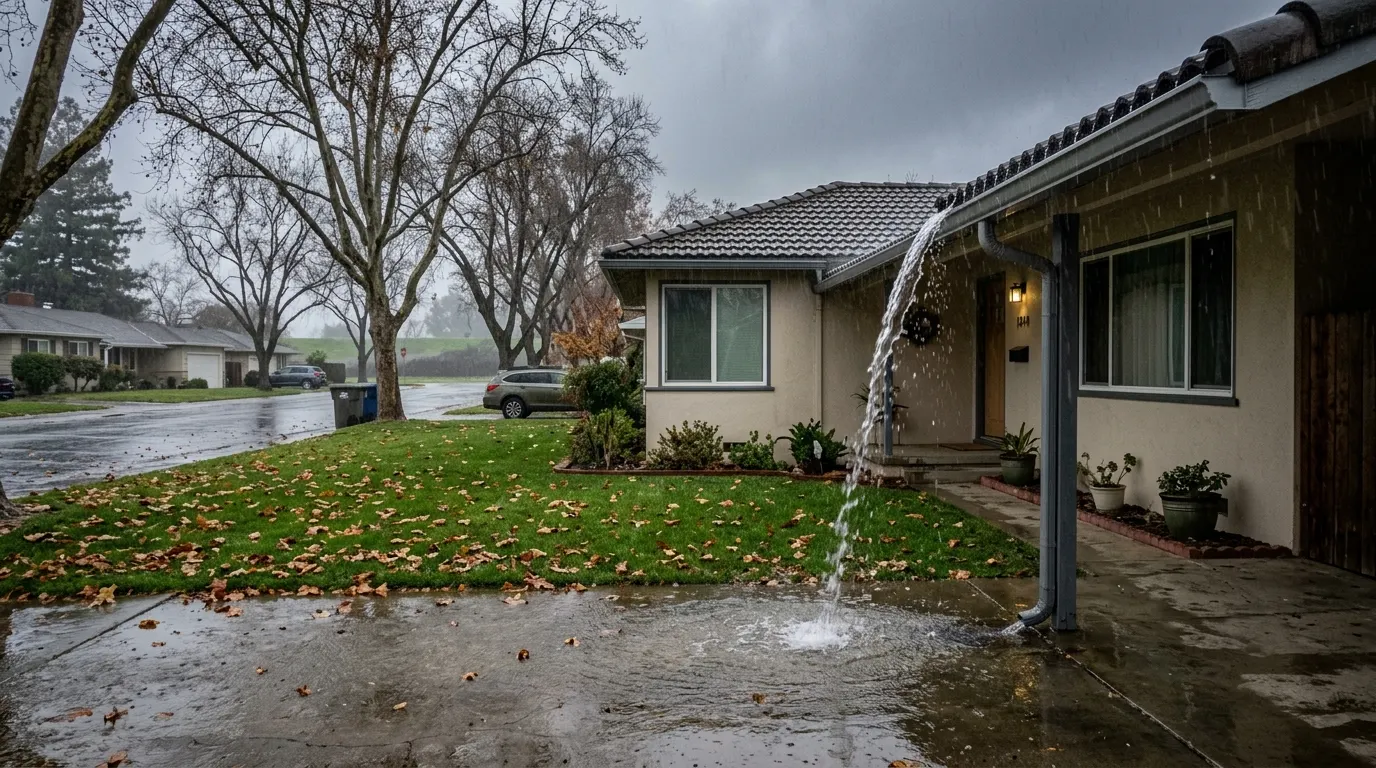
Atmospheric river storms dump 4-8 inches of rain in 48 hours on already-saturated ground. A clogged gutter during one of these events sends concentrated discharge against a foundation that has no soil absorption buffer.
For context: the City of Sacramento receives about 18 inches of rain per year, most of it between October and April (NOAA National Weather Service Sacramento). West Sacramento is effectively the same rainfall total, but the drainage outcome is very different -- water that would percolate into East Sac clay-loam instead pools on West Sac clay over a shallow water table. We cover the foundation implications in our clay soil foundation protection guide, but the short version is that gutter overflow costs West Sac homeowners more per incident than equivalent overflow in Folsom or Rocklin.
Delta Floodplain Drainage Strategy for West Sac Homes
The standard Sacramento-area downspout playbook -- extend 6 feet, discharge onto permeable yard, optionally tie into a dry well -- works for about 80% of Sacramento metro homes. It works for closer to 40% of West Sac homes. The difference is groundwater and surface grade.
West Sac neighborhoods east of I-80 and north of US-50 sit on historical river terrace soils with groundwater often 4-8 feet below grade during the wet season. Southport and newer tract developments south of the Barge Canal sit on deeper fill over native Delta clay, with somewhat better infiltration but still well below the deep percolation profile you get on the east side of the river.
What Works: Surface Discharge, Positioned Correctly
The most reliable drainage approach for West Sac homes is also the simplest: extend downspouts 6 to 10 feet from the foundation onto permeable yard surfaces with positive grade away from the house. Splash blocks catch the initial velocity, and downspout extensions carry the discharge past the foundation backfill zone. For homes without enough yard depth, pop-up emitters installed in a graded swale work well.
What usually does not work: French drains and catch basins connected to deep infiltration systems. The shallow water table in older West Sac neighborhoods saturates these systems within the first atmospheric river of the season. Water then backs up toward the foundation, which is exactly what the system was supposed to prevent.
Approximate Wet-Season Groundwater Depth by West Sac Neighborhood
Below-grade groundwater during wet season (Jan-Mar); shallower = deep infiltration systems fail faster
The practical read: if you live in Bryte, Broderick, or anywhere within a few blocks of the Sacramento River levee, plan on surface discharge as the default. If you are in newer Southport tract housing built on engineered fill, dry wells can work but should still be sized conservatively. When in doubt, a soil percolation test during the wet season is worth the $200-$400 before you commit to a drainage system.
Levee-Adjacent Homes Have Extra Considerations
Homes within 100 feet of the Sacramento River levee on the West Sac side fall under the Central Valley Flood Protection Board's encroachment rules. Permanent below-grade structures near the levee toe may require a CVFPB encroachment permit. Straight surface drainage and above-ground downspout extensions do not trigger the rule, but deep French drains, subsurface cisterns, or any trenching that approaches the levee prism does. If you are uncertain, the City of West Sacramento Building Division and Yolo County Environmental Health can route you to the right review path.
Tree Species and Debris Loads Unique to West Sacramento
West Sacramento's tree canopy reflects its river-adjacent geography. Unlike the Yolo bypass agricultural zones to the west or the urban forest of Davis, West Sac is dominated by native riparian species -- cottonwoods, sycamores, valley oaks -- plus a legacy of non-native plantings in the older Bryte and Broderick neighborhoods. The debris mix creates specific gutter challenges that generic Sacramento cleaning guides miss.
| Tree Species | Debris Type | Peak Drop Period | Gutter Impact |
|---|---|---|---|
| Fremont Cottonwood | Cotton fluff, large leaves, brittle branches | May-Jun (fluff), Oct-Dec (leaves), year-round (branches) | Severe -- fluff coats mesh guards, branches puncture screens |
| California Sycamore | Oversized leaves, bark sheets, seed balls | Nov - Feb | High -- leaves bridge gutters, seed balls jam downspouts |
| Valley Oak | Acorns, leaves, catkins | Sep - Dec | Severe -- acorns plug downspouts, dent gutter bottoms |
| Black Walnut | Husks, leaf stems, nut shells | Sep - Nov | High -- husks stain aluminum, nuts jam screens |
| Tree of Heaven (Ailanthus) | Seed samaras, small leaves | Sep - Nov | Moderate -- samaras pass through standard screens |
| Eucalyptus (scattered) | Bark ribbons, sickle leaves, gum nuts | Year-round | Severe -- all three debris types stack; flammable |
Cottonwood Fluff: A West Sac Problem Most Homeowners Miss
Fremont cottonwoods line the Sacramento River, the West Sacramento Bypass, and much of the levee grassland. In May and June, female cottonwoods release dense cotton-borne seeds that coat every horizontal surface downwind -- including gutters and gutter guards. On standard mesh guards, cottonwood fluff combines with pollen and the remnants of earlier leaf debris to form a felt-like mat that sheds water instead of letting it through.
Homeowners notice the problem during the first summer thunderstorm. Gutters that worked fine through March suddenly overflow during a 10-minute convective cell. The fix is a quick hose rinse from above -- 15 minutes with a spray nozzle breaks the mat up and washes it off. Skip it, and the mat cures over summer into a harder crust that requires brushing.
West Sacramento Gutter Debris Load by Month
Combined debris intensity from cottonwood, sycamore, valley oak, and walnut trees typical of West Sac neighborhoods
Unlike Davis or Folsom where debris is concentrated in late fall, West Sac has two distinct debris peaks: May-June cottonwood fluff, and November-December leaf drop combined with the start of the atmospheric river season. Most West Sac maintenance calendars miss the summer peak entirely. We cover the cottonwood problem in more detail alongside other tree species in our sycamore and London plane debris guide and the valley oak acorn drop window.
Neighborhood-by-Neighborhood West Sacramento Gutter Guide
West Sacramento's housing stock varies dramatically by neighborhood. A 1940s Bryte bungalow sits on original riverbank soils with mature cottonwoods overhead; a 2020 Southport tract home sits on engineered fill with young ornamental trees. The gutter plan for each is completely different.
Bryte and Broderick
Bryte and Broderick are the oldest residential neighborhoods in West Sac, with homes dating from the 1910s through the 1950s. The tree canopy here is heavy -- mature Fremont cottonwoods, valley oaks, and sycamores overhang narrow streets. Original galvanized steel gutters or early aluminum are common. Fascia boards on pre-1960 homes are often undersized by modern standards and frequently show rot behind older gutter systems.
- Primary debris: Cottonwood fluff (May-June), valley oak acorns and leaves (Sep-Dec), sycamore leaves and seed balls (Nov-Feb)
- Gutter condition: Many homes still have 4-inch or 5-inch gutters with open tops. Expect to budget for fascia repair before guard installation
- Recommended cleaning frequency: Three times per year (late May or June, October, December)
- Best guard option: Heavy-duty micro-mesh with aluminum frame and raised profile
Westfield Village and Elkhorn
Built primarily in the 1950s and 1960s, Westfield Village and Elkhorn are classic mid-century ranch neighborhoods on the north side of West Sacramento. Trees are mature but planted for residential scale rather than riparian species -- mostly ornamental pears, Chinese pistache, zelkova, and some valley oaks. Single-story homes dominate.
- Primary debris: Mixed ornamentals -- pear leaves, pistache berries, zelkova leaves, some oak acorns from street trees
- Gutter condition: Most homes have been reroofed at least once; gutters are typically standard 5-inch K-style aluminum in serviceable condition
- Recommended cleaning frequency: Twice per year (November, March) is usually sufficient
- Best guard option: Standard micro-mesh or quality fine-screen guards
Southport
Southport is the newer master-planned portion of West Sacramento south of the Barge Canal, built primarily from the late 1990s forward. Homes are two-story tract housing on engineered fill with professionally designed drainage. Trees are mostly young to middle-aged ornamentals. This is the easiest part of West Sacramento for gutter maintenance.
- Primary debris: Young ornamental tree leaves, pollen, construction dust from ongoing development
- Gutter condition: New to moderately aged gutter systems in good condition, properly sized
- Recommended cleaning frequency: Once or twice per year depending on specific lot's tree exposure
- Best guard option: Fine-mesh screens are cost-effective for current debris levels; plan to upgrade as trees mature
Bridge District and The Washington
The Bridge District and The Washington are West Sacramento's newer urban-infill neighborhoods near the Sacramento River across from downtown Sacramento. Mixed-use developments include townhomes, condos, and single-family homes built after 2010. Gutter systems are modern, but proximity to mature cottonwoods along the river levee still creates debris load during peak months.
- Primary debris: Cottonwood fluff and leaves from levee trees, young ornamentals from streetscape plantings
- Gutter condition: Modern aluminum systems, sometimes with hidden or box gutter detailing on architectural homes
- Recommended cleaning frequency: Twice per year minimum, plus a June cottonwood rinse
- Best guard option: Micro-mesh; match finish to architectural details on visible runs
West Sac Gutter Maintenance Burden by Neighborhood
Annual maintenance burden based on tree maturity, debris species, and housing stock age
West Sacramento Free Gutter Assessment
We inspect your gutters, identify which river-adjacent tree species are driving your debris load, and recommend the right guard or drainage system for your specific West Sac lot. Serving Bryte, Broderick, Westfield Village, Elkhorn, Southport, the Bridge District, and all surrounding West Sacramento neighborhoods.
Schedule Your Free AssessmentPermits: City of West Sacramento and Yolo County Rules
West Sacramento is an incorporated city within Yolo County. Building permits are issued by the City of West Sacramento Community Development Department through the city's online permitting portal. For most straightforward gutter work, no permit is required. The lines that matter are around new construction, re-roofs, and anything that modifies subsurface drainage.
When a Permit Is Not Required
- Straight gutter replacement: Replacing existing gutters with equivalent gutters in the same location is considered maintenance and does not require a permit
- Gutter guard installation: Adding guards to existing gutters is a non-structural alteration and is permit-exempt
- Downspout replacement: Replacing a damaged downspout with an equivalent new one does not require a permit
- Splash blocks and downspout extensions: Surface-level drainage accessories that sit on grade do not require a permit
When a Permit Is Required
- Re-roofing: Permit required. If you are re-roofing, it is usually cost-effective to replace gutters at the same time under the same scope
- New construction or additions: Full building permit covers gutter installation as part of scope
- Subsurface drainage connections: Tying downspouts into French drains, dry wells, or other below-grade systems typically requires a plumbing or drainage permit
- Storm drain connections: Connecting downspouts to the municipal storm drain is restricted in most California cities. Verify with West Sacramento Public Works before any tie-in
- ADU projects: Accessory dwelling unit gutter and drainage work falls under the ADU permit
- Levee-adjacent work: Anything within 100 feet of the Sacramento River levee may trigger Central Valley Flood Protection Board encroachment review
Pro Tip: Bundle Gutter Work with Re-Roof Permits
If you're re-roofing your West Sac home, doing gutters and drip edge at the same time is almost always cheaper than doing them separately. The roofing crew already has scaffold or ladders in place, permits already cover the work, and coordinating flashing between roof and gutter is simpler with one scope. Ask prospective contractors whether they coordinate directly with your roofer or carry both scopes in-house.
Always verify any licensed contractor you hire against the California Contractors State License Board. Gutter work falls under CSLB C-43 (Sheet Metal) classification. Our CSLB verification walkthrough covers the exact two-minute check every West Sac homeowner should run before signing a contract.
Best Gutter Guard Options for West Sacramento Homes
West Sac's debris mix -- cottonwood fluff, sycamore seed balls, valley oak acorns, walnut husks -- eliminates several popular guard categories from serious consideration. The guards that work here share three traits: fine mesh aperture (under 300 microns), raised or angled profile to shed hard debris, and aluminum or stainless frame construction that resists the corrosion load of year-round moisture near the river.
Micro-Mesh Guards: The Default Choice for West Sac
Micro-mesh guards with stainless steel screens (typically 50-mesh to 75-mesh) over aluminum frames handle the full West Sac debris spectrum -- from 1-inch acorns down to cottonwood fluff. They also maintain full water throughput during atmospheric river events, which matters more here than in lower-rainfall neighborhoods.
For West Sac specifically, we recommend raised-profile micro-mesh rather than flat-mount. Hard-shelled debris like acorns and walnut husks sits on top of flat guards and creates a dam. Raised or angled profiles let them roll off automatically. This matters more here than almost anywhere else in Sacramento metro because of the valley oak and walnut population in older neighborhoods.
Guard Types to Avoid in West Sac
Foam inserts and brush-style guards fail within one season under West Sac conditions. Foam absorbs the constant ambient moisture near the river and breeds mold and bacterial growth. Brush guards trap cottonwood fluff and compact it into a dense mat.
Reverse-curve (surface-tension) guards are another poor match for West Sac. They rely on water adhering to the guard surface and curving into the gutter. During an atmospheric river, the water volume overwhelms the surface-tension effect and sends runoff over the gutter edge. Sycamore leaves and cottonwood branches also stick to the curved surface, creating exactly the dam the guard was supposed to prevent.
Gutter Guard Debris Rejection Under West Sac Tree Cover
Estimated debris blocked after 12 months under mature cottonwood + sycamore canopy
AB 3074 and Wildfire Ember Considerations for West Sac
California AB 3074 -- the Zone 0 ember-resistant zone law -- applies statewide to homes in state responsibility areas and very high fire hazard severity zones (VHFHSZ). West Sacramento proper is not mapped as a VHFHSZ under the current CAL FIRE Fire Hazard Severity Zone viewer. The city sits on the valley floor with minimal wildland interface.
That said, West Sac homeowners should not ignore ember risk. The Yolo Bypass, Clarksburg agricultural zones, and the Sacramento River corridor carry dense grass and riparian fuel loads that regularly ignite during Red Flag Wind events. Embers from regional wildfires -- including past Sierra foothill events -- have traveled well over 10 miles into the Sacramento metro. A gutter packed with cottonwood fluff, dry sycamore leaves, or cottonwood bark is essentially a strip of kindling running along your roofline.
Practical Fire Hardening for West Sac Gutters
- Non-combustible gutter guards: Metal micro-mesh (aluminum or stainless) prevents embers from settling on flammable debris
- Avoid plastic or vinyl guards: Even in non-VHFHSZ areas, plastic guards melt or ignite during direct ember contact
- Clear gutters before summer windstorms: Late May to early June, after cottonwood fluff season, is the best window
- Trim overhanging dead branches: Cottonwoods shed brittle branches year-round; a dead branch directly over a clogged gutter is the highest-risk ember landing zone
For comprehensive wildfire hardening including California-specific rebate programs, our wildfire protection guide covers the full Zone 0 framework. California home hardening rebates can offset gutter guard installation costs in qualifying fire-prone areas.
West Sacramento Gutter Maintenance Calendar
The West Sac maintenance calendar has two peaks -- not one. Most Sacramento gutter cleaning schedules focus on fall debris drop and miss the May-June cottonwood fluff window entirely. Here's the schedule calibrated for West Sac specifically.
| Month | Action | West Sac-Specific Notes |
|---|---|---|
| March | Post-winter professional cleaning | Clear remaining winter debris; inspect for hanger damage from heavy sycamore and oak loads |
| April | Pollen rinse for guards | Valley pollen coats mesh surfaces; hose rinse restores flow |
| Late May-June | Cottonwood fluff rinse (critical) | This is the West Sac-specific window most homeowners miss. Fluff mats on guards within weeks |
| Jul - Aug | Dry-season inspection + upgrades | Best time for guard installation, replacement, or downspout upgrades before storm season |
| September | Pre-storm visual inspection | Check downspout extensions, splash blocks; valley oak acorns begin dropping |
| October | Full professional cleaning + flush | Clear acorns, early sycamore leaves, summer debris before first atmospheric river |
| November-December | Second cleaning for heavy-canopy homes | Sycamores and oaks drop peak leaf volume; atmospheric rivers begin |
| Jan-Feb | Monitor during storms | Watch for overflow during atmospheric river events; call for emergency service if discharge reaches foundation |
Homes with properly installed micro-mesh guards can skip the November cleaning and reduce the April and June tasks to quick hose rinses. That cuts the annual schedule from three or four professional visits to one cleaning plus two self-service rinses. For more on atmospheric river preparation specifically, see our storm prep guide.
Gutter Cleaning and Guard Costs for West Sac Homeowners
West Sacramento gutter cleaning costs track close to the Sacramento metro average with one exception: homes in Bryte and Broderick under mature cottonwood and sycamore canopy run 15-25% higher per cleaning because of debris volume. Southport tract homes with young landscaping run at the low end.
Gutter Cleaning Cost by Home Type
| Home Type | Per Cleaning | Annual Cost (2-3x) | Common West Sac Neighborhoods |
|---|---|---|---|
| Single-story, light canopy | $150 - $200 | $300 - $400 | Southport tract, Bridge District condos |
| Single-story, heavy canopy | $200 - $300 | $500 - $750 | Bryte bungalows, Elkhorn ranches |
| Two-story, moderate canopy | $250 - $350 | $500 - $700 | Westfield Village, newer Southport |
| Two-story, heavy canopy | $300 - $400 | $750 - $1,000 | Older Broderick, levee-adjacent homes |
Gutter Guard Installation Cost for West Sac Homes
Gutter guard installation in the Sacramento region typically runs $6-$18 per linear foot depending on guard type and home accessibility. West Sac homes in heavily canopied neighborhoods should budget toward the higher end because of the guard quality required to handle mixed cottonwood, sycamore, and oak debris.
- Micro-mesh guards (recommended for West Sac): $10-$18 per linear foot installed, or $1,500-$3,600 for a typical 150-200 linear foot home
- Fine-screen guards: $6-$12 per linear foot, or $900-$2,400. Acceptable for Southport and newer tract homes
- Reverse-curve guards: $8-$15 per linear foot. Not recommended for West Sac tree conditions
- Foam/brush inserts: $2-$5 per linear foot. Do not install under West Sac canopy -- replacement within 12 months is almost guaranteed
The 10-year math favors micro-mesh for heavily canopied West Sac homes. A Bryte property running three cleanings per year at $275 average spends about $8,250 on cleaning alone over a decade. The same home with micro-mesh guards spends roughly $2,500 on installation plus one annual inspection at $150 -- total around $4,000. Our gutter guard ROI calculator lets you run your own numbers.
Pro Tip: Budget for a Drainage Upgrade Alongside Guards
Guards alone don't solve the West Sac drainage problem. Even a perfectly clean gutter discharging 6 inches from the foundation during an atmospheric river causes trouble on shallow groundwater. Budget an extra $200-$500 for downspout extensions or pop-up emitters when you install guards. The combined upgrade solves both problems and typically pays back faster than either one alone.
Frequently Asked Questions: Gutter Cleaning West Sacramento
How often should gutters be cleaned in West Sacramento?
Minimum twice per year: late October before storm season and March after the last atmospheric rivers. Homes in Bryte, Broderick, and river-adjacent neighborhoods with mature cottonwoods and sycamores need a third cleaning in December, plus a hose rinse in late May to clear cottonwood fluff. Micro-mesh gutter guards reduce that to one professional inspection plus two self-service rinses for most West Sac properties.
Do I need a permit for gutter installation in West Sacramento?
Straight gutter replacement does not require a permit from the City of West Sacramento Building Division. Permits are required for new construction, re-roofing, subsurface drainage connections, and ADU projects. Verify with Yolo County Environmental Health before tying downspouts into any underground drainage system given West Sac's shallow water table. Our Sacramento drainage code guide covers the region-wide framework.
How much does gutter cleaning cost in West Sacramento?
Single-story West Sac homes: $150-$300 per cleaning depending on canopy exposure. Two-story homes: $250-$400. Annual maintenance without guards runs $300-$1,000 depending on how many visits are needed. Homes in older Bryte and levee-adjacent Broderick are at the high end; Southport tract homes are at the low end.
Does West Sacramento flooding affect how gutters should drain?
Yes. West Sac sits inside the 200-year FEMA flood zone behind federally certified levees. Shallow groundwater (4-8 feet below grade in older neighborhoods) means dry wells, French drains, and deep infiltration systems that work elsewhere in Sacramento often fail here. Surface discharge with downspout extensions positioned 6-10 feet from the foundation is the reliable approach. Our Natomas flood-zone drainage guide covers the same framework for the comparable Natomas basin.
What tree debris causes the worst gutter problems in West Sacramento?
Fremont cottonwoods are the signature problem tree, dropping cotton fluff in May-June, leaves through fall, and brittle branches year-round. California sycamores along the levee produce oversized leaves and seed balls. Valley oaks, black walnuts, and scattered eucalyptus in older neighborhoods add acorns, husks, and bark. The three-layer debris load means foam and brush guards fail within a season.
Does AB 3074 apply to West Sacramento homes?
California AB 3074 (Zone 0 ember-resistant zone) applies to homes in state responsibility areas and very high fire hazard severity zones. West Sacramento is not currently mapped as a VHFHSZ. However, regional ember exposure from Sierra foothill and Yolo Bypass grass fires still makes non-combustible metal micro-mesh guards a smart investment. Plastic and foam guards should be avoided even outside formal AB 3074 boundaries.
Is West Sacramento in Sacramento Gutter Guard's service area?
Yes. We serve all of West Sacramento and surrounding Yolo County including Bryte, Broderick, Westfield Village, Elkhorn, Southport, the Bridge District, The Washington, and Clarksburg. West Sacramento is directly across the Sacramento River from downtown Sacramento. We provide free on-site estimates for gutter cleaning, gutter guard installation, gutter repair, and gutter replacement throughout West Sac.
Ready to Solve Your West Sac Gutter Problems?
Sacramento Gutter Guard has been serving West Sacramento and the greater Sacramento region for years. We understand the Delta floodplain drainage reality, the cottonwood debris cycle, and the Yolo County permitting landscape. Call us at (916) 232-5022 or request a free on-site estimate.
Related Articles
Natomas Flood Zone Gutter Drainage
Same Delta floodplain framework applied to the Natomas basin across the river.
Davis CA Gutter Cleaning Guide
Neighboring Yolo County city with heavier urban tree canopy and different debris mix.
Sacramento Clay Soil & Foundation Protection
Why gutter discharge strategy matters more on shallow groundwater sites.
Atmospheric River Gutter Prep
The storm-season prep checklist every West Sac homeowner should run each October.
Sacramento Drainage Code Requirements
Regional drainage code framework including Yolo County rules for West Sac.
Verify Your CSLB C-43 Contractor
Two-minute license check every West Sac homeowner should run before hiring.
Sources
- City of West Sacramento. "Community Development Department & Building Division." cityofwestsacramento.org
- FEMA Flood Map Service Center. "West Sacramento Flood Hazard Zones." msc.fema.gov
- California Department of Water Resources. "State Plan of Flood Control and West Sacramento Levee System." water.ca.gov
- Central Valley Flood Protection Board. "Encroachment Permit Requirements." cvfpb.ca.gov
- CAL FIRE. "Fire Hazard Severity Zones Viewer and AB 3074 Zone 0 Framework." osfm.fire.ca.gov
- California Contractors State License Board. "C-43 Sheet Metal Classification." cslb.ca.gov
- NOAA / National Weather Service Sacramento. "Climate Normals and Atmospheric River Data." weather.gov/sto
- Yolo County Environmental Health. "Drainage and Well Permitting." yolocounty.org