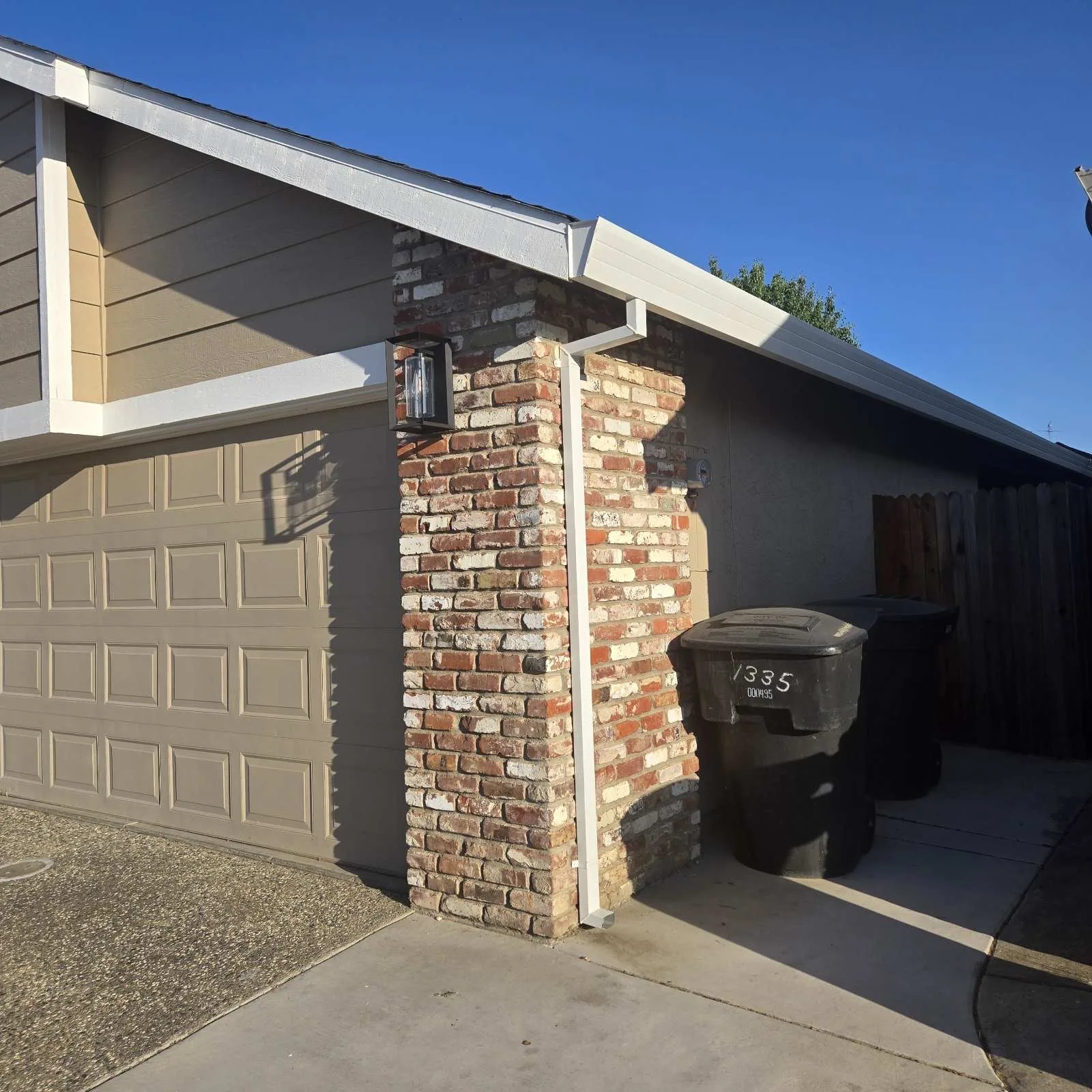

Quick Answer
Natomas homes face gutter and drainage challenges that most Sacramento neighborhoods do not: flat terrain with virtually no natural runoff slope, expansive clay soil that resists absorption, FEMA flood zone designation requiring flood insurance, and builder-grade 5-inch gutters that underperform during atmospheric river events. The fix involves upgrading to 6-inch gutters, extending downspouts 6-10 feet from the foundation, installing micro-mesh gutter guards to prevent clogs during compressed storm windows, and routing discharge into underground drainage or dry wells. Natomas homeowners who address these issues before October typically avoid the foundation and water damage claims that cost Sacramento-area homeowners an average of $15,400 per incident (Insurance Information Institute).
Why Natomas Gutter and Drainage Needs Are Different from the Rest of Sacramento
The Natomas Basin is not a typical Sacramento neighborhood when it comes to water management. The entire basin -- North Natomas, South Natomas, and the surrounding areas bounded by the Sacramento River to the west, the American River to the south, and the Natomas Cross Canal to the north -- sits below the flood stage of the rivers that surround it (Reclamation District 1000). That single geographic fact changes everything about how your gutters and drainage need to perform.
In neighborhoods like East Sacramento or Land Park, rainwater that overflows a gutter eventually finds its way downhill to a storm drain. In Natomas, there is no downhill. The terrain is flat agricultural land that was developed into master-planned communities starting in the 1980s (South Natomas) and accelerating through the 2000s to today (North Natomas). Water that pools near your foundation has nowhere to go on its own.
Reclamation District 1000 manages the 42-mile levee system and internal drainage infrastructure that keeps the basin dry. But that infrastructure handles basin-wide water management -- the canal system, pump stations, and levees. The 20 feet between your gutter downspout and your foundation is your responsibility.
Four Factors That Make Natomas Gutters Higher-Stakes
Flat Terrain
Most Natomas lots have less than 1% slope. Gutter discharge pools at the foundation instead of flowing away naturally, making downspout extensions and grading critical.
Clay Soil
Sacramento's expansive clay absorbs water slowly and swells when wet. In Natomas, this creates a double problem: surface pooling and lateral pressure against foundation walls.
Builder-Grade Systems
Most North Natomas homes were built with standard 5-inch K-style gutters and short downspout terminations -- the minimum that meets code, not what the site conditions demand.
Flood Zone Designation
FEMA's Zone A99 classification means Natomas homeowners with federally backed mortgages must carry flood insurance -- a cost that proper drainage maintenance can help manage.
Natomas FEMA Flood Zone Status: What Homeowners Need to Know in 2026
The Natomas Basin has been in some form of FEMA Special Flood Hazard Area designation for decades. As of 2026, most of the basin is classified as Zone A99 -- an interim designation applied by FEMA while the Natomas Levee Improvement Project is completed (City of Sacramento Flood Preparedness). This means the federal government acknowledges that levee upgrades are underway but has not yet fully recertified the system.
The levee project is a joint effort between the Sacramento Area Flood Control Agency (SAFCA), the U.S. Army Corps of Engineers, and Reclamation District 1000. The goal: bring all 42 miles of Natomas levees up to 200-year flood protection standards. Construction has been phased across multiple levee reaches, with work continuing through 2025 and 2026 (SAFCA).
What Levee Recertification Means for Your Home
Once FEMA recertifies the Natomas levee system, properties behind the levees can be reclassified out of the Special Flood Hazard Area. For homeowners with federally backed mortgages, that could eliminate the mandatory flood insurance requirement and significantly reduce annual housing costs. The average California flood insurance premium under the National Flood Insurance Program is approximately $901 per year (Insurify), though Sacramento County's Class 2 Community Rating System designation provides up to a 40% discount on NFIP policies (Sacramento County).
Until recertification happens, maintaining your property's drainage system is both a practical and financial priority. Insurance adjusters and appraisers evaluate how well a property manages water. Documented gutter maintenance, functional downspout extensions, and proper grading all contribute to a lower-risk property profile.
Natomas Levee & Flood Zone Timeline
Key milestones from FEMA designation to projected recertification (SAFCA, RD1000)
North Natomas vs. South Natomas: Different Homes, Different Gutter Problems
Natomas is not one neighborhood -- it is two distinct areas with different housing stock, different tree canopies, and different gutter challenges. Understanding which side of the basin your home sits on determines which problems to prioritize.
North Natomas: Newer Homes, Builder-Grade Shortfalls
North Natomas homes are predominantly built between the early 2000s and today, with many communities still under active development. Nearly all are part of master-planned subdivisions with HOAs and Mello-Roos assessments. The housing stock is uniform: two-story stucco homes with concrete tile or composition roofing, standard 5-inch K-style aluminum gutters, and 2x3-inch downspouts.
The gutter problems in North Natomas are systemic, not age-related. Builders install the minimum gutter system that meets code -- which is adequate for an average Sacramento rain event but insufficient for the atmospheric rivers that deliver 2-4 inches in 24 hours. We see three recurring issues on North Natomas service calls:
- Undersized gutters overflowing during heavy rain -- 5-inch K-style gutters handle approximately 5,520 square feet of roof drainage per section. Many North Natomas two-story homes exceed this capacity, especially at valley points where two roof planes converge.
- Short downspout terminations -- Builder-installed downspouts often end 6-12 inches from the foundation, dumping concentrated water flow directly onto the flat lot with no grade to carry it away.
- Construction debris in gutters -- Homes near active building sites accumulate drywall dust, sawdust, and stucco particles that mix with rain into a cement-like sludge that standard screens cannot filter.
South Natomas: Older Homes, Mature Trees, Aging Systems
South Natomas was developed primarily in the 1980s and 1990s. Homes here tend to be single-story ranch-style or modest two-story builds with older gutter systems -- some original to the house. The mature tree canopy that makes South Natomas attractive also creates significantly higher gutter maintenance demands.
Thirty-year-old trees drop exponentially more debris than the 10-year-old saplings in North Natomas. Valley oaks, live oaks, and Chinese pistache trees shed leaves, catkins, seeds, and small branches that overwhelm unprotected gutters within weeks during fall. South Natomas homes without gutter guards typically need three cleanings per year instead of two.
The aging gutter systems add another layer. Aluminum gutters from the 1980s and 1990s develop sagging from loosened hangers, joint separation at seams, and tiger striping from decades of oxidation. Many South Natomas homes are candidates for full gutter replacement with modern seamless aluminum systems rather than piecemeal repair.
North Natomas vs. South Natomas Gutter Challenges
Side-by-side comparison based on service call patterns
Flat-Lot Drainage Solutions for Natomas Homes
The core drainage problem in Natomas is simple: water does not move laterally without help. In neighborhoods with natural grade -- Folsom, Auburn, the foothills -- gravity does most of the work. A gutter downspout can discharge onto a sloped yard and the water flows away from the house. In Natomas, that discharged water sits where it lands.
Sacramento's expansive clay soil makes this worse. Clay absorbs water slowly, swells when saturated, and creates hydrostatic pressure against foundation walls. The combination of flat terrain and clay soil means that every gallon your gutters collect must be actively routed away from the structure. Passive discharge is not enough.
The Natomas Drainage Upgrade Checklist
These five steps address the most common drainage failures we see in Natomas homes, ranked by impact:
- Extend downspouts 6-10 feet from the foundation. This is the single highest-impact fix for most Natomas homes. Downspout extensions can be above-ground flexible hoses (cheapest, easiest) or buried rigid PVC lines (cleaner, permanent). Either option costs far less than foundation repair.
- Upgrade to 6-inch K-style gutters. A 6-inch gutter handles roughly 40% more water volume than a 5-inch system. For two-story Natomas homes with complex rooflines, this upgrade prevents the overflow events that dump water directly against the house during heavy storms.
- Install underground drainage lines to the street or a dry well. For homes where extending downspouts above ground is impractical (side yards, zero-lot-line homes), underground drainage routes gutter discharge through buried 4-inch PVC to a pop-up emitter at the curb or a subsurface dry well. This is the gold standard for Natomas drainage.
- Verify grading slopes away from the foundation. The minimum recommended grade is 6 inches of drop over the first 10 feet from the foundation wall. Many Natomas homes have settled since construction, creating reverse grades that funnel water toward the house instead of away.
- Add a sump pump with battery backup (if applicable). Some Natomas homes, particularly in lower-elevation areas near the Natomas East Main Drain Canal, benefit from sump pump systems that actively remove water from crawl spaces or subgrade areas. A battery backup protects against the power outages that often coincide with major storms.
Pro Tip
Before storm season, run a garden hose in each gutter section for 5 minutes and watch where the water goes after it exits the downspout. If it pools within 3 feet of your foundation, you have a drainage problem that needs to be fixed before the first November rain. This simple test reveals issues that are invisible during dry months -- and Natomas has eight dry months per year to create a false sense of security.
Best Gutter Guard Options for Natomas Homes
Gutter guards are not optional in Natomas -- they are a practical requirement for any homeowner who does not want to clean gutters three times a year or risk overflow during a storm they were not home to notice. The flat terrain and flood zone status raise the stakes on every clog. A blocked gutter in Folsom sends water down a slope. A blocked gutter in Natomas sends water straight into your foundation.
Not all guard types perform equally in Natomas conditions. The right choice depends on whether you are in North Natomas (light debris, construction dust) or South Natomas (heavy leaf load, mature canopy).
Micro-Mesh Guards: The Top Choice for Both Areas
Micro-mesh gutter guards use a fine stainless steel screen (typically 50-mesh or finer) over an aluminum frame. They block leaves, pine needles, shingle grit, construction dust, and the small organic debris that other guard types miss. For Natomas specifically, micro-mesh handles the construction-site particulates common in North Natomas and the heavy leaf volume in South Natomas.
The critical advantage for Natomas is flow capacity. Quality micro-mesh systems maintain full water throughput even when covered with debris because the mesh prevents accumulation inside the gutter channel. During a 2-inch-per-hour rainfall -- common during Sacramento atmospheric rivers -- the gutter stays at full capacity instead of progressively clogging from the inside.
Guard Types to Avoid in Natomas
Foam inserts and brush-style guards are particularly poor performers in Natomas. Foam inserts trap moisture against the gutter floor, creating standing water conditions in a neighborhood where standing water is already the primary risk. Brush guards allow fine debris to settle between bristles, reducing flow capacity by up to 50% within a single season. Neither type delivers the flow performance that Natomas's flat-lot drainage demands.
Gutter Guard Water Flow Retention by Type
Percentage of original gutter flow capacity maintained after 1 year (industry testing data)
Live in Natomas? Get a Gutter Assessment.
We inspect your current gutter system, measure your roof drainage area, evaluate your lot grading, and recommend the specific upgrades your home needs. No charge, no pressure.
Schedule Your Free AssessmentNatomas Gutter Maintenance Calendar: Month-by-Month
Sacramento's rain season compresses nearly all annual precipitation into five months (NOAA). For Natomas homeowners, this creates a tight window where gutter performance is critical and a long dormant period where problems develop silently. Here is the maintenance schedule we recommend for Natomas homes specifically:
| Month | Action | Why It Matters in Natomas |
|---|---|---|
| September | Visual inspection from ground level | Catch sagging, loose hangers, or visible gaps before October debris arrives |
| October | Full professional cleaning + downspout flush | Clear summer dust/debris before first rain; verify downspout extensions are connected and flowing |
| November | Post-leaf-drop check (South Natomas) | Mature trees drop most leaves in Nov; a second touch clears what accumulated since October cleaning |
| Dec - Feb | Monitor during storms; check for overflow | Peak rain months; if you see overflow, call for service immediately -- flat lots do not forgive pooling |
| March | Spring cleaning + full system inspection | Remove winter debris, check for damage from storms, clean downspout screens |
| April | Pollen season flush (if needed) | Sacramento pollen can coat and block micro-mesh guards; a hose rinse restores flow |
| May - Aug | Dry season -- no action needed | Use this window for upgrades: gutter replacement, guard installation, drainage line burial |
Homes with micro-mesh gutter guards installed can skip the November and April maintenance steps in most cases. That reduces the annual schedule to two touchpoints: one pre-season cleaning in October and one post-season inspection in March.
What Natomas Gutter Upgrades Cost vs. What They Prevent
Every gutter upgrade decision in Natomas should be weighed against the cost of the problem it prevents. Foundation repair on clay soil starts at $5,000 and frequently exceeds $15,000. The average water damage insurance claim in the U.S. is $15,400 (Insurance Information Institute/Verisk). Mold remediation after water intrusion averages $3,000-$7,000 (EPA). These are not theoretical risks in Natomas -- they are common outcomes when flat-lot drainage fails.
Upgrade Cost vs. Damage Prevention Value
Typical Natomas home investment compared to avoided repair costs
The math is straightforward. The most expensive comprehensive gutter overhaul for a Natomas home -- new 6-inch seamless gutters, micro-mesh guards, underground drainage, and downspout extensions -- runs $5,000-$8,000. A single foundation repair claim on clay soil can exceed that in the first week. And unlike foundation repair, gutter upgrades last 20-30 years with minimal maintenance.
HOA Rules and Insurance Implications for Natomas Gutter Work
Nearly all North Natomas homes are part of an HOA, and many South Natomas subdivisions have associations as well. Before modifying your gutter system, check your CC&Rs for exterior modification restrictions. Most Natomas HOAs allow gutter guard installation and downspout extensions without architectural review, but color changes, material changes, or visible drainage lines may require approval.
Flood Insurance and Gutter Maintenance Documentation
If you carry flood insurance (mandatory for many Natomas homeowners with federally backed mortgages), documenting your drainage maintenance creates a paper trail that supports claims and can influence risk assessments. Keep records of:
- Dates and receipts for professional gutter cleaning
- Photos of your drainage system before and after storm season
- Invoices for gutter guard installation, downspout extensions, or drainage upgrades
- Any grading or drainage improvements with before/after measurements
Sacramento County's Class 2 Community Rating System (CRS) designation already provides Natomas homeowners with up to a 40% discount on NFIP flood insurance policies (Sacramento County). This rating is maintained through county-wide floodplain management activities, but individual property maintenance supports the broader effort -- and gives you stronger standing if you ever need to file a claim.
For homeowners whose insurance policies include water damage riders, evidence of proactive gutter maintenance can help demonstrate that you took reasonable precautions to prevent water intrusion. This is relevant for both flood claims and standard homeowners insurance claims for non-flood water damage.
Frequently Asked Questions: Natomas Gutters & Drainage
Do Natomas homes need special gutters because of the flood zone?
Natomas homes do not require a different gutter type by code, but they need a more robust drainage strategy. The basin sits below the flood stage of surrounding rivers and relies entirely on 42 miles of levees. With flat terrain and limited natural runoff, every gallon your gutters discharge must be directed well away from the foundation. Oversized 6-inch gutters, extended downspouts, and underground drainage lines are strongly recommended over the standard builder-grade 5-inch systems.
Is Natomas still in a FEMA flood zone in 2026?
As of 2026, portions of the Natomas Basin remain designated as FEMA Zone A99, an interim classification applied while levee improvements are completed. The Natomas Levee Improvement Project has been upgrading 42 miles of levees to 200-year flood protection standards. Once construction is complete and FEMA recertifies the levees, properties can be reclassified out of Special Flood Hazard Areas, potentially eliminating mandatory flood insurance requirements.
How much does flood insurance cost for Natomas homeowners?
The average California flood insurance premium under NFIP is approximately $901 per year (Insurify). Sacramento County's Class 2 CRS designation provides up to a 40% discount, saving residents an average of $121 per policy annually. Actual premiums vary based on elevation, structure type, and coverage amount. Maintaining proper gutter and drainage systems supports lower-risk assessments during property evaluations.
What causes standing water in Natomas yards after rain?
Standing water in Natomas yards typically results from flat terrain with minimal natural grade, Sacramento's expansive clay soil that drains poorly, and builder-grade gutter systems that discharge too close to the foundation. Solutions include extending downspouts 6-10 feet from the foundation, installing underground drainage lines, and upgrading to 6-inch gutters.
How often should Natomas homeowners clean their gutters?
Twice per year minimum: late October before storm season and early spring. South Natomas homes near mature trees may need a third cleaning in November or December. North Natomas homes near active construction sites face additional dust buildup. Installing micro-mesh gutter guards reduces cleaning frequency to once per year or less for most Natomas homes.
Natomas Homeowner? Get Your Drainage Assessed Before Storm Season.
We serve North Natomas, South Natomas, and surrounding Sacramento neighborhoods. Our assessment covers your gutter system capacity, downspout discharge points, lot grading, and drainage routing -- with specific recommendations for your home's flood zone conditions. Free estimate, no obligation.
Get Your Free Natomas Gutter AssessmentThe Bottom Line for Natomas Homeowners
Living in Natomas means living behind levees, on flat land, above clay soil, in a FEMA flood zone. None of those factors are going away, even after levee recertification. What you can control is how well your property handles the water that lands on your roof and around your foundation.
The formula is not complicated: gutters sized for your roof area, guards that prevent clogs during the compressed November-March rain season, downspouts that discharge well away from the foundation, and a drainage path that moves water to the street or a dry well instead of letting it pool on clay.
Start with the highest-impact fix -- downspout extensions -- and work up from there. If your home has the original builder-grade gutter system, a full assessment before October will tell you exactly where the vulnerabilities are and what it costs to fix them. Request a free estimate and we will walk your property with you.
Related Articles
Sacramento Clay Soil & Foundation Protection
How Sacramento's clay soil creates unique foundation risks and the gutter solutions that prevent damage.
5-Inch vs. 6-Inch Gutters Sacramento
Which gutter size is right for your Sacramento home's roof area and rainfall conditions.
Underground Downspout Drainage
Complete guide to burying downspout lines for cleaner, more effective drainage in Sacramento.
Downspout Extensions & Drainage Solutions
Cost-effective ways to route water away from your foundation with downspout extensions.
Atmospheric River Gutter Preparation
How to prepare your gutter system for Sacramento's most intense storm events.
Foundation Damage Prevention With Gutters
The direct connection between gutter performance and foundation health in Sacramento homes.
Sources
- Reclamation District 1000. "Natomas Levee Project" and "Flood Risk." rd1000.org
- Sacramento Area Flood Control Agency (SAFCA). "Natomas Basin Project." safca.org
- City of Sacramento. "Natomas Floodplain & Flood Preparedness." cityofsacramento.gov
- FEMA. "National Flood Insurance Program." fema.gov
- Insurify. "A Guide to California Flood Insurance (2026)." insurify.com
- Sacramento County. "Sacramento County Maintains Important FEMA Rating." saccounty.gov
- Insurance Information Institute / Verisk. "Facts + Statistics: Homeowners Insurance." iii.org
- CBS Sacramento. "Levee improvements may lower or eliminate flood insurance premiums in Natomas." cbsnews.com
- NOAA / National Weather Service Sacramento. "Climate Normals: Sacramento." weather.gov/sto