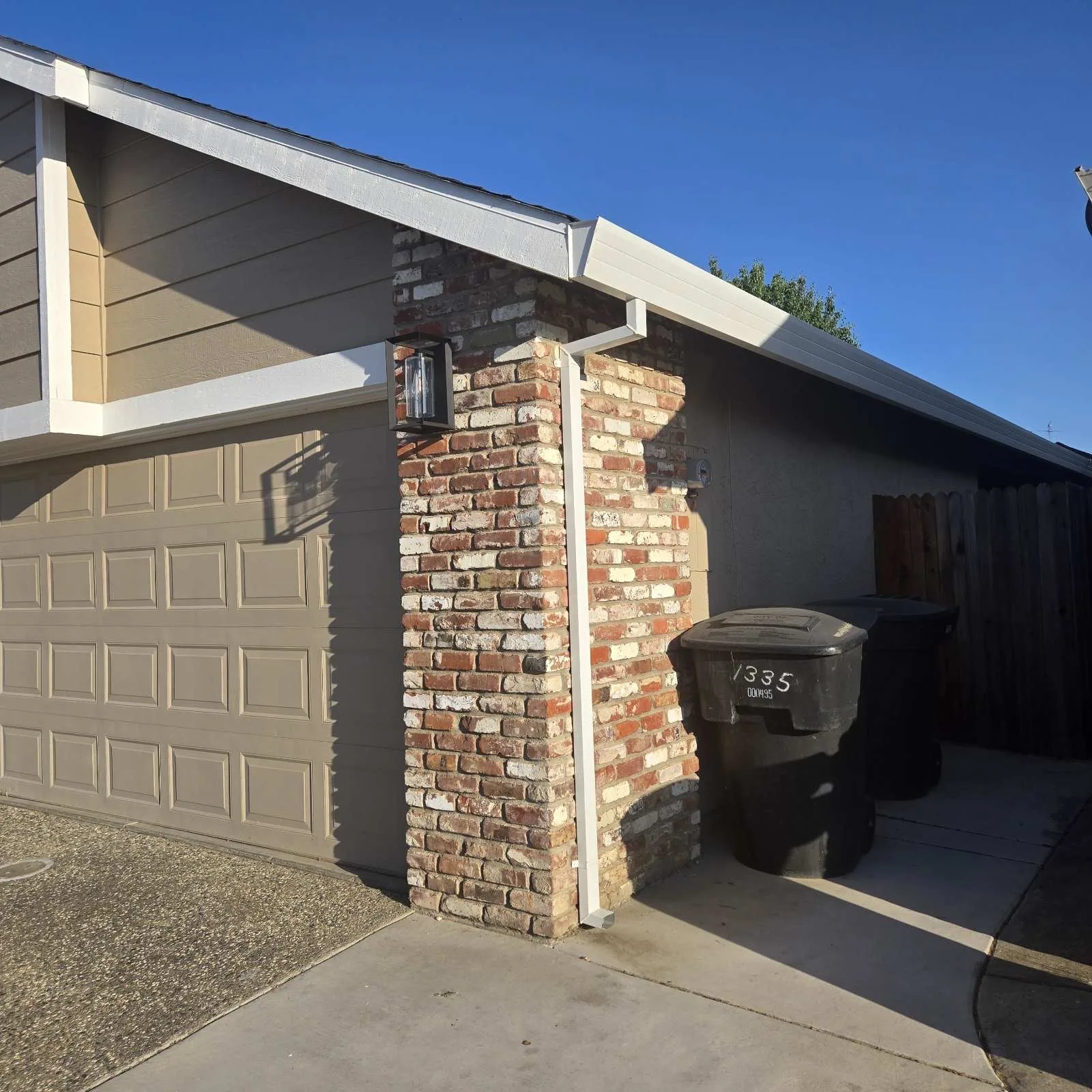

Quick Answer: Sacramento ADU gutter requirements are governed by four overlapping codes: California Plumbing Code Section 1101.12.1 (roof drainage sized for 1.5"/hour), IRC Section R903.4 (downspouts 5+ feet from foundations on expansive soil), Sacramento County's Stormwater Quality Design Manual (onsite detention when impervious surface exceeds 500 sq ft), and CBC Chapter 7A Section 705A.4 (gutter guards required in WUI fire zones). Missing any of these during plan check is a common reason Sacramento ADU permits get returned for corrections.
TL;DR: ADU Gutter Code Requirements for Sacramento
Sacramento issued 1,134 ADU permits between 2020 and 2024—an eight-fold increase over the prior five years (Abridged, 2025). Every one of those projects had to satisfy multiple drainage and gutter code requirements. This guide breaks down every applicable code section, explains what triggers stormwater mitigation, covers the special rules for garage conversions, and provides a permit-ready checklist so your ADU drainage plan passes plan check on the first submittal.
Bottom line: Plan your gutter and drainage system at the design phase, not after framing. A complete drainage plan costs nothing extra to include in your permit application—but incomplete plans cause 21% of ADU permit returns in Sacramento County. Get a free ADU drainage assessment before you submit.
Table of Contents
- The Four Codes That Govern ADU Gutters in Sacramento
- California Plumbing Code: Roof Drainage Sizing for ADUs
- IRC R903.4: Downspout Foundation Setback on Clay Soil
- Sacramento's 500 Sq Ft Impervious Surface Threshold
- WUI Fire Zones: When Gutter Guards Are Required by Law
- Garage Conversion ADU Gutter Rules
- ADU Gutter Permit Checklist for Sacramento
- Frequently Asked Questions
ADU gutter requirements in Sacramento are not a single rule—they are a stack of four separate code sections from three different regulatory bodies, each covering a different aspect of how your accessory dwelling unit handles rainwater. Miss one, and your permit application comes back for corrections. Miss two, and your project timeline slips by weeks. According to Fortune ADU, 38% of Sacramento County ADU permit applications are returned at least once, and incomplete drainage plans are among the most common reasons.
This guide covers every gutter and drainage code requirement that applies to Sacramento ADUs in 2026. Whether you are building a detached granny flat, converting a garage, or adding a junior ADU, the same fundamental drainage standards apply—though the specific obligations vary by project type. We install gutter systems on ADU projects across the Sacramento Valley, and we see the same code compliance gaps repeatedly. The information here reflects what Sacramento County plan checkers actually look for.
The Four Codes That Govern ADU Gutters in Sacramento
Sacramento ADU gutter systems must comply with overlapping requirements from federal, state, and county codes. No single document covers everything. Here is the complete code stack, in order of how inspectors typically review them.
ADU Gutter Code Stack: What Each Code Covers
| Code / Standard | Section | Requirement | Applies To |
|---|---|---|---|
| California Plumbing Code | 1101.12.1 | Roof drainage sized for 1.5"/hour rainfall | All new ADUs |
| International Residential Code | R903.4 | Downspout discharge 5+ ft from foundation on expansive soil | All new ADUs |
| Sacramento Stormwater Manual | Section 3 | Onsite detention when impervious surface > 500 sq ft | ADUs exceeding threshold |
| California Building Code | 7A / 705A.4 | Gutter guards to prevent leaf/ember accumulation | ADUs in WUI fire zones |
For a deep dive into how these codes apply to all residential gutter systems (not just ADUs), see our full Sacramento gutter drainage code requirements guide. The sections below focus on how each code specifically impacts ADU projects.
California Plumbing Code: Roof Drainage Sizing for ADUs
California Plumbing Code Section 1101.12.1 is the foundation of every ADU gutter requirement in Sacramento. It states that roof areas must be drained by roof drains or gutters, sized to accommodate a maximum rainfall rate of 1.5 inches per hour (Permit Sonoma Technical Bulletin B-34). This is the design standard, not the maximum rainfall Sacramento actually experiences—atmospheric river events regularly exceed it.
For ADUs, this code section means your gutter system must handle the peak flow generated by your specific roof area at a 1.5-inch-per-hour rate. The math is straightforward: multiply your roof area (in square feet) by 0.0104 gallons per minute to get peak flow demand. A 600-square-foot ADU roof generates approximately 6.2 gallons per minute at the design rainfall rate.
Peak Gutter Flow Demand by ADU Roof Size (at 1.5"/hr Code Rate)
Dashed gold line = 5-inch K-style gutter capacity per 10 ft section. ADUs above 600 sq ft should use 6-inch gutters to maintain code-compliant flow margins.
Pro Tip: Roof Pitch Changes the Math
A steeply pitched roof has a larger effective collection area than its horizontal footprint. A 600-square-foot ADU footprint with a 12:12 pitch collects rain across 846 effective square feet (a 1.41x multiplier). CPC sizing calculations should use effective roof area, not footprint. This is why many ADUs that appear to fit within 5-inch gutter capacity actually need 6-inch gutters once roof pitch is factored in.
Downspout sizing follows the same CPC section. The code requires adequate downspout capacity to handle the peak flow. For most Sacramento ADUs, 3x4-inch downspouts (each handling approximately 12.5 gallons per minute) provide sufficient capacity. The standard rule is one downspout per 20-25 linear feet of gutter run. A typical ADU with 60-80 feet of gutter needs a minimum of 3-4 downspouts.
IRC R903.4: Downspout Foundation Setback on Sacramento's Clay Soil
International Residential Code Section R903.4 requires downspouts to discharge to the ground surface no less than 5 feet from foundation walls, or to an approved drainage system, in areas with expansive or collapsible soils. Sacramento sits on some of the most expansive clay soil in California, making this section directly applicable to every ADU in the region.
This 5-foot setback rule is where many ADU projects run into trouble. California's minimum ADU rear and side setback is 4 feet from the property line (Government Code Section 65852.2). When the ADU sits 4 feet from the fence and the main house sits 15-20 feet from the same fence, the space between structures is tight. A downspout discharging at the 5-foot mark from the ADU foundation may land within 5 feet of the main house foundation—creating a code conflict.
ADU Setback vs Downspout Distance: The Tight-Lot Problem
On lots where the main house and ADU are less than 10 feet apart, surface downspout discharge cannot satisfy the 5-foot setback for both structures. Underground drainage solves this.
The practical solution for tight ADU lots is underground downspout drainage. By connecting downspouts to a buried 4-inch PVC line that routes water to a pop-up emitter or catch basin on the far side of the lot, you satisfy the IRC R903.4 setback requirement without surface pooling between structures.
Sacramento's expansive clay soil makes this setback rule particularly critical. The clay soil in most Sacramento neighborhoods expands when saturated and contracts when dry. Repeated wet-dry cycles from poorly placed downspout discharge create differential foundation movement that leads to cracks, sticking doors, and structural damage over time. On a 4-foot setback ADU lot, the margin for error is zero.
Sacramento's 500 Square Foot Impervious Surface Threshold
The Sacramento County Stormwater Quality Design Manual requires onsite stormwater detention or mitigation when a project adds more than 500 square feet of net new impervious surface. This threshold applies to the total project impact—not just the ADU footprint.
What counts as impervious surface in an ADU project:
- •ADU building footprint: The roof area that sheds water to gutters or ground
- •Concrete or asphalt walkways: Paths connecting the ADU to the main house, driveway, or street
- •Patios and outdoor living areas: Concrete, pavers, or other non-permeable surfaces
- •HVAC equipment pads: Concrete pads for heat pump or mini-split condensers
- •Parking areas: If the ADU replaces a garage and new parking is added
Warning: Most Detached ADUs Exceed the 500 Sq Ft Threshold
A 500-square-foot detached ADU with a 30-foot concrete walkway (3.5 ft wide = 105 sq ft), a 60 sq ft patio, and a 16 sq ft HVAC pad totals 681 square feet of new impervious surface. Even a modest 400-square-foot ADU with minimal walkways frequently crosses the 500 sq ft line. Plan for stormwater mitigation from the start—it is far cheaper to include in the original design than to add after plan check returns your application.
Typical 500 Sq Ft ADU: Impervious Surface Breakdown
When you exceed the threshold, Sacramento County offers several mitigation options that integrate with your ADU gutter system:
- 1Rain gardens or bioswales: Planted detention areas that receive gutter discharge and allow infiltration. Low cost ($500-$1,500) and attractive, but require ongoing maintenance.
- 2Permeable pavers for walkways: Replace standard concrete with permeable pavers to reduce net impervious area below the threshold. Costs $8-$15 per sq ft installed vs $6-$10 for standard concrete.
- 3Underground detention tanks: Buried tanks that store peak runoff and release it slowly. Higher cost ($2,000-$5,000) but require no surface area and minimal maintenance.
- 4Dry wells: Gravel-filled pits that receive downspout discharge and allow percolation. Work well in areas with better-draining soil but are less effective on heavy Sacramento clay.
For a full comparison of these drainage solutions, see our yard drainage and gutter discharge guide.
Need Help With ADU Drainage Code Compliance?
We assess your lot, calculate impervious surface totals, and design a gutter and drainage system that passes Sacramento County plan check on the first submittal. Free estimates for ADU projects across Sacramento County.
We coordinate directly with your ADU contractor and architect
WUI Fire Zones: When Gutter Guards Are Required by Law
California Building Code Chapter 7A, Section 705A.4, states that "roof gutters shall be provided with the means to prevent the accumulation of leaves and debris" on structures within designated Wildland-Urban Interface (WUI) fire zones (UpCodes). This is a legal requirement—not a recommendation.
Within the Sacramento region, WUI fire zones include portions of:
- •Eastern Sacramento County: Fair Oaks (eastern sections), Orangevale, Gold River
- •Folsom and El Dorado Hills: Most foothill areas east of Highway 50
- •Placer County foothills: Auburn, Loomis, Granite Bay, Newcastle
- •Nevada County: Grass Valley, Penn Valley, Alta Sierra
If your ADU is in a WUI zone, your gutter guard choice must also meet fire-resistance standards. Metal micro-mesh guards with steel or aluminum frames satisfy this requirement. Plastic or foam guards do not comply. For a detailed comparison of guard types that meet WUI standards, see our guide on gutter guards for wildfire protection.
Pro Tip: Check Your Fire Hazard Severity Zone Before Design
CAL FIRE maintains an interactive Fire Hazard Severity Zone map where you can look up any Sacramento-area address. If your parcel falls in a Moderate, High, or Very High fire hazard zone, CBC Chapter 7A applies in full—including the gutter guard requirement. Check this before finalizing your ADU design, because adding WUI-compliant gutter guards after construction costs roughly double what it costs during the build.
Garage Conversion ADU Gutter Rules: What Changes and What Doesn't
Garage conversion ADUs in Sacramento follow a different gutter and drainage path than detached new-build ADUs. Since the structure and roofline already exist, the code requirements focus on verifying that the existing drainage system is adequate for the now-habitable space—not on designing a new one from scratch.
Key differences for garage conversions:
What Typically Does NOT Change
- +Existing roofline stays the same (no new impervious surface from the roof)
- +Existing gutter runs and downspout locations are usually adequate
- +No new stormwater mitigation if the roofline is unchanged
What Inspectors WILL Check
- !Existing gutters must be functional—no leaks, sags, or missing sections
- !Downspouts must discharge 5+ ft from the foundation (IRC R903.4)
- !Grading must slope 2% away from foundation for at least 6 feet
- !Water must not discharge toward neighboring property
- !WUI gutter guard requirement still applies if in a fire zone
Real Scenario: The East Sacramento Garage Conversion
A homeowner in East Sacramento converted a detached two-car garage into a 440-square-foot ADU. The existing garage had original 4-inch aluminum sectional gutters from 1978—functional but badly corroded at the seams. During the ADU final inspection, the building inspector flagged the gutter system because two downspouts discharged directly against the now-habitable foundation wall, less than 12 inches from the structure.
The fix required replacing all gutters with seamless aluminum (the old sectional gutters were leaking at joints), extending downspouts with underground pipe to discharge 8 feet from the foundation, and adding a pop-up emitter in the side yard. Total cost: $2,400. If the homeowner had addressed the gutters during the conversion—when contractors were already on site—the work would have been roughly $1,400.
The special case to watch for is garage conversions that add a new walkway, patio, or parking area. If those additions push net new impervious surface above 500 square feet, the stormwater threshold kicks in even though the roof itself is unchanged. A typical garage-to-ADU conversion that adds a 120-square-foot entry patio and a 150-square-foot replacement parking pad (total 270 sq ft new impervious) stays under the threshold. Add a 40-foot concrete walkway and a larger patio, and you may cross it.
ADU Gutter and Drainage Permit Checklist for Sacramento
Use this checklist to verify your ADU drainage plan is complete before submitting to Sacramento County or City of Sacramento for plan check. Every item below corresponds to a code requirement that plan checkers will review.
Pre-Submittal Drainage Checklist
- 1Calculate effective roof area (footprint x roof pitch multiplier) and verify gutter size handles 1.5"/hour flow rate per CPC 1101.12.1
- 2Confirm downspout count and sizing: one 3x4" downspout per 20-25 linear feet of gutter, minimum 3 for most ADUs
- 3Show downspout discharge locations on site plan: each must be 5+ feet from any foundation per IRC R903.4
- 4Calculate total new impervious surface: ADU footprint + walkways + patios + HVAC pads + parking areas
- 5If impervious surface exceeds 500 sq ft: include stormwater mitigation plan (rain garden, permeable pavers, detention tank, or dry well)
- 6Verify grading plan shows 2% minimum slope away from all foundations for at least 6 feet
- 7Confirm no drainage directed toward neighboring property—all runoff must stay on-site or discharge to approved facilities
- 8Check WUI fire zone status: if applicable, specify fire-rated gutter guard product on plans per CBC 705A.4
- 9If connecting to existing main house drainage: document existing system capacity and confirm it can handle combined load
- 10For garage conversions: note existing gutter condition on plans and indicate any required repairs or extensions
Having each of these items addressed on your site plan and drainage plan before submittal significantly reduces the chance of a plan check return. The Sacramento County Building Permits and Inspection Division provides ADU-specific checklists and forms, but they do not break down gutter requirements in this level of detail—which is why so many applications come back for drainage corrections.
For the full picture of what gutter installation costs in Sacramento and how to budget for your ADU drainage system, see our detailed cost guide. If you are building a brand-new ADU (not a conversion), our new construction gutter installation guide covers the complete process from design through final inspection.
Real Scenario: Permit Return Avoided in Elk Grove
An Elk Grove homeowner was building a 550-square-foot detached ADU with a 35-foot walkway and a 48-square-foot utility patio. Their architect had specified 5-inch gutters and surface-discharge downspouts on the plans.
Before submittal, we reviewed the drainage plan and flagged three issues: total impervious surface was 720 square feet (above the 500 sq ft threshold), two downspout locations discharged within 3 feet of the main house foundation, and the gutter sizing was marginal for the 7:12 roof pitch. We revised the plan to 6-inch gutters, rerouted downspouts to underground lines with pop-up emitters, and added a rain garden to satisfy the stormwater mitigation requirement. The permit was approved on the first submittal.
Frequently Asked Questions
Does Sacramento require gutters on ADUs?
California Plumbing Code Section 1101.12.1 requires roof areas on new structures to be drained by roof drains or gutters connected to an approved drainage system. Sacramento County drainage standards further require stormwater to be directed at least 10 feet from foundations. While code does not mandate "gutters" by name for every accessory structure, the practical effect of these combined requirements means virtually every Sacramento ADU needs a gutter system to pass final inspection. See our full drainage code guide for details.
What building codes apply to ADU gutters in Sacramento?
Four primary codes govern ADU gutter systems: CPC Section 1101.12.1 (roof drainage sizing at 1.5"/hour), IRC Section R903.4 (downspout 5+ feet from foundation on expansive soil), Sacramento County Stormwater Quality Design Manual (impervious surface and detention thresholds), and CBC Chapter 7A Section 705A.4 (gutter guards in WUI fire zones). All four apply simultaneously to detached new-build ADUs.
Do garage conversion ADUs need gutters in Sacramento?
Garage conversions that keep the existing roofline typically do not need new gutters. However, inspectors will verify that existing gutters are functional and that downspouts discharge at least 5 feet from the now-habitable foundation. Damaged, leaking, or improperly discharged gutters must be repaired or replaced to pass the ADU final inspection.
What happens if my ADU adds more than 500 square feet of impervious surface?
Sacramento County requires onsite stormwater detention or mitigation when net new impervious surface exceeds 500 square feet. This includes the ADU footprint plus walkways, patios, and equipment pads. Mitigation options include rain gardens, permeable pavers, underground detention tanks, and French drain systems. This is reviewed during plan check and must be addressed before permits are issued.
Does my ADU need gutter guards by law in Sacramento?
Only if your property is in a designated Wildland-Urban Interface fire zone. CBC Chapter 7A Section 705A.4 requires "means to prevent accumulation of leaves and debris" in gutters—which means gutter guards. Parts of eastern Sacramento County, Folsom, El Dorado Hills, and foothill communities fall within WUI zones. Check CAL FIRE's hazard map for your address. Outside WUI zones, guards are not legally required but are recommended. See our wildfire protection guide for WUI-compliant options.
Do I need a permit to install gutters on my Sacramento ADU?
Gutters installed during ADU construction are covered under the ADU building permit. Post-construction gutter replacement on an existing ADU typically does not require a separate permit. However, connecting to new underground drainage, rerouting discharge, or installing a French drain or catch basin may require a plumbing or grading permit. Contact the Sacramento County Building Division at 916-875-5296 to confirm for your specific project.
The Bottom Line on ADU Gutter Requirements in Sacramento
Sacramento's ADU gutter requirements are not one simple rule. They are a stack of four codes—CPC, IRC, the county stormwater manual, and CBC Chapter 7A—each covering a different piece of the drainage puzzle. Every detached ADU needs gutters sized for code-compliant flow, downspouts that clear the foundation by at least 5 feet on Sacramento's clay soil, a stormwater plan if impervious surface exceeds 500 square feet, and fire-rated gutter guards if the property is in a WUI zone.
Garage conversions face a lighter burden, but existing gutter condition, downspout discharge distance, and grading are all fair game for inspectors when the space becomes habitable.
Address all of this at the design phase. Including a complete drainage plan in your initial permit submittal costs nothing extra and avoids the plan check returns that delay projects by weeks. Retrofitting drainage after construction costs double.
Building an ADU in Sacramento? Get Your Drainage Right the First Time
We review your ADU plans for drainage code compliance, calculate impervious surface totals, size gutters and downspouts to code, and install during construction to save you 25-40%. Free estimates include a complete drainage assessment.
Same-day estimates available for ADU projects across Sacramento County
Related Articles
Sacramento Gutter Drainage Code Requirements
Complete 2026 code reference for all residential gutter and downspout drainage standards in Sacramento County.
ADU Gutter Installation Guide
Sizing, costs, drainage connections, and gutter guard options for Sacramento ADU construction projects.
Underground Downspout Drainage
How underground drainage systems solve tight-lot setback problems for ADUs and main homes in Sacramento.