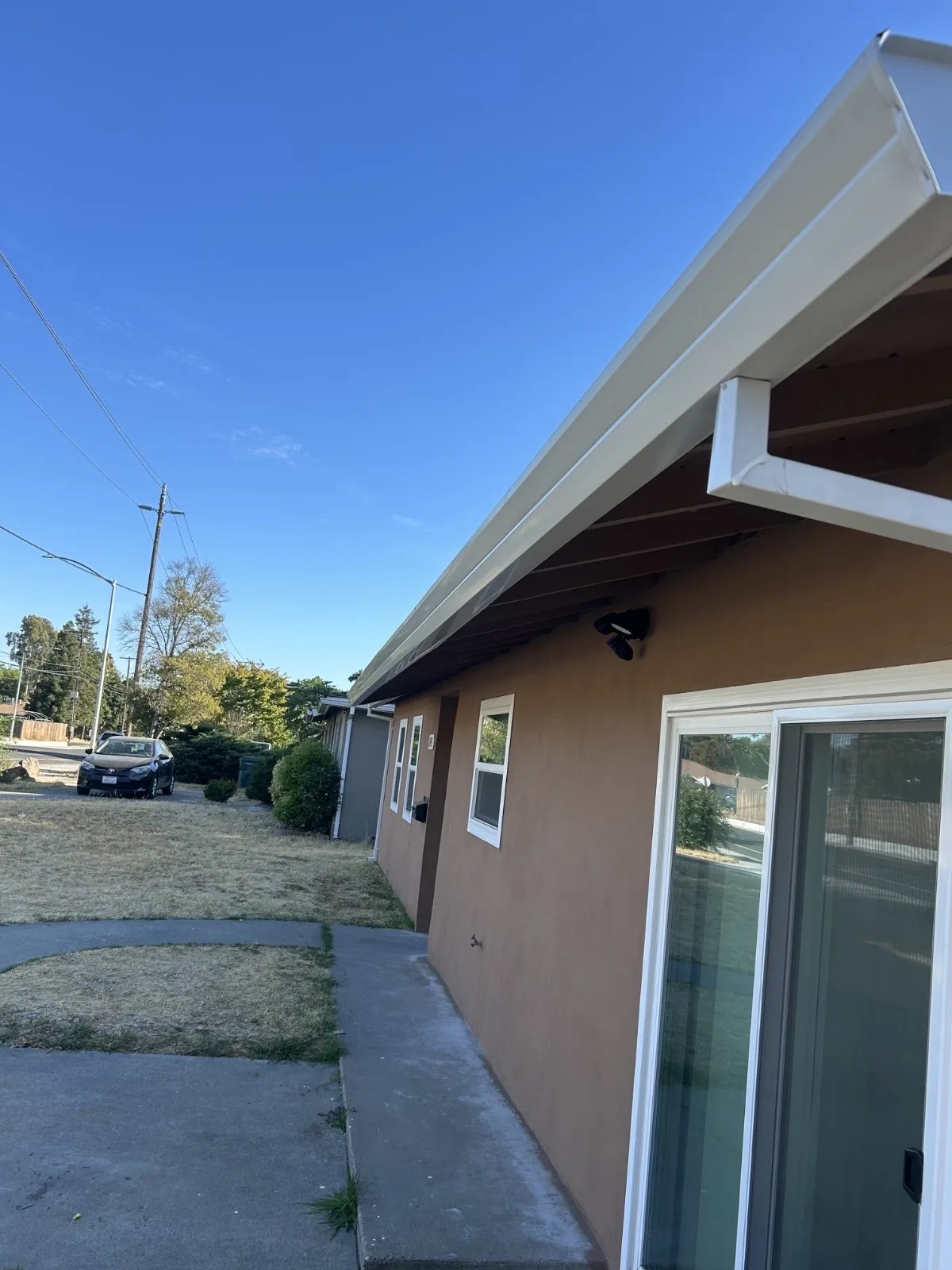
Quick Answer: Sacramento ADUs require gutter systems that comply with county drainage standards directing water at least 10 feet from foundations. Most detached ADUs need 5-inch or 6-inch seamless gutters with 3x4-inch downspouts, and any project adding more than 500 square feet of impervious surface triggers onsite stormwater detention requirements. Installing gutters during ADU construction costs $800-$2,200 and saves 25-40% versus retrofitting later.
TL;DR: ADU Gutter Essentials for Sacramento
Sacramento issued 1,134 ADU permits between 2020-2024—an 8x increase over the previous five years (Abridged, 2025). Most of those projects need a purpose-built gutter and drainage system, not just an afterthought connection to the main house. If your ADU adds over 500 square feet of impervious surface, Sacramento requires onsite stormwater detention. Plan your gutter system at the design stage—not after framing—to avoid permit delays and costly rework.
Bottom line: Budget $800-$2,200 for ADU gutters during construction, or $1,500-$4,000+ to add them after. Get a free estimate for your ADU gutter project.
Table of Contents
- Why ADU Gutter Installation Is Different From a Standard Home
- Sacramento Drainage Codes That Apply to ADU Construction
- How to Size Gutters for a Sacramento ADU
- Connecting ADU Gutters to Your Existing Drainage System
- Stormwater Mitigation: The 500 Square Foot Threshold
- ADU Gutter Installation Costs in Sacramento
- How ADU Setback Rules Create Drainage Challenges
- Gutter Guards for Sacramento ADUs
- Frequently Asked Questions
ADU gutter installation in Sacramento is one of the most overlooked details in accessory dwelling unit construction—and one of the most consequential. Sacramento issued 1,134 ADU building permits between 2020 and 2024, compared to just 143 in the five years prior (Abridged, 2025). That eight-fold increase means thousands of new small structures are being added to existing residential lots, each one creating new impervious surface and new drainage demands on lots that were originally designed for a single home.
The gutter system on an ADU isn't just about keeping rain off the doorstep. It's a code compliance issue, a stormwater management issue, and—on Sacramento's clay soil—a foundation protection issue. Get it wrong and you risk permit delays, water damage to both the ADU and the main house, and costly retrofits after the build is done. We've installed gutter systems on hundreds of ADU projects across the Sacramento Valley, and the same planning mistakes come up repeatedly. This guide covers every decision you need to make, from gutter sizing to drainage code compliance to cost.
Why ADU Gutter Installation Is Different From a Standard Home
An ADU is not a miniature house when it comes to drainage planning. It's a new structure on an already-developed lot, which means the drainage dynamics are fundamentally different from new construction on a blank parcel. Every gallon of water your ADU's roof collects has to go somewhere—and that somewhere can't be your neighbor's yard, your main home's foundation, or the newly poured ADU slab.
The California Plumbing Code (Section 1101.12.1) requires roof areas to be drained by roof drains or gutters, sized to accommodate a rainfall rate of 1.5 inches per hour (Permit Sonoma Technical Bulletin B-34). Sacramento's atmospheric river events regularly exceed that threshold—delivering over 9 inches in under four weeks during the 2025-2026 storm season alone.
What Makes ADU Drainage Unique:
- + Tight lot coverage: ADUs squeeze new impervious surface onto lots originally graded for one structure
- + 4-foot setbacks: California's minimum rear and side setback puts ADU rooflines close to property lines and neighboring structures
- + Shared drainage infrastructure: ADU runoff often needs to tie into the main home's existing (and potentially undersized) system
- + Stormwater thresholds: Exceeding 500 sq ft of new impervious surface triggers onsite detention requirements in Sacramento
- + Foundation proximity: Close spacing between ADU and main house means overflow from either structure threatens both foundations
A standard home on a new lot has the luxury of purpose-designed grading, dedicated drainage easements, and ample setbacks on all sides. An ADU has none of that. The gutter system has to work harder and smarter to compensate. That means proper sizing, strategic downspout placement, and a drainage discharge plan that accounts for the ADU's position relative to the main house, property lines, and existing drainage paths.
Estimated Runoff per Inch of Rain by ADU Roof Size
Calculated at 0.623 gallons per square foot per inch of rainfall. Sacramento averages 20+ inches annually.
Sacramento Drainage Codes That Apply to ADU Construction
Sacramento's drainage code requirements apply to ADUs just as they apply to any new construction. The county's Environmental Management Department reviews drainage and stormwater impact as part of every ADU permit application. Here are the specific standards your project must meet.
Key Drainage Standards for Sacramento ADUs
- 110-foot foundation clearance: Stormwater runoff must be directed away from foundations with no pooling within 10 feet of the structure. This applies to both the ADU and the main house.
- 2Roof drainage sizing: Per CPC Section 1101.12.1, gutters and downspouts must be sized for 1.5 inches of rainfall per hour. For a 600 sq ft ADU roof, that's approximately 9.4 gallons per minute peak flow.
- 3500 sq ft impervious surface threshold: Net new impervious area exceeding 500 sq ft requires onsite stormwater detention per Sacramento's Stormwater Quality Design Manual.
- 4Grading and slope: Finish grade must slope away from all foundations at a minimum of 2% (1/4 inch per foot) for at least 6 feet.
- 5Property line discharge: Downspout discharge cannot be directed toward neighboring properties. Runoff must be contained on-site or directed to approved drainage facilities.
- 6Low Impact Development (LID): New development projects must incorporate LID features per Sacramento's Stormwater Quality Standards, which may include bioswales, rain gardens, or permeable surfaces.
Warning: 38% of Sacramento ADU Applications Get Returned
According to Sacramento County permitting data, 38% of ADU permit applications are returned for corrections at least once, and incomplete or inaccurate site plans—including drainage plans—were responsible for 21% of rejections in 2024 (Fortune ADU). Having a clear gutter-and-drainage plan in your initial submittal significantly reduces your chances of a return.
How to Size Gutters for a Sacramento ADU
Gutter sizing for an ADU follows the same hydraulic principles as any structure, but the smaller scale and tighter site conditions create specific considerations. The two primary factors are roof area (in square feet) and roof pitch. Sacramento's climate demands also factor in—the concentrated winter rainfall pattern means your system will face peak loads far higher than annual averages suggest.
| ADU Roof Area | Recommended Gutter Size | Downspout Size | Min. Downspouts |
|---|---|---|---|
| Under 500 sq ft | 5-inch K-style | 2x3 or 3x4 inch | 2 |
| 500-800 sq ft | 5-inch or 6-inch K-style | 3x4 inch | 3 |
| 800-1,200 sq ft | 6-inch K-style | 3x4 inch | 4 |
| Over 1,200 sq ft (two-story ADU) | 6-inch K-style | 3x4 inch | 4-6 |
*Based on Sacramento rainfall intensity of 1.5+ inches/hour and standard K-style gutter capacity ratings. Steep roof pitches (above 8:12) effectively increase collection area—size up accordingly.
For Sacramento specifically, we recommend defaulting to 6-inch gutters on any ADU with a roof area above 600 square feet. The capacity difference between 5-inch and 6-inch gutters is over 40%, and the cost premium during construction is minimal—typically $150-$300 total. That small upcharge buys significant overflow protection during atmospheric river events that can dump rain faster than 5-inch gutters can channel it.
Pro Tip: Account for Roof Pitch Multiplier
Steeper roofs collect more rain per horizontal square foot because of the angle of incidence. A roof with a 12:12 pitch has an effective collection area 1.41x its footprint. For a 600 sq ft ADU footprint with a steep roof, you're effectively draining 846 sq ft of rain catchment. This is why steep-pitch ADUs should always use 6-inch gutters even when the footprint seems small enough for 5-inch.
5-Inch vs 6-Inch Gutter: Peak Flow Capacity (gal/min)
Peak flow capacity per 10-foot gutter section at optimal slope. Data from industry standard K-style gutter specifications.
Connecting ADU Gutters to Your Existing Drainage System
One of the biggest decisions in ADU gutter planning is whether to tie into the main home's existing drainage system or build a standalone system for the ADU. Both approaches are valid, but each has tradeoffs that depend on your lot layout, the condition of the existing system, and how close the ADU sits to the main house.
Option A: Tie Into Existing System
- +Lower cost if main house has underground drainage nearby
- +Single discharge point simplifies lot drainage
- -Existing system may lack capacity for added load
- -Old 2x3 downspouts create bottlenecks
- -A clog in the shared system backs up both structures
Option B: Standalone ADU Drainage
- +Purpose-sized for ADU roof area
- +Isolates ADU drainage from main house issues
- +Easier to maintain independently
- -Higher upfront cost ($1,500-$3,500 for full system)
- -Requires separate discharge point on lot
A typical 600 square foot ADU roof generates roughly 375 gallons of runoff per inch of rain. During a heavy Sacramento storm delivering 1.5 inches per hour, that's approximately 9.4 gallons per minute flowing through the system at peak. If the main home's existing downspouts are 2x3 inches (common on older Sacramento homes), they may already be at capacity handling the main roof. Adding ADU runoff could cause overflow at every connection point.
Our recommendation: always assess the existing system's capacity before committing to a tie-in. If the main house has underground downspout drainage with 4-inch pipe and 3x4 downspouts, a tie-in usually works well. If it has surface-discharge 2x3 downspouts with no underground system, a standalone ADU drainage system is almost always the smarter investment.
Main House Drainage Capacity Check: Can It Handle Your ADU?
Red indicates insufficient capacity for combined main house + ADU load. Green indicates adequate capacity. Dashed line = ADU peak demand at 1.5"/hour rainfall.
Building an ADU in Sacramento?
Get your gutter and drainage system right the first time. We assess your existing drainage, size the ADU system, and install during construction to save you 25-40% versus adding gutters after the build.
We coordinate directly with your ADU contractor's construction schedule
Stormwater Mitigation: The 500 Square Foot Impervious Surface Threshold
This is the requirement that catches most ADU builders off guard. In Sacramento, if your ADU project adds more than 500 square feet of net new impervious surface, you're required to provide onsite stormwater detention (Sacramento Stormwater Quality Design Manual). That 500 square foot threshold includes everything: the ADU footprint, new concrete walkways, patios, driveway extensions, and any other hard surfaces.
For perspective, a modest 500 square foot detached ADU with a 3-foot-wide concrete walkway running 30 feet to the main house already puts you at 590 square feet of new impervious surface—over the threshold. Once you add a small patio or pad for an HVAC unit, the number climbs further.
Common Stormwater Mitigation Options for Sacramento ADUs
The gutter system feeds directly into whichever mitigation method you choose. Your ADU gutters need to be designed as part of the stormwater management plan from the beginning—not bolted on as a separate line item. The gutter discharge planning guide covers the connection details between gutters and various ground-level drainage solutions.
How Fast Impervious Surface Adds Up on a Typical ADU Project
Based on a 400 sq ft ADU with 4-ft wide x 35-ft walkway and 132 sq ft patio. Yellow = at threshold. Red = above threshold, detention required.
What Does ADU Gutter Installation Cost in Sacramento?
ADU gutter installation costs in Sacramento depend on three variables: the ADU footprint, whether you install during or after construction, and how complex the drainage connection is. Here's what the numbers actually look like for the typical Sacramento ADU project.
| Component | During Construction | After Construction |
|---|---|---|
| Seamless gutters (5-inch) | $600 - $1,000 | $900 - $1,600 |
| Seamless gutters (6-inch) | $800 - $1,400 | $1,200 - $2,200 |
| Downspouts (3x4 inch, per unit) | $75 - $150 | $100 - $200 |
| Gutter guards (micro-mesh) | $400 - $900 | $800 - $1,800 |
| Underground drain tie-in | $500 - $1,200 | $800 - $2,000 |
| Standalone drainage (French drain or catch basin) | $1,500 - $3,500 | $2,500 - $5,500 |
| Typical Total (gutters + guards + drainage) | $1,800 - $4,500 | $3,200 - $8,000+ |
*Costs based on a typical 500-800 sq ft detached ADU in Sacramento County. Prices reflect 2026 market rates. Actual costs vary by ADU size, site conditions, and drainage complexity.
The during-construction savings come from the same factors that apply to new construction gutter installation: scaffolding is already on-site, fascia boards are exposed, trenching for underground drains happens before landscaping, and the gutter installer can coordinate directly with the general contractor. Once the ADU is finished and landscaping is in, every one of those advantages disappears.
Pro Tip: Bundle Gutters Into the ADU Contract
Ask your ADU contractor to include gutter installation as a line item in the construction contract rather than hiring a separate gutter company after the build. Many ADU contractors have gutter installation subcontractors they work with regularly, and bundling the work into one contract simplifies scheduling, reduces mobilization costs, and ensures the gutter system is inspected as part of the overall building permit. If your contractor doesn't have a gutter sub, we coordinate directly with Sacramento-area ADU builders to handle the gutter scope.
How ADU Setback Rules Create Drainage Challenges
California state law allows detached ADUs with a minimum 4-foot rear and side setback from property lines (Result Construction, 2026). That tight setback is what makes ADUs feasible on small Sacramento lots—but it creates real drainage problems that the gutter system has to solve.
With only 4 feet between the ADU wall and the property line, a standard roof overhang of 12-18 inches puts the gutter line roughly 2.5-3 feet from the fence. There's almost no room for downspout discharge at grade level without water pooling against the fence or flowing onto the neighbor's property. Sacramento code prohibits directing stormwater toward adjacent parcels, so the gutter system must capture every drop and route it where it belongs.
Setback-Specific Gutter Strategies:
- + Underground downspout routing: Run downspouts directly into underground 4-inch PVC pipe that routes water to an approved discharge point. No surface splash means no neighbor conflicts.
- + Internal downspouts: On the property-line side, route downspouts inside the wall cavity or along internal corners. More expensive but eliminates any exterior drainage within the setback zone.
- + Extended gutter runs: Slope gutters on the property-line side toward downspouts located on the ADU's interior-facing walls (toward the main house). This keeps all discharge away from property lines.
- + Foundation protection strips: Install a 2-foot gravel strip along the ADU foundation on the setback side to manage any incidental drip from the roof edge.
The space between the ADU and the main house presents the opposite problem: too much water, not enough separation. If the ADU sits 15-20 feet from the main house—common on Sacramento lots—both structures' gutter discharge converges in a narrow corridor. Without proper grading or underground drainage in this zone, you get saturated soil that threatens both foundations. On Sacramento's expansive clay soil, saturated soil expands and can exert enough hydrostatic pressure to crack slabs and shift foundations over time.
Real Scenario: The Natomas ADU Drainage Problem
A homeowner in North Natomas built a 600 sq ft detached ADU with a 4-foot rear setback. The contractor installed gutters but discharged them at grade level on the rear side—pointing toward the fence line. During the first December storm, water pooled against the neighbor's fence, flooded their raised garden bed, and prompted a complaint to code enforcement.
The fix required trenching a 40-foot underground drain line from the rear downspouts to a pop-up emitter in the front yard—work that cost $2,800 after landscaping was already complete. During construction, the same underground line would have cost roughly $1,200 because the trenching equipment was already on-site and the yard was bare dirt.
Why Sacramento ADUs Especially Need Gutter Guards
ADUs have shorter gutter runs than full-size homes, which means a single clog has a proportionally larger impact. On a main house with 200 linear feet of gutter, one clog affects maybe 10-15% of the system. On an ADU with 60-80 linear feet, one clog can back up 25-40% of the system and cause overflow across an entire side of the structure.
Sacramento properties with mature valley oaks, Deodar cedars, or pine trees—which describes a significant percentage of established neighborhoods where ADUs are being built—face heavy debris loads year-round. Oak leaves and catkins in spring, pine needles in summer and fall, and general tree debris through winter create a constant clogging risk. Micro-mesh gutter guards are the single most effective way to prevent clogs and protect the ADU drainage system.
- •Micro-mesh guards: Best for Sacramento. Block pine needles, oak catkins, shingle grit, and pollen. $6-$12 per linear foot installed during construction.
- •Screen guards: Adequate for large leaves but let fine debris through. $3-$6 per linear foot. Not recommended under pine canopy.
- •Foam inserts: Low upfront cost ($2-$4/ft) but clog with pollen and decompose within 3-5 years in Sacramento's UV-intense summers. Not recommended.
- •Reverse-curve/solid surface: Shed large debris well but struggle with Sacramento's fine pollen and can cause water overshoot during heavy rain. Better suited to low-debris environments.
Installing gutter guards during ADU construction costs $400-$900 for a typical unit. Adding them after the build costs $800-$1,800—the same pattern of double the cost that applies to the gutters themselves. For a detailed comparison of guard types and pricing, see our gutter guard installation service page.
Frequently Asked Questions
Do ADUs in Sacramento require gutters?
Sacramento County drainage design standards require all new structures, including ADUs, to manage stormwater runoff and prevent water pooling within 10 feet of foundations. While California building code doesn't explicitly mandate gutters on accessory structures, the practical effect of Sacramento's drainage standards means virtually every ADU needs a gutter system to pass final inspection.
Can ADU gutters connect to the main house drainage system?
Yes, but only if the existing system has adequate capacity. A typical 600 sq ft ADU roof adds roughly 375 gallons of runoff per inch of rain. If the main house uses 2x3-inch downspouts, they may already be at capacity. Assess the existing system first—if it has underground drainage with 4-inch pipe and 3x4 downspouts, a tie-in usually works well. Otherwise, a standalone system is the safer investment.
How much does ADU gutter installation cost in Sacramento?
ADU gutter installation during construction typically costs $800-$2,200 for seamless aluminum gutters, depending on the ADU footprint. Adding gutter guards costs $400-$900 extra. If your drainage plan requires underground tie-ins or a standalone French drain system, total drainage costs can reach $3,000-$5,500. Installing after construction costs 25-40% more across every component. See the full cost guide for detailed pricing.
What size gutters does an ADU need in Sacramento?
Most Sacramento ADUs perform well with 5-inch K-style gutters if the roof area is under 500 square feet. For ADUs with larger roof areas, steep pitches above 8:12, or locations under heavy tree canopy, 6-inch gutters are recommended. Sacramento's concentrated winter rainfall can deliver over 1 inch per hour during atmospheric river events, so oversizing by one step is a low-cost insurance policy. Always use 3x4-inch downspouts minimum.
Does adding impervious surface from an ADU trigger stormwater mitigation requirements?
Yes. In Sacramento, if the net increase in impervious surface exceeds 500 square feet, onsite stormwater detention is required. This includes the ADU footprint, walkways, patios, and equipment pads. A typical 500 sq ft ADU with walkways usually exceeds this threshold. Mitigation options include rain gardens, permeable pavers, underground detention tanks, and French drain systems.
Should I install gutter guards on my ADU?
Strongly recommended, especially if your property has mature oaks, pines, or cedars. ADUs have shorter gutter runs than full-size homes, so a single clog backs up a larger percentage of the system. Micro-mesh guards are the best choice for Sacramento's debris mix. Installing during construction costs $400-$900 versus $800-$1,800 after the build. Visit our gutter guard installation page for more details.
The Bottom Line on ADU Gutter Installation in Sacramento
Sacramento's ADU boom is adding thousands of new structures to existing residential lots—and every one of them needs a drainage system that accounts for tight setbacks, shared infrastructure, stormwater thresholds, and Sacramento's punishing winter rainfall pattern. The gutter system is not an afterthought. It's a code compliance requirement, a foundation protection strategy, and a neighbor-relations insurance policy all in one.
Plan gutters and drainage at the design stage, not after framing. Budget $800-$2,200 for gutters during construction, plus $400-$900 for guards and $500-$3,500 for drainage connections depending on complexity. Waiting until after the build doubles those numbers. The math is the same as any construction upgrade: doing it right the first time is always cheaper than fixing it later.
Need Gutters for Your Sacramento ADU Project?
We specialize in ADU gutter installation across Sacramento County. Free estimates include drainage assessment, system sizing, and coordination with your ADU contractor—all before your build is done and costs go up.
Same-day estimates available for ADU projects across Sacramento County
Related Articles
New Construction Gutter Installation
Builder-grade vs custom gutters for Sacramento new builds with full cost comparison.
Gutter Installation Cost Guide
Detailed pricing for seamless gutter installation across Sacramento.
French Drain vs Catch Basin vs Pop-Up Emitter
Compare Sacramento downspout drainage solutions on cost, capacity, and clay soil performance.