Quick Answer: Do London Plane and Sycamore Trees Clog Sacramento Gutters?
Yes, and more often than any other street tree in Sacramento. London plane trees (Platanus x acerifolia) and American sycamore (Platanus racemosa) drop four distinct debris types across the calendar: anthracnose-damaged leaves in spring, peeling bark plates in summer, large palmate leaves in fall, and 1.5-inch spiky seed balls in late winter. That is why Midtown, Land Park, East Sac, and Curtis Park homes under these trees face year-round gutter problems instead of a single seasonal event. A 2mm stainless micro-mesh guard plus a downspout strainer stops all four debris types. Screen guards and foam inserts fail.
Table of Contents
- The Sacramento London Plane Legacy
- The Four Debris Waves of a London Plane Year
- Anthracnose and the Spring Leaf Drop Nobody Expects
- Peeling Bark Plates: Summer’s Weird Gutter Problem
- The Spiky Seed Balls That Survive Six Months of Rain
- Midtown, Land Park, and East Sac Hotspots
- Gutter Guards That Actually Work on Plane Trees
- Cleaning Schedule for Plane-Tree Properties
- Cost Analysis: Four-Season Debris vs. Guards
- Frequently Asked Questions
London plane tree gutter problems in Sacramento are not a fall cleanup issue. They are a year-round system failure that breaks most gutter guards and outpaces most cleaning schedules. If you live in Midtown, Land Park, East Sacramento, or Curtis Park on a lot under a mature plane tree, your gutters are being hit by four different debris types across four different seasons. That is a fundamentally different problem than the single-event drops that define oak or sweetgum properties.
London plane (Platanus x acerifolia) is a hybrid of American sycamore (Platanus occidentalis) and oriental plane (Platanus orientalis). The city planted it heavily as a street tree between the 1920s and the 1970s because it tolerates smog, heat, and compacted urban soils. It is still the signature canopy tree of several grid neighborhoods. According to the Sacramento Tree Foundation, the regional urban forest inventory includes tens of thousands of plane and sycamore trees, with the heaviest concentrations in the central city neighborhoods that developed before World War II.
TL;DR: London plane and sycamore trees drop four distinct debris types per year. Spring anthracnose leaves (April to May), summer bark plates (June to August), fall leaves (October to November), and late winter seed balls (January to April). Midtown, Land Park, East Sac, and Curtis Park are the hot zones. Unguarded gutters need four cleanings a year. A 2mm stainless micro-mesh with a downspout strainer is the only guard configuration that stops all four debris types. For a guard cost breakdown, see our per-linear-foot guide.
The Sacramento London Plane Legacy
Sacramento adopted London plane as a civic street tree for the same reasons London did a century earlier: the tree tolerates pollution, shrugs off summer heat, and grows fast enough to shade a street within 20 years of planting. The City of Sacramento and volunteer groups planted thousands of plane trees along grid-neighborhood streets throughout the middle of the twentieth century, and a related native species, California sycamore (Platanus racemosa), occurs naturally along the American and Sacramento rivers.
The practical result for homeowners: if your house predates 1970 and sits in Midtown, East Sac, Land Park, or Curtis Park, the street tree canopy over your roof is likely London plane. Mature specimens reach 60 to 80 feet tall with crowns of 40 to 60 feet wide. Many Midtown blocks have continuous canopy coverage with branches extending well over the private property line, meaning the tree sits in the public right-of-way but the debris falls on your roof. You carry the cleanup cost without control over the tree itself.
Why Plane Trees Stopped Getting Planted
Around 1990, Sacramento Urban Forestry began phasing out London plane as a preferred street tree selection. The primary reasons were anthracnose susceptibility (covered later in this guide), sidewalk heave from shallow roots, and the sheer volume of debris the species drops onto public and private infrastructure. Newer neighborhoods like Natomas, the Pocket, and most of Elk Grove rarely have London plane as a street tree, which is why those areas see very different gutter debris profiles than the pre-1970 grid.
If you are comparing tree species in your own yard to figure out what is dropping on your roof, our guide on gutter problems by Sacramento home era breaks down the debris profiles typical for each neighborhood type from 1920s Craftsman to 2000s stucco.
The Four Debris Waves of a London Plane Year
Most Sacramento trees drop debris in a concentrated window: oaks in fall, sweetgum in winter, pines a little bit year-round. London plane is different. It has four distinct debris events spread across the calendar, and each one has different physical properties that defeat different types of gutter protection.
London Plane Debris Calendar vs. Sacramento Rainfall
Debris timing based on UC IPM phenology notes and regional installer observation. Rainfall from NWS Sacramento historical averages.
The important pattern: there is no quiet month. Sacramento homeowners with oak trees get a break from December through August. Homeowners with sycamore or London plane do not. That is why cleaning frequency matters more for plane-tree properties than for any other tree type we service in the metro.
Anthracnose and the Spring Leaf Drop Nobody Expects
Anthracnose is the single most important reason sycamore and London plane gutter problems do not follow typical seasonal logic. The fungal disease (Apiognomonia veneta) attacks new growth during cool, wet springs, killing young leaves before they fully expand. According to UC Integrated Pest Management, anthracnose is the most common foliar disease of sycamore and plane trees in California, and Sacramento’s spring rain patterns make the region particularly prone to it.
Here is what homeowners see: a tree that looked healthy in March starts shedding deformed, brown-edged leaves in April and May. Clumps of small twigs fall with them. During years with multiple atmospheric river events in February and March, anthracnose can be severe enough to defoliate large portions of the canopy. Those leaves and twigs fall directly into gutters during warm weather, decomposing faster than typical fall leaves and producing the wet, smelly slime that plane-tree homeowners will recognize.
Why Anthracnose Debris Is Worse for Gutters
- Wet leaves drop into warm spring gutters and begin decomposing within days
- Small attached twigs create mesh-piercing damage on cheap screen guards
- Decaying material holds moisture against gutter floors, accelerating aluminum corrosion
- Standing slime becomes a mosquito breeding habitat within two to three weeks
- Timing coincides with late-season rains, so gutters fill instead of drying out
Severity Varies by Year
Anthracnose severity follows spring weather. A cool, wet April through early May produces the worst outbreaks. A warm, dry spring keeps infection pressure low. UC IPM notes that severe anthracnose years often follow winters with above-average rainfall carrying into April. The atmospheric river pattern that hit Sacramento in late winter 2023 produced textbook anthracnose conditions, and we saw spring gutter failure calls spike that April and May.
Pro Tip: The May Gutter Check
Most Sacramento homeowners schedule gutter cleanings for November (fall) and March (spring before summer). If you live under a London plane or sycamore, add a May check. By mid-May you can tell how bad the anthracnose year is and whether you need a targeted cleaning before summer. This is the difference between discovering a plugged downspout in October and discovering it after a hot summer of bacterial growth.
Peeling Bark Plates: Summer’s Weird Gutter Problem
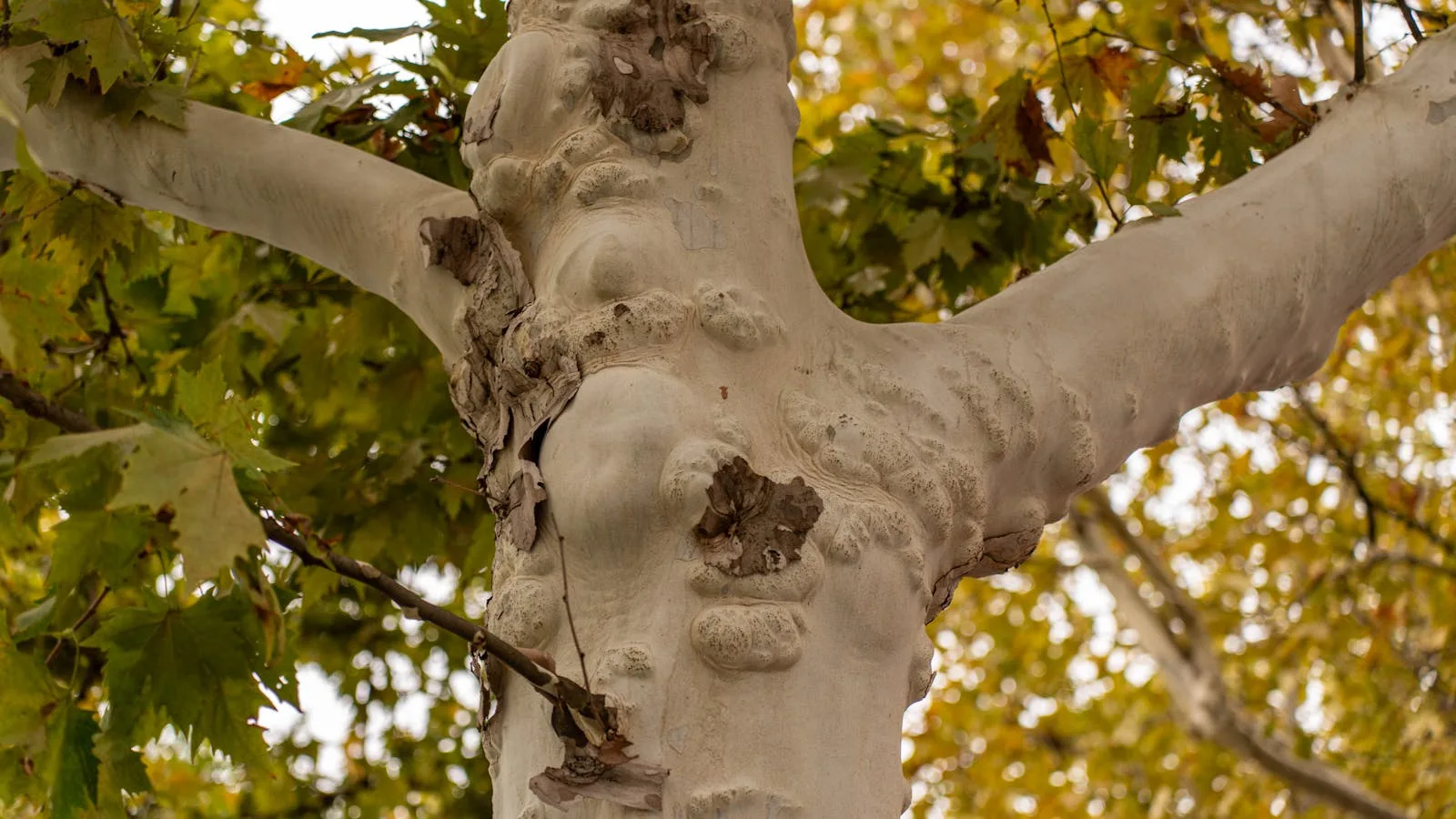
London plane and sycamore trees are famous for their camouflage bark: mottled patches of cream, tan, olive, and gray created by annual bark shedding. That is not an aesthetic choice. The trees actively shed bark in large plates through the summer as the trunk and major limbs expand. By late July, mature plane trees in Midtown drop hundreds of curled bark pieces, ranging from small chips to irregular plates the size of a playing card.
Those plates are the second unusual debris type that breaks conventional gutter systems. Bark is rigid, lightweight, curled, and deeply resistant to decomposition. It does not rot like a leaf. It does not slide like a seed ball. It wedges into gutter corners, snags on hangers, and forms dense mats that water cannot flush past.
What Bark Plates Do to Gutter Systems
- • Screen guards dent. Larger bark plates fall with enough inertia from 60+ feet up to deform thin aluminum screen guards, creating low spots that trap debris and standing water.
- • Reverse-curve guards jam. Curled bark pieces wedge into the front slot of surface-tension guards and block the flow channel entirely.
- • Foam inserts saturate. Foam guards become permanent bark-chip compost during the summer shed window. By fall they are already 50 percent full of decaying material.
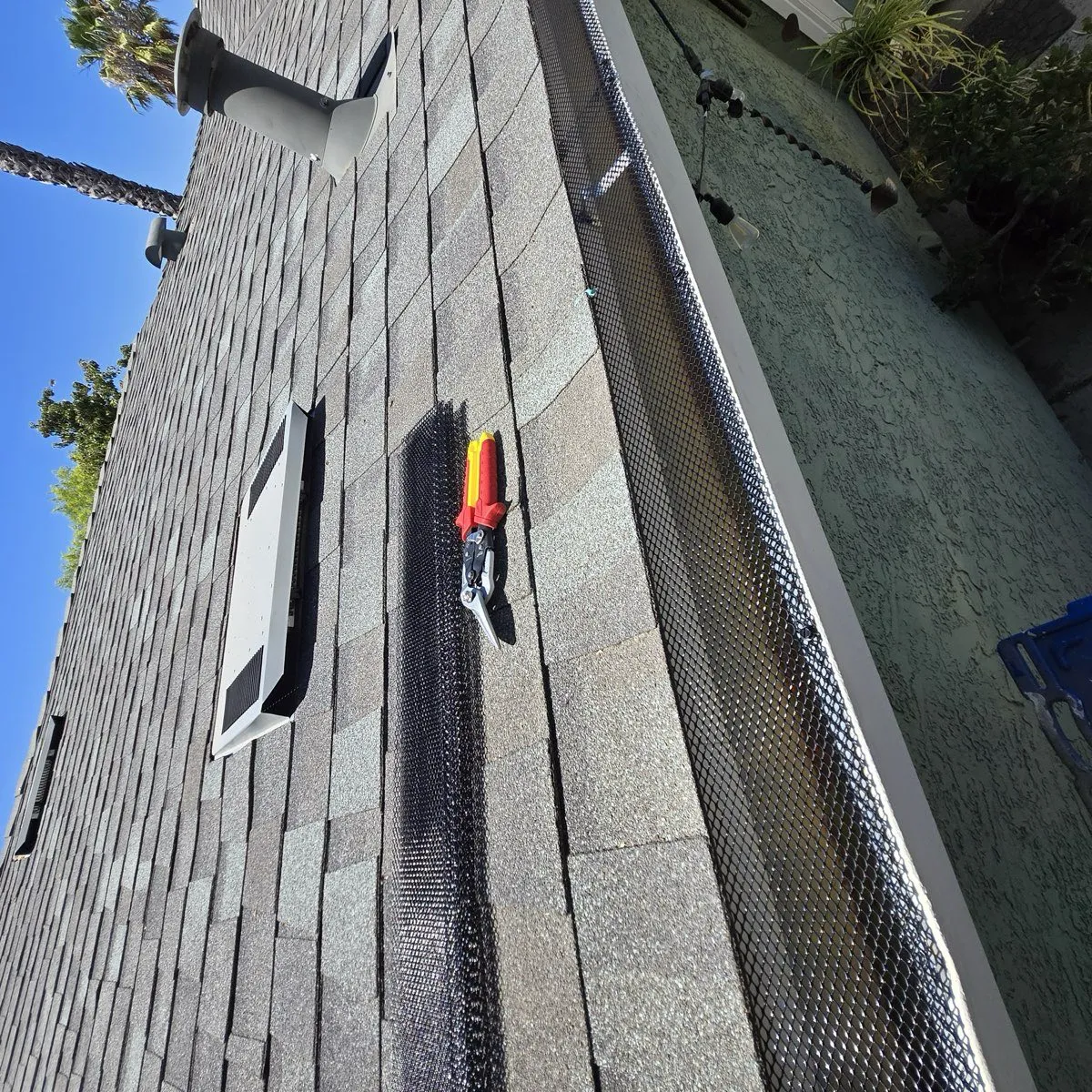
- • Micro-mesh works. Flat 2mm stainless mesh allows bark plates to dry on the surface and blow off during the next breeze event. No plate gets retained because nothing holds it.
This is the debris type most commonly responsible for summertime downspout clogs on Sacramento plane-tree properties. Homeowners often think the summer is a quiet season for gutters, so the plug forms undetected and then fails catastrophically when the first October storms arrive. Our downspout clog guide covers the symptoms to watch for.
The Spiky Seed Balls That Survive Six Months of Rain
The debris type most Sacramento homeowners know for plane trees is the one that is hardest to miss: the 1.5-inch spiky brown seed balls that hang in clusters through the winter and drop between January and April. These are achene clusters. Each ball contains hundreds of individual winged seeds packed tightly, with the outer surface covered in stiff bristly hairs.
Seed balls are almost exactly the wrong size and shape for residential gutters. Physically, they behave like hard, low-density balls that roll to gravity low points and wedge into downspout reducers. Chemically, they are woody and resistant to decomposition. A seed ball that enters a gutter in February will still be intact, mostly, by the following July.
Why They Break Most Guard Products
| Guard Type | Blocks Seed Balls | Blocks Bark Plates | Blocks Anthracnose Leaves | Verdict |
|---|---|---|---|---|
| 1/4″ screen (6mm) | Partial | No | No | Fails |
| 1/8″ screen (3mm) | Yes | Dents under impact | No (small twigs pass) | Fails |
| Reverse-curve | No (jams slot) | No | Partial | Fails |
| Foam insert | No | No | No (traps) | Fails |
| Brush (hedgehog) | Traps in bristles | No | No | Fails |
| 2mm stainless micro-mesh | Yes (rolls off) | Yes | Yes | Works |
The critical detail for seed balls is the guard surface angle. A flat-mounted micro-mesh lets seed balls roll off during normal wind events. A flat-mounted screen with 3mm openings blocks the whole ball but lets the individual seeds and fibrous bristle fragments pass through, which then collect at the downspout and form secondary plugs. For a general guard type comparison, see our guide to why cheap DIY gutter guards fail.
Midtown, Land Park, and East Sac Hotspots
London plane and sycamore street-tree density is not uniform across Sacramento. A handful of neighborhoods carry the legacy of the mid-century civic planting programs, and the homeowners there shoulder most of the regional plane-tree gutter problem. Based on our service territory data and public urban forestry records, these are the highest-density areas.
- • Midtown grid (J through Q streets, 17th through 30th) — Heavy London plane street-tree plantings along east-west streets. Small lots with homes sited directly against the public right-of-way mean canopy coverage extends fully over the roofline. Spring anthracnose years produce some of the worst gutter slime we see anywhere in the metro.
- • Land Park (around William Land Park) — Mixed canopy of native valley oak and planted London plane. The plane trees are most common along 13th, 14th, and the east-west streets south of Broadway. Seed ball density in March is particularly high here.
- • East Sacramento (Fab 40s and McKinley Park area) — Original 1920s street trees include significant London plane stock, with especially heavy density along J, H, and I Streets east of 33rd. Many homes have 60-year-old plane trees directly overhead.
- • Curtis Park — Mixed older street-tree plantings with significant plane-tree presence along 2nd Avenue and 5th Avenue corridors. Narrow lots concentrate debris onto rooflines. Access for cleaning and guard installation can be tight due to mature ornamental landscaping.
- • American River Parkway-adjacent streets — Native California sycamore (Platanus racemosa) grows along the parkway and spills over into adjacent yards. River Park, Campus Commons, and parts of Del Paso Heights see native sycamore debris loads in addition to planted London plane.
- • South Land Park and Hollywood Park — Mid-century subdivisions planted London plane as primary street trees. Now 60 to 70 years old and at mature debris output.
- • Select blocks in downtown and Old Sacramento — Public plantings from the 1960s and 1970s still shed heavily onto adjacent residential and mixed-use structures.
If your neighborhood is on this list and you have not addressed your gutters recently, the probability of an existing downspout plug is very high. We recommend a baseline professional clean before investing in any long-term solution, both to confirm the current gutter condition and to identify which tree species are actually dropping onto your roof. Compare the tree profile against our valley oak guide, sweetgum guide, and eucalyptus guide if you have mixed species overhead.
Plane Tree Debris Wrecking Your Midtown or Land Park Gutters?
We install 2mm stainless micro-mesh guards engineered for four-season debris properties across Midtown, Land Park, East Sacramento, and Curtis Park. Free on-site tree species ID and debris-load assessment.
Gutter Guards That Actually Work on Plane Trees
The same 2mm stainless steel micro-mesh recommendation that works for pine needles, valley oak acorns, and sweetgum pods also works for London plane and sycamore. The reasons are physical rather than product-marketing. A 2mm mesh is small enough to block every debris type the tree produces and large enough not to surface-clog from the very fine dust that would collect on tighter meshes.
- Stainless steel micro-mesh (1.5–2mm openings) — The recommended default for plane-tree properties. Stainless resists the tannin and moisture acidity from decaying anthracnose leaves better than aluminum mesh. Mesh sits flat over the gutter with a slight roof-pitch angle so seed balls and bark plates roll off.
- Reinforced hangers every 18 inches or less — Plane-tree properties stress gutter hangers more than most because seed balls and accumulated bark create concentrated weight at low points. Standard 30-inch hanger spacing can fail during heavy-debris years. Tighten it up at installation and you save the gutter from pulling away from the fascia.
- Downspout strainers on every drop — A $5 strainer prevents the occasional bark fragment or fibrous seed-ball remnant that slips through a damaged mesh section from reaching the downspout elbow. On plane-tree homes this is non-negotiable.
- Oversized downspouts (3x4 inch minimum) — If you are replacing gutters on a plane-tree property, upsize the downspouts. 2x3 downspouts clog roughly twice as often as 3x4 on the same property. For homes with significant seed-ball risk, oversized downspouts dramatically reduce plug frequency.
- Skip the reverse-curve, foam, and brush products — All three fail against at least one of the four plane-tree debris waves. Reverse-curve jams on seed balls and bark. Foam saturates with anthracnose slime. Brush traps bark and seeds. These products are cheaper up front and far more expensive over ten years.
For a broader comparison of brand-level performance across debris types, see our best gutter guard brands comparison. For cost specifics by linear foot, our pricing guide includes plane-tree property examples.
Cleaning Schedule for Plane-Tree Properties
Unguarded plane-tree gutters need four cleanings per year, timed to each debris wave. That is double the typical Sacramento recommendation. For a general frequency comparison across home types, our guide on how often to clean gutters in Sacramento covers the baseline case.
Without Gutter Guards (Plane-Tree Property)
| When | Targets | Typical Cost |
|---|---|---|
| Late February | Late winter seed-ball accumulation before spring rain | $175–$275 |
| Mid-May | Anthracnose leaf and twig debris after spring drop | $150–$250 |
| Late August | Summer bark-plate accumulation before fall debris | $150–$250 |
| Mid-November | Fall leaf drop at peak storm season | $175–$300 |
| Annual Total | $650–$1,075 |
With 2mm Micro-Mesh Guards Installed
- • Late May surface sweep — Remove anthracnose debris from mesh surface with leaf blower or soft broom. 20 to 30 minutes.
- • Late August surface sweep — Remove accumulated bark pieces. Same approach.
- • Late November surface sweep — Clear fall leaves before winter storms. Can often be combined with a downspout flow test.
- • Annual cost: $0–$300 — depending on DIY versus professional service. Many plane-tree homeowners hire the November service only and DIY the other two.
Pro Tip: The February Hose Test
At the end of February, run a garden hose into each gutter section for 30 seconds and watch the downspout exit. Slow or intermittent flow means seed balls have plugged below. Fast flow confirms your system made it through winter clean. This ten-minute test catches plane-tree downspout plugs before spring rain amplifies them into overflow events.
Cost Analysis: Four-Season Debris vs. Guards
Because plane-tree properties need four cleanings a year instead of two, the financial case for micro-mesh guards is stronger than for most other Sacramento tree types. Here is a typical ten-year comparison for a Midtown or Land Park home with 160 linear feet of gutter and one to three mature London plane trees overhead.
| Scenario | Year 1 Cost | Annual Ongoing | 10-Year Total |
|---|---|---|---|
| Cleaning only (4x/year) | $850 | $650–$1,075 | $6,500–$10,750 |
| Cleaning + 1 damage event | $850 + $2,800 repair | $650–$1,075 | $9,300–$13,550 |
| 2mm micro-mesh guards installed | $3,000–$5,200 | $0–$300 | $3,000–$8,200 |
| Break-even year | Year 3–5 depending on cleaning frequency and damage events | ||
Plane-tree break-even happens earlier than for most Sacramento tree types because the cleaning frequency is so high. Homeowners who pay for four cleanings annually often recoup a full guard investment within three to four years, and after that the savings compound.
10-Year Cumulative Cost: Cleaning vs. Guards (Plane-Tree Property)
Midtown Bungalow: Before and After
A 1924 Craftsman bungalow on a Midtown 20-something street had three London plane street trees overhanging the front half of the roof. The homeowner was paying for four professional cleanings a year ($220 average each) plus an emergency visit every second winter when a seed-ball downspout plug caused overflow. Total annual cost roughly $1,100, with two fascia-rot repair events across six years adding another $4,200.
After 155 linear feet of 2mm stainless micro-mesh with reinforced hangers and 3x4 downspouts, the homeowner’s annual maintenance dropped to one November service call ($165). Total project cost: $4,850. Two years in, no overflow events and no damage calls. Calculated break-even including avoided repairs: roughly year three.
Frequently Asked Questions
Do London plane trees clog gutters?
Yes, London plane trees (Platanus x acerifolia) are among the worst gutter-clogging trees in Sacramento. They drop four distinct debris types across the year: anthracnose-damaged leaves in spring, peeling bark plates in summer, large maple-shaped leaves in fall, and 1.5-inch spiky seed balls in late winter. A single mature London plane on a Midtown or Land Park lot can produce enough material to overwhelm unguarded gutters three or four times per year. The seed balls and bark plates are the most destructive components because they resist decomposition and plug downspout openings. A 2mm or smaller micro-mesh guard combined with a downspout strainer is the only reliable defense.
How often should I clean gutters with sycamore trees?
Gutters on properties with mature sycamore or London plane trees need at least four professional cleanings per year in Sacramento: late April after anthracnose leaf drop, late July after peak bark shed, mid-November after fall leaf drop, and late February after seed ball break-up. That is roughly double the frequency of a typical Sacramento home. Each cleaning runs about $150 to $300 depending on home size and access, so annual costs without guards typically land between $600 and $1,200. If you have two or more mature sycamores overhead, monthly spot checks during spring anthracnose events and summer bark shed are also wise to catch early plugs.
What gutter guard works for sycamore debris?
The only gutter guard that reliably handles sycamore and London plane debris is a stainless steel micro-mesh with openings of 2mm or smaller, mounted flat over the gutter with a slight roof-pitch angle. Mesh lets water through while seed balls, bark plates, and leaves slide off the edge during wind and rain. Reverse-curve guards fail because seed balls wedge into the front slot. Aluminum screen guards with 3mm or 6mm openings pass debris through and dent under bark-plate impact. Foam and brush guards trap seed balls and bark fragments, becoming permanent compost piles within one season. A 1.5mm to 2mm stainless micro-mesh paired with a downspout strainer is the only installer-recommended combination for sycamore properties.
What is anthracnose and why does it make gutter problems worse?
Anthracnose is a fungal disease (Apiognomonia veneta) that attacks London plane and sycamore trees during cool, wet Sacramento springs. According to UC Integrated Pest Management, the fungus causes early leaf drop, twig dieback, and deformed leaves in April and May. For gutter systems, anthracnose creates a second leaf-drop season on top of the normal fall drop: trees shed damaged spring leaves directly onto roofs, often mixed with small twigs and fungal tissue. This wet, decaying debris drops into warm gutters and becomes compost within weeks, producing smelly slime that attracts mosquitoes and accelerates aluminum corrosion. Anthracnose years are typically the years we see the worst early-summer gutter failures on Midtown and East Sac properties.
Which Sacramento neighborhoods have the worst London plane tree gutter problems?
The worst London plane and sycamore gutter problems in Sacramento are concentrated in Midtown, Land Park, East Sacramento, and Curtis Park, where the trees were planted as street trees in the 1920s through 1940s and are now at mature size. The Fab 40s and 20th through 30th streets in Midtown have canopies that overhang rooflines almost continuously. Curtis Park and Land Park both have civic plantings of London plane along major residential streets. Newer neighborhoods like Natomas and Elk Grove have fewer of these trees because sycamore fell out of favor with Sacramento urban forestry around 1990 due to anthracnose susceptibility and maintenance costs. The Sacramento Tree Foundation has documented the heavy street-tree legacy in these older grid neighborhoods.
Can I just let London plane seed balls fall and clean them up later?
For Midtown and Land Park properties with unguarded gutters, deferring seed-ball cleanup rarely works. London plane seed balls drop intact between January and April, mixing with late-winter rain and the first atmospheric river events of spring. They roll to the low point of any gutter run and pile up over downspout drops, creating hard plugs that survive six months or more because the seed balls resist decomposition. Homeowners who wait until summer to clean typically find fascia staining, overflow marks on exterior walls, and downspout joints that have separated from water weight. A late-February professional clean is the minimum reactive defense. A 2mm micro-mesh guard is the proactive one.
Ready to End Four-Season Plane Tree Gutter Problems?
We install 2mm stainless micro-mesh guards engineered for Sacramento’s heaviest-debris street-tree neighborhoods. Free on-site assessment with tree species ID, honest recommendation, and pricing by linear foot. No pressure. No surprises.
Free estimates • Midtown, Land Park, East Sacramento, Curtis Park & surrounding areas
Related Articles
Valley Oak Acorn Gutter Clogs
The three-week drop window that wrecks Land Park and East Sac downspouts.
Sweetgum Seed Pod Solutions
Liquidambar gum balls and the guards that actually block them.
Eucalyptus Bark, Leaves & Gum Nuts
Fire-risk debris most Sacramento homeowners ignore.
Best Gutter Guards for Pine Needles
Pine needle solutions for Sacramento-area homes.
Gutter Problems by Sacramento Home Era
1950s ranch, Midtown Craftsman, and Natomas stucco debris profiles.
How Often to Clean Gutters Sacramento
Frequency guide by tree type and neighborhood.
Serving Sacramento’s Plane-Tree Neighborhoods
We install 2mm micro-mesh guards across Sacramento’s London plane and sycamore corridors — Midtown, Land Park, East Sacramento, Curtis Park, River Park, and Hollywood Park — plus the broader metro service area below.