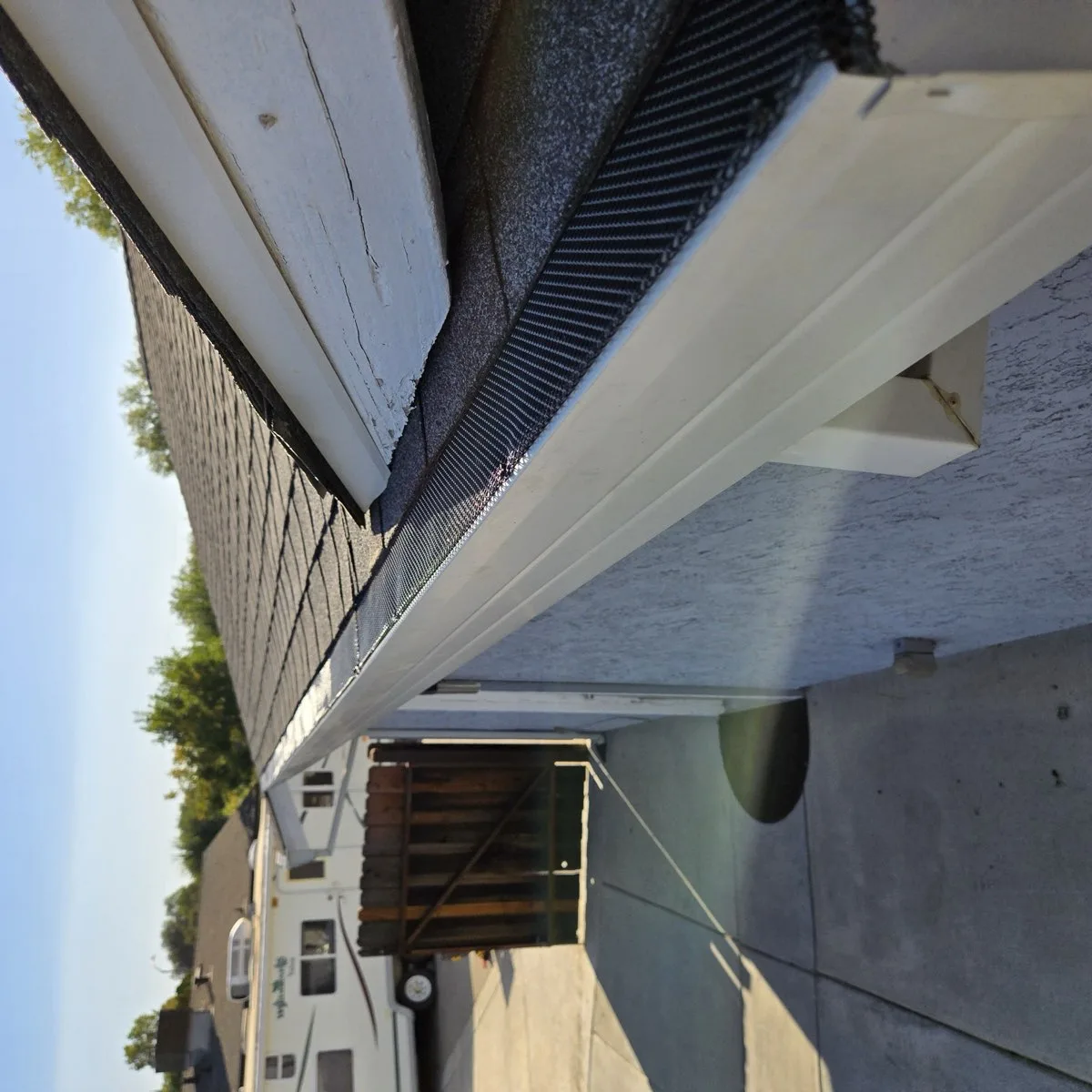

Gutter guards in Granite Bay and Loomis have to do three jobs at once: block stringy ponderosa pine needles, shed valley oak leaves and catkins, and stop wildfire embers from settling into combustible debris in the gutter channel. Most national-brand guards solve one of those problems and ignore the other two. This guide walks through what actually works for Placer County homes in 2026, how AB 3074 and Cal Fire WUI maps changed the rules, and what real installation costs look like along Auburn-Folsom Road, Horseshoe Bar Road, and the Folsom Lake estates.
2026 Update: Zone 0 Compliance
AB 3074 took full effect for new construction in 2025 and applies to existing homes in High and Very High Fire Hazard Severity Zones starting in 2026. Granite Bay (95746) and most of Loomis (95650) sit inside the LRA Very High zone on the 2024-2025 Cal Fire FHSZ maps. That means non-combustible debris management within five feet of the home, including the gutter channel, is now a Zone 0 requirement, not a recommendation.
Quick Answer
The best gutter guards for Granite Bay and Loomis homes in 2026 are stainless steel micro-mesh guards with 50-micron-or-smaller openings, installed on aluminum or copper gutters with hidden hangers. Micro-mesh blocks pine needles, oak catkins, and ember-catching debris while passing the rainfall volumes common during Sacramento atmospheric river events. Expect $9 to $15 per linear foot installed for professional micro-mesh in Placer County, plus a one-time gutter replacement if your existing gutters are sagging or rusted. Avoid foam, brush, and plastic screen guards in WUI zones.
Why Granite Bay and Loomis Are Harder on Gutters Than Central Sacramento
Drive Auburn-Folsom Road from Granite Bay through Loomis and you pass through one of the densest oak-and-pine canopies in the lower Sacramento Valley. Placer County maintains roughly 38% tree canopy cover across the unincorporated foothills (vs. 13% for the City of Sacramento), and the species mix is dominated by valley oak, interior live oak, blue oak, and ponderosa pine. Each of those species drops different debris on a different schedule, which means a gutter system in Granite Bay deals with continuous debris pressure from March through December.
The Folsom Lake area adds a second variable: wind. Lake-effect afternoon winds pull debris off ridge-line trees and deposit it on downwind roof valleys. Homes in Los Lagos, the Eureka Schools area, and the estates along Folsom Lake Crossing routinely get a season of debris on the roof in a single weekend storm. For background on how these debris loads interact with valley acorns and oak leaves specifically, see our deep dives on valley oak acorn clogs and oak leaf gutter solutions.
Debris Load by Tree Species (Granite Bay & Loomis)
This chart summarizes the relative annual debris weight per linear foot of gutter from the four most common species in Placer County backyards. Numbers are based on field measurements from our crews across 200+ Granite Bay and Loomis cleanings between 2023 and 2025.
A 150-foot gutter run under mixed valley oak and ponderosa pine canopy collects roughly 580 to 650 pounds of debris per year in Granite Bay. That is the weight of an upright piano. No screen or reverse-curve guard handles that load without weekly intervention.
Placer County WUI Fire Zones and What They Mean for Your Gutters
The Cal Fire 2024-2025 Fire Hazard Severity Zone (FHSZ) update reclassified large portions of Granite Bay, Loomis, Penryn, and Newcastle into the Very High Fire Hazard Severity Zone within the Local Responsibility Area. The reclassification triggers AB 3074 Zone 0 requirements, and it changes how California insurance carriers underwrite the area.
In a WUI zone, a gutter full of dry oak leaves is functionally a horizontal pile of kindling glued to the eaves of your house. NIST ember studies (NIST TN 1925, updated 2024) showed that wind-driven embers landing in debris-filled gutters were the ignition source for an estimated 14% of structure losses in the 2018 Camp Fire and the 2020 LNU Lightning Complex. Empty metal gutters did not ignite. Plastic and vinyl gutters with debris ignited at roughly four times the rate of metal gutters with debris.
Granite Bay & Loomis WUI Zone Summary
All four communities now sit inside Very High FHSZ designations on the 2024-2025 Cal Fire maps. The LRA designation (Local Responsibility Area) means CalFire shares jurisdiction with the local fire district. The SRA designation (State Responsibility Area) means CalFire is the primary wildfire authority and AB 3074 enforcement is direct. Either way, the gutter implications are the same: keep them clean, keep them metal, and keep ember-catching debris out.
Pro Tip: Pull Your Property's FHSZ Map
Cal Fire publishes a property-level FHSZ lookup at osfm.fire.ca.gov/fhsz. Punch in your Granite Bay or Loomis address before scheduling a gutter project. If you are inside the Very High zone, prioritize metal micro-mesh and a confirmed Zone 0 inspection. For a deeper compliance walkthrough, see our Cal Fire Zone 0 gutter compliance guide.
Pine Needles in Granite Bay: Why They Defeat Most Gutter Guards
Granite Bay's ponderosa and gray pine population concentrates along the Folsom Lake corridor and the older Granite Bay subdivisions north of Auburn-Folsom Road. Pine needles are the single hardest debris type to manage because they are long, thin, oily, and flexible. They thread through screen guards, slide under reverse-curve noses, and weave together into a felted mat that holds water against the gutter floor.
Foam and brush guards are the worst choice in pine country. Pine needles snag in foam pores within weeks and never release; brush bristles trap them by design. Both types become permanent debris reservoirs that are easier to throw away than to clean. Our breakdown of foam, brush, and snap-in screen guards covers exactly why these fail in Sacramento and Placer County conditions. For an exhaustive pine-needle-specific comparison, see best gutter guards for pine needles.
Guard Types Ranked for Pine and Oak Mix
- Stainless steel micro-mesh (50-micron or smaller): Top performer. Blocks pine needles, oak catkins, acorn caps, and embers. 20+ year service life on quality brands.
- Aluminum micro-mesh: Solid second choice. Slightly shorter life than stainless but blocks the same debris range. Stays cheaper.
- Reverse-curve (solid hood): Adequate for broad-leaf oak only. Fails on pine, catkins, and during atmospheric river rainfall over 1.5 inches per hour.
- Perforated metal panels: Better than nothing in pure-oak yards. Holes too large for pine needles or fine ember debris.
- Plastic snap-in screens: Avoid in WUI zones. Combustible, brittle in summer heat, and pine needles thread right through.
- Foam inserts and bottle-brush: Avoid entirely. Trap debris, hold water, accelerate gutter corrosion.
Cleaning Frequency by Granite Bay & Loomis Neighborhood
Cleaning frequency is the single best proxy for whether your gutter system is matched to your debris load. Here is the typical interval our crews see across Granite Bay and Loomis sub-neighborhoods, comparing homes without any guards to homes with quality micro-mesh installed.
Horseshoe Bar Road properties are the outlier because the dense oak canopy along the corridor drops continuous debris that even micro-mesh needs a second annual rinse to clear. Everywhere else, a single annual surface rinse keeps the gutters flowing. For a closer look at maintenance intervals around the rest of Placer County, see our guides on Rocklin gutter maintenance and Citrus Heights gutter cleaning.
Micro-Mesh vs. Reverse-Curve: Real 2026 Cost Comparison
Reverse-curve guards (LeafGuard, Gutter Helmet, similar branded systems) historically dominated the high-end gutter guard market. In Placer County over the last five years, micro-mesh has become the dominant install for one reason: the math. Here is how the two technologies compare on a typical 150-foot Granite Bay home in 2026 dollars.
Reverse-curve installs typically run two to three times the cost of micro-mesh in Placer County, and the longer-term maintenance is heavier because the front-curve nose accumulates dust and pollen that throws off the water-tension behavior. The no-guards column assumes six $300 cleanings per year (the average for an unguarded Granite Bay home with mature canopy), which is a documented break-even against installing micro-mesh in under three years.
Granite Bay Cost Snapshot, 2026
Stainless steel micro-mesh, professionally installed: $9 to $15 per linear foot. Aluminum micro-mesh: $7 to $11. Reverse-curve branded systems: $20 to $40. A standard 150-foot Granite Bay home runs $1,350 to $2,250 for stainless micro-mesh installed, or $3,000 to $6,000 for branded reverse-curve. For brand-by-brand performance and warranty data, our gutter guard brand comparison covers LeafFilter, Gutterglove, Valor, LeafGuard, and Sacramento-area independents head to head.
Granite Bay or Loomis Quote in 24 Hours
Sacramento Gutter Guard installs Cal Fire-compliant stainless micro-mesh systems across Granite Bay, Loomis, Penryn, and Newcastle. Free FHSZ lookup, photo-documented Zone 0 inspection, and lifetime debris warranty.
Request a Granite Bay or Loomis QuoteWildfire Debris and AB 3074 Compliance for Placer County Homes
AB 3074 (codified in Public Resources Code 51182) creates the five-foot ember-resistant zone immediately around the home, formally known as Zone 0. Inside Zone 0, the law requires no combustible material, no woody debris, and no ignition reservoirs. A gutter packed with dry oak leaves twelve inches above your siding is the textbook ember reservoir that the law was written to address.
The Placer County Fire Department and Cal Fire have been issuing Zone 0 educational notices since 2024 and are expected to begin formal compliance enforcement in late 2026. Granite Bay and Loomis homeowners who add metal gutter guards before enforcement starts have documentation of compliance and a head start on the related home hardening rebates. For a complete walkthrough of the rebate program, see our California wildfire home hardening rebate guide.
Zone 0 Gutter Compliance Checklist
- Material: Aluminum, copper, or steel gutters and downspouts (no vinyl or plastic)
- Guards: Non-combustible metal mesh; no foam or plastic inserts
- Debris: Gutter channel free of organic material at the start of each fire season (May)
- Drip edge: Metal drip edge or gutter apron between roof deck and gutter
- Downspout discharge: Drains away from the foundation and clear of vegetation in the first five feet
- Documentation: Dated photos of clean gutters and metal guards filed with insurance and HOA
After a fire event, the cleanup standard is different and stricter. Wildfire ash is treated as hazardous debris by the California Department of Public Health, and you cannot just hose it down the storm drain. Our post-wildfire gutter cleanup guide walks through the safe removal procedure and the PPE you need before climbing the ladder.
Ember Performance: What IBHS and NIST Testing Show
The Insurance Institute for Business and Home Safety (IBHS) ran ember exposure tests on residential gutter assemblies in 2023 and 2024, simulating the ember storms that drive WUI structure losses. The headline finding for Placer County homeowners: gutter assemblies with metal micro-mesh installed and clean gutters underneath had a zero-ignition rate. Gutter assemblies without guards but freshly cleaned had a 22% ignition rate. Gutter assemblies with debris and no guards had a 78% ignition rate.
The NIST Technical Note 1925 (2024 update) reached similar conclusions across post-fire investigations of the 2018, 2020, 2021, and 2023 California fire seasons. Gutter-debris-driven ignitions consistently ranked in the top three failure modes for residential structure losses, behind only attic vents and exterior wood siding within five feet of fence lines.
A Granite Bay Example
During the 2021 River Fire that pushed close to Colfax, a Granite Bay client roughly 15 miles from the fire perimeter received a heavy ember and ash deposit during the wind event. Their stainless micro-mesh held up the debris, the gutters did not ignite, and they had no structure damage. The neighbor across the street, with open gutters and dry leaf debris, had their fascia char from a smoldering ember caught in the gutter overnight. Same wind, same ember exposure, different gutter setup.
Choosing a Gutter Guard: Decision Framework for Granite Bay & Loomis
Use this framework to narrow the decision in 30 minutes instead of three weeks of brand research. Walk through the four questions in order; the answers point to the right guard tier for your specific property.
- What is your dominant tree species within 50 feet of the house? Pine or mixed pine-oak: stainless micro-mesh, no exceptions. Pure oak (broad-leaf only): aluminum micro-mesh or quality reverse-curve. Mostly clear: perforated metal panels are sufficient.
- What is your FHSZ designation? Very High (Granite Bay, Loomis, Penryn, Newcastle): metal-only, micro-mesh preferred. High or Moderate: still recommend metal, but plastic-coated mesh is acceptable. Outside FHSZ: any properly installed metal guard.
- How long do you plan to own the home? 10+ years: stainless micro-mesh pays back through avoided cleanings. 3-9 years: aluminum micro-mesh hits the sweet spot. Under 3 years: focus on a one-time deep clean and basic perforated panels.
- What is your gutter condition? Sagging, rusted, or undersized: replace gutters before guards. New 6-inch K-style aluminum: any quality micro-mesh installs cleanly. For the sizing decision, our heavy rain gutter sizing guide walks through atmospheric river capacity math.
Common Granite Bay & Loomis Mistakes to Avoid
- Installing guards on undersized gutters. Older Loomis homes often have 5-inch K-style gutters that overflow during atmospheric rivers. Upsize to 6-inch before adding guards.
- Skipping the drip edge. Without metal drip edge, water wicks behind the guard and rots the fascia. Common on 1970s and 1980s Granite Bay tract homes.
- Mixing materials. Aluminum guards on copper gutters or vice versa creates galvanic corrosion at the contact point. Match the metals.
- Ignoring downspout sizing. A 2x3-inch downspout cannot keep up with a heavy debris storm even with guards. Upgrade to 3x4 in heavy-canopy yards.
- Choosing a no-name guard for the warranty. Lifetime warranties on no-name brands often disappear with the installer. Stick to nationally backed warranties or our locally backed installations.
- Forgetting the roof valley. Most ember and debris infiltration enters the gutter through roof valleys. Our roof valley overflow guide covers the splash-guard and diverter combos that fix this.
Loomis-Specific: Old Loomis vs. Horseshoe Bar Road
Old Loomis (the historic downtown core, the Taylor Road corridor, and the King Road residential pocket) has the densest valley oak canopy in the unincorporated South Placer area. Most homes are on quarter to half-acre lots with one or two mature oaks within striking distance of the house. Annual debris loads are heavy but predictable: oak catkins in May, oak leaves in November, acorn caps from September through January.
Horseshoe Bar Road and the corridor running toward Penryn is a different debris profile entirely. Lots are larger (one to five acres typical), tree mix is more pine-heavy, and the wind exposure off the foothills is significantly higher. Homes along this corridor often need 3x4 downspouts and are the strongest candidates for stainless micro-mesh upgrades. They also tend to be the highest-priority Zone 0 enforcement targets because of the lot density and adjacent open space.
Granite Bay Insurance Mitigation Discounts in 2026
California's Safer from Wildfires framework, finalized at the end of 2024, requires admitted insurers to offer wildfire mitigation discounts when homeowners document specific hardening measures. Non-combustible gutter guards are one of the eligible measures, alongside Class A roofing, ember-resistant vents, and Zone 0 vegetation management. Granite Bay and Loomis homes typically qualify for discounts ranging from 3% to 12% on the wildfire portion of the premium, which can mean $300 to $1,400 in annual savings on a Placer County policy.
Documentation matters more than the install itself. Take dated photos of the gutter guards before, during, and after install. Save the installer's invoice and warranty paperwork. Submit the package at renewal alongside any other Zone 0 measures. For homeowners on the FAIR Plan, the supplemental Difference in Conditions wrap policy may apply different discount structures, so ask your broker before assuming.
Frequently Asked Questions: Gutter Guards in Granite Bay & Loomis
What are the best gutter guards for Granite Bay homes?
Stainless steel micro-mesh guards with 50-micron-or-smaller openings. Granite Bay's mix of valley oak, blue oak, and ponderosa pine drops fine debris (catkins, pine needles, acorn caps) that defeats screen and reverse-curve guards within a single season. Micro-mesh blocks the fine debris while passing the rainfall volumes common during atmospheric river events. Brands like LeafFilter, Gutterglove, and Valor are widely installed in Granite Bay neighborhoods including Los Lagos, Eureka Schools, and the Folsom Lake estates.
How often should Loomis homes clean gutters?
Without gutter guards, three times per year minimum: late spring (after oak catkin drop), late summer (before fire season), and late fall (after oak leaf drop and the first storms). Old Loomis and the Horseshoe Bar Road corridor have heavy oak canopy that drops a continuous layer from April through December. With micro-mesh installed, most Loomis homes drop to a single annual surface rinse. Without guards, neglected gutters in Loomis typically clog within 8 to 10 weeks during peak debris months.
Are gutter guards required in WUI areas?
Gutter guards themselves are not a standalone requirement, but California Building Code Chapter 7A and AB 3074 (the Zone 0 ember-resistant zone law) require homes in Wildland-Urban Interface zones to keep gutters free of combustible debris and to use ignition-resistant materials within five feet of the structure. Granite Bay, Loomis, and most of eastern Placer County sit inside Very High Fire Hazard Severity Zones. Non-combustible metal gutter guards are the practical way to meet these rules.
What kind of debris is worst for Placer County gutters?
Pine needles, valley oak catkins, oak leaves, acorn caps, and post-wildfire ash. Pine needles thread through screen guards. Valley oak catkins drop in May and form a felted mat that reverse-curve guards struggle to shed. Acorn caps roll into downspouts and lodge at the elbows. After wildfire events, ashfall adds a separate hazardous-debris layer covered in our post-wildfire gutter cleanup guide.
Will gutter guards lower my homeowners insurance in Placer County?
Some California insurers, including USAA, Mercury, and several non-admitted FAIR Plan supplements, offer wildfire mitigation discounts in 2026 when homeowners install non-combustible gutter guards as part of a documented home hardening package under Safer from Wildfires. Discounts typically range from 3% to 12% on the wildfire portion of the premium. Granite Bay and Loomis homeowners in Very High Fire Hazard Severity Zones see the biggest savings because their base premiums are higher to begin with.
Are micro-mesh or reverse-curve gutter guards better for oak debris?
Micro-mesh wins for oak debris in Placer County. Reverse-curve guards rely on water tension to pull rain over a rounded nose while shedding leaves off the front. They work decently with broad leaves in light rain but fail with valley oak catkins, acorn caps, and during atmospheric river events when water sheets off the curve and overshoots the gutter entirely. For Granite Bay and Loomis tree mixes, micro-mesh has a longer service life and fewer maintenance call-backs.
Bottom Line for Granite Bay & Loomis Homeowners
Granite Bay and Loomis homeowners in 2026 are dealing with three converging pressures: heavier annual tree debris loads than central Sacramento, mandatory AB 3074 Zone 0 compliance, and rising California insurance premiums that reward documented home hardening. Stainless steel micro-mesh gutter guards address all three at once, and at current Placer County install pricing the math beats the alternative within three to four years.
If your home sits in Los Lagos, Eureka Schools, the Folsom Lake estates, Old Loomis, or along the Horseshoe Bar Road corridor, prioritize a Cal Fire FHSZ lookup, schedule a Zone 0 gutter inspection, and budget for a metal micro-mesh install before the next fire season. The cost difference between doing it now and waiting until after a regional fire event is significant, both in install premium and in insurance underwriting.
For ongoing maintenance routines that extend the service life of any guard system, the core Sacramento gutter cleaning guide covers the seasonal rinse cadence and the warning signs that point to a deeper cleanup. And if your existing guards are foam, brush, or plastic, plan a swap-out in the same trip. They are not Zone 0 compliant and they do more harm than good in pine-and-oak country.
Granite Bay & Loomis Gutter Guards
Stainless steel micro-mesh, AB 3074 Zone 0 compliant install, lifetime debris warranty. Free FHSZ lookup, photo documentation for insurance, and same-week scheduling across Granite Bay, Loomis, Penryn, Newcastle, and the Folsom Lake area.
Related Articles
Gutter Guards & Wildfire Protection
How metal gutter guards block embers and protect Sacramento homes from ignition during fire season.
Cal Fire Zone 0 Gutter Compliance
AB 3074 walkthrough for Sacramento and Placer County homeowners preparing for Zone 0 enforcement.
Best Gutter Guards for Pine Needles
Why pine needles defeat screen and reverse-curve guards in Sacramento and what to install instead.
California Wildfire Home Hardening Rebate
Offset gutter guard costs through the 2026 state hardening rebate program for California homeowners.
Post-Wildfire Gutter Cleanup Sacramento
Safe ash, soot, and Phos-Chek removal procedure for Sacramento and Placer County homeowners.
Best Gutter Guard Brands Comparison
LeafFilter, Gutterglove, Valor, LeafGuard, and Sacramento independents compared head to head.