Quick Answer: What Causes Crepe Myrtle Gutter Problems in Sacramento?
Crepe myrtle gutter problems in Sacramento come from three overlapping issues: tiny petal drop during bloom, sticky aphid honeydew that drips into gutters all summer, and sooty mold that grows on the honeydew sugars. The result is a black, glue-like sludge inside aluminum gutters that ordinary screens cannot pass and pressure washing cannot remove without damaging seams. The fix is a 2mm stainless micro-mesh gutter guard plus an annual post-bloom degreaser rinse, ideally in mid-September after the petal drop ends. Curtis Park, Land Park, Midtown, and older Roseville and Rocklin neighborhoods see the worst conditions because crepe myrtle was the dominant ornamental street tree for decades.
Table of Contents
- The Three-Problem Stack: Petals, Honeydew, Mold
- Why Crepe Myrtle Aphids Coat Your Gutters
- Sooty Mold: The Black Stuff Inside Your Gutters
- Sacramento Neighborhoods With the Worst Crepe Myrtle Issues
- Crepe Myrtle Debris Drop Timeline
- Which Gutter Guards Handle Sticky Debris
- How to Clean Sticky Crepe Myrtle Gutters
- Long-Term Prevention Strategy
- Frequently Asked Questions
Crepe myrtle gutter problems in Sacramento aren’t a leaf-volume problem like valley oak acorns or sweetgum seed pods. They’re a stickiness problem. A single mature crepe myrtle (Lagerstroemia indica) lining a Curtis Park curb or shading a Roseville driveway hosts an aphid colony every summer. Those aphids drip a sticky sugar called honeydew onto everything below, and once that liquid reaches your gutter, it does something leaves and pods can’t: it cements the next layer of debris in place.
Crepe myrtle is one of the most-planted ornamental trees in the Sacramento region. According to the Sacramento Tree Foundation, the city’s urban canopy includes tens of thousands of crepe myrtles, with the species featured on approved street-tree planting lists across Sacramento, Roseville, Rocklin, Folsom, and Elk Grove. The University of California Statewide Integrated Pest Management Program documents the crepe myrtle aphid (Tinocallis kahawaluokalani) as one of the most common ornamental tree pests in California, and the resulting honeydew is the underlying cause of nearly every “black gutter” complaint we get in summer.
TL;DR: Crepe myrtle drops three things into Sacramento gutters: 5–10mm petals (June–September), aphid honeydew (June–September), and seed capsules plus leaves (October–January). The honeydew turns into sticky black sludge that ordinary screens can’t pass and ordinary cleaning can’t remove without a degreaser. A 2mm stainless steel micro-mesh guard plus a single post-bloom rinse handles 95% of crepe myrtle properties. Foam, brush, and powder-coated guards all fail. See professional gutter cleaning for sticky-gutter pricing in Sacramento.
The Three-Problem Stack: Petals, Honeydew, Mold
Most homeowners who call us about crepe myrtle gutters describe one of three things: black streaks running down the gutter face, a sticky residue when they touch the gutter lip, or pink and white petals visible from the ground. These aren’t three separate problems — they’re three layers of the same chain reaction.
Layer 1: Bloom Drop
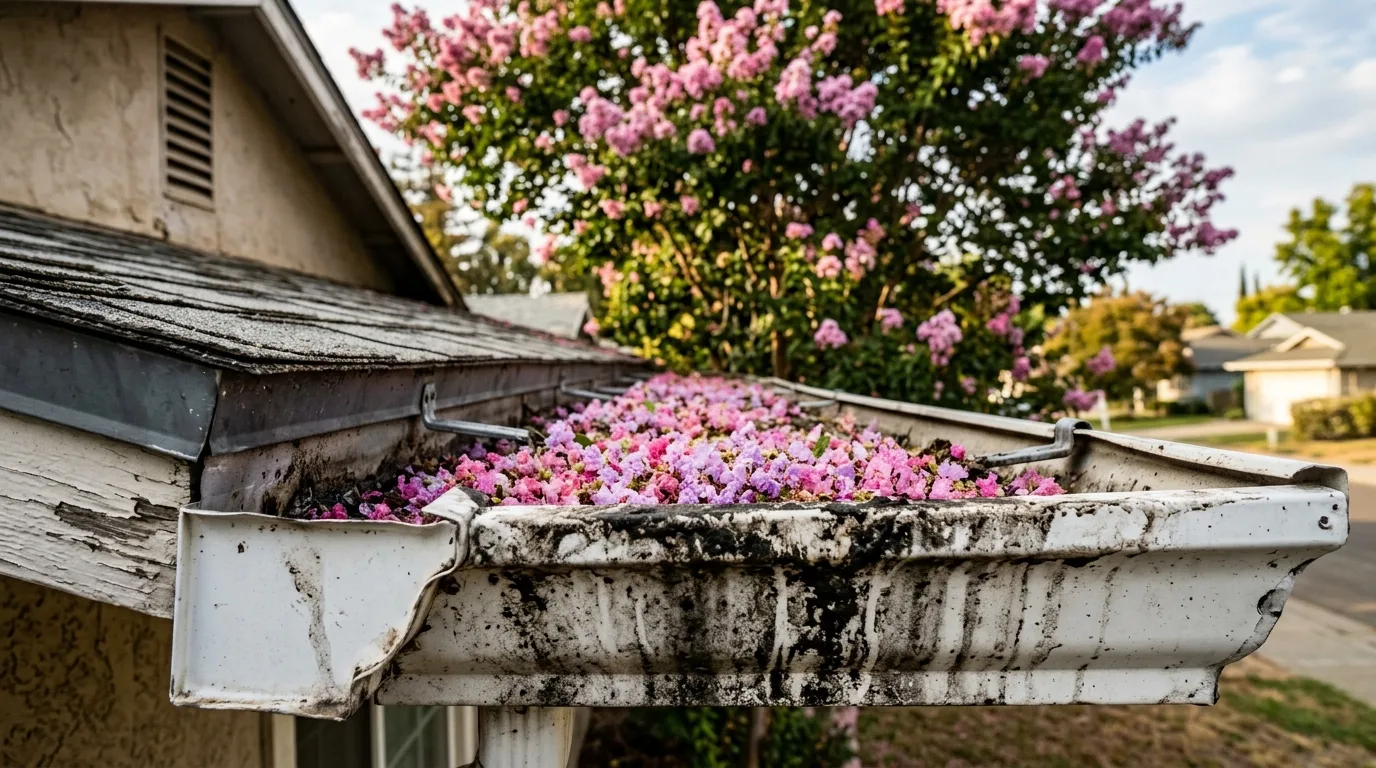
Crepe myrtle blooms in clusters of 50–200 small flowers per panicle. As each flower finishes, individual petals (5–10mm wide, papery, slightly curled) detach and fall in continuous waves from late June through early September. A mature 25-foot crepe myrtle drops millions of petals per season — enough volume to coat a roof in a pink, white, or lavender film during peak bloom.
Layer 2: Honeydew Rain
Crepe myrtle aphids feed on the underside of leaves and excrete liquid sugar all summer. On a hot Sacramento afternoon, you can stand under an infested tree and feel the mist hit your skin. That same mist coats the roof, slides down the shingles, and pools at the gutter line — turning every petal it touches into a sticky disk that adheres to aluminum.
Layer 3: Sooty Mold
Airborne sooty mold spores land on honeydew, feed on the sugars, and grow into the black film that stains gutters, fascia boards, and outdoor furniture across Sacramento every summer. The mold itself is harmless, but it signals an active honeydew supply — and it locks the petal layer beneath it into a hardened crust.
This stack is what makes crepe myrtle so different from other Sacramento debris trees. Pine needles fall and stay loose. Acorns concentrate at low points but don’t bond to anything. Sweetgum pods are bulky but inert. Crepe myrtle debris uses the honeydew as glue, layers itself with sooty mold, and over a single season turns into a black, rubbery mat that has to be scraped out with a putty knife.
Crepe Myrtle Debris & Honeydew Activity by Month (Sacramento)
Activity windows based on UC IPM crepe myrtle aphid lifecycle data and Sacramento-region arborist observations.
The dashed box over July and August is when the petal drop and honeydew flow peak together. This is the worst window of the year for crepe myrtle gutters — sticky liquid hits the gutter daily, and there’s a fresh petal layer to bond every drip into a coating. Sacramento homeowners who only clean gutters in fall miss the entire summer accumulation cycle and inherit a hardened black mat by October.
Why Crepe Myrtle Aphids Coat Your Gutters
The crepe myrtle aphid is host-specific — it lives almost exclusively on Lagerstroemia species. According to the UC IPM Pest Notes on aphids, populations build through warm spring weather and explode in summer, with multiple overlapping generations producing exponential growth. A single mature crepe myrtle can host millions of aphids by July.
Aphids feed by piercing the underside of the leaf and drawing sap. Plant sap is mostly water and dissolved sugars. Aphids retain the proteins and amino acids they need and excrete the excess water and sugar as honeydew. On a windless 100-degree Sacramento afternoon, you can hear it — a soft, irregular tapping as droplets hit roof shingles and concrete patios beneath an infested tree.
That honeydew is what creates the gutter problem. It’s sugar water with trace plant proteins, and once it dries inside an aluminum gutter, it leaves a sticky film. The film catches dust, pollen, petals, and anything else airborne. By August, the gutter interior on a heavily-aphid-infested property looks like the inside of an unwashed soda can: a brown, sticky coating that doesn’t flush out with a hose.
Pro Tip: The Sidewalk Test
On any hot summer afternoon, walk the sidewalk under your crepe myrtle and look for tacky, glossy spots on the concrete. If your shoes stick or you can see a dotted shine, you have an active aphid population overhead and your gutters are getting the same treatment from above. Sacramento concrete sidewalks under heavy crepe myrtle canopy often turn black from accumulated sooty mold over years — the same staining pattern repeats inside the gutter run, just hidden.
Sooty Mold: The Black Stuff Inside Your Gutters
Sooty mold is a category of fungi (mostly Cladosporium, Aureobasidium, and Alternaria species) that feed on sugary residues. They don’t infect plants directly — they grow on whatever surface has sugar deposits. That includes leaves, branches, fences, cars, outdoor furniture, and gutters. The black film homeowners often mistake for “mildew” or “mold from rain” is sooty mold, and the underlying cause is always honeydew.
Inside a gutter, sooty mold compounds the cleaning problem. The mold layer forms a hydrophobic surface that water beads off rather than rinsing through. So even after a Sacramento storm runs water through the gutter for hours, the black mat remains intact. We’ve pulled debris from Curtis Park gutters that were last cleaned 18 months earlier and the entire gutter interior was a continuous black ribbon — a single connected mass that lifted out like a thick rubber strip.
The Tiger Stripe Connection
The vertical black streaks Sacramento homeowners notice on aluminum gutter exteriors are typically gutter tiger stripes — a separate phenomenon caused by surface-tension water flow patterns picking up dirt and oxidation. But on crepe myrtle properties, those tiger stripes get amplified because honeydew runs down the gutter face during summer rains and feeds extra sooty mold growth on the exterior. If your gutter face is darker on the downstream side of the run, suspect crepe myrtle honeydew as the contributing factor.
Why Bleach Makes It Worse
The most common DIY mistake we see on crepe myrtle gutters in Sacramento is reaching for chlorine bleach to attack the black film. Chlorine bleach (sodium hypochlorite) reacts with aluminum, attacks the painted finish, and corrodes the zinc layer on galvanized hangers and brackets. A bleach treatment may visibly lighten sooty mold for a few weeks, but it accelerates pitting and oxidation that shortens gutter lifespan.
Oxygen bleach (sodium percarbonate, sold as OxiClean and similar products) is aluminum-safe and effective against sooty mold. It releases hydrogen peroxide on contact with water, which breaks down the mold biomass without corroding metal. For interior gutter cleaning on crepe myrtle properties, oxygen bleach plus a soft brush is the right tool.
Sacramento Neighborhoods With the Worst Crepe Myrtle Gutter Issues
Crepe myrtle distribution in Sacramento follows the planting decisions of city forestry departments and homebuilders going back to the 1970s. The species was promoted heavily as a drought-tolerant ornamental, and entire neighborhoods used it as the dominant street or median tree. Based on our service data and city tree planting records, these are the highest-risk areas for crepe myrtle gutter problems.
- • Curtis Park — Crepe myrtle is one of the dominant ornamental street trees in Curtis Park, planted alongside the historic mixed canopy. Bungalow rooflines sit close to the street, so curbside crepe myrtles drop directly onto front gutters.
- • Land Park — Mature crepe myrtles share canopy space with valley oaks. Properties get the worst of both worlds: spring through fall sticky residue plus fall acorn drop. We do a lot of summer degreaser cleans in this neighborhood.
- • Midtown (the Grid) — City planted crepe myrtles in the parking strips of many Midtown blocks for the summer color show. Honeydew on parked cars is a constant complaint — same residue is hitting the gutters.
- • East Sacramento — Older sections have heritage crepe myrtles, including some 60+ year-old specimens that produce massive bloom volumes. The Fab 40s area has both crepe myrtle street trees and yard trees planted by homeowners.
- • Carmichael and Fair Oaks — Older subdivisions used crepe myrtle as a street tree on cul-de-sacs and through-streets. The combination with mature oak canopy creates layered debris year-round.
- • Roseville (Older Subdivisions) — Roseville approved crepe myrtle as a street tree species for decades, and pre-2000 subdivisions in central Roseville often have crepe myrtle as the dominant ornamental. See our Roseville gutter cleaning guide for local pricing and frequency advice.
- • Rocklin and Lincoln — Newer master-planned communities planted crepe myrtle heavily as front-yard accent trees. The trees are now 15–25 years old — right at the size where bloom volume and aphid populations peak.
- • Folsom and Elk Grove (Newer Subdivisions) — Builder-planted crepe myrtle is common across both cities. Same pattern as Rocklin: trees are mature enough now to create real gutter problems.
The unifying pattern: any Sacramento-region neighborhood with crepe myrtle as a dominant ornamental will have crepe myrtle gutter problems. The species is too widespread to avoid, and the aphid is host-specific to crepe myrtle, so wherever the trees are, the honeydew follows.
Crepe Myrtle Debris Drop Timeline by Component
Crepe myrtle generates four distinct debris components, each with its own drop window and gutter impact. Knowing which one is hitting your gutter at any given month is what determines the right cleaning or guard strategy.
| Debris Type | Drop Window | Size | Gutter Impact |
|---|---|---|---|
| Petals | Late June – Early September | 5–10mm | Bond to honeydew, form sticky mat |
| Honeydew | June – Mid-September | Liquid film | Adhesive base layer; feeds sooty mold |
| Seed Capsules | October – December | 8–13mm | Pass through 1/4″ screens; lodge in 2x3 downspouts |
| Leaves | November – January | 25–75mm | Standard leaf debris; bond to honeydew residue if present |
The timing matters because each component requires a different response. Honeydew is best handled with a mid-summer rinse before the petal drop layers in. Petals are best handled with a 2mm micro-mesh that blocks them at the surface. Seed capsules are small and round — they pass through screen guards and lodge in downspouts, so a fine mesh or downspout strainer is the fix. Leaves are the easiest of the four to handle.
Sticky Black Gutters from Crepe Myrtle?
We handle crepe myrtle properties across Curtis Park, Land Park, Midtown, East Sac, Roseville, and the broader Sacramento metro. Free on-site assessment includes degreaser-clean pricing and 2mm stainless micro-mesh guard quotes for sticky-debris properties.
Which Gutter Guards Handle Crepe Myrtle Sticky Debris
Standard gutter guard advice doesn’t translate well to crepe myrtle properties because the dominant problem isn’t solid debris — it’s adhesive residue. A guard has to do two things: block the petals and seed capsules at the surface, and resist sticky honeydew accumulation on the mesh itself. Here’s how each major guard type performs.
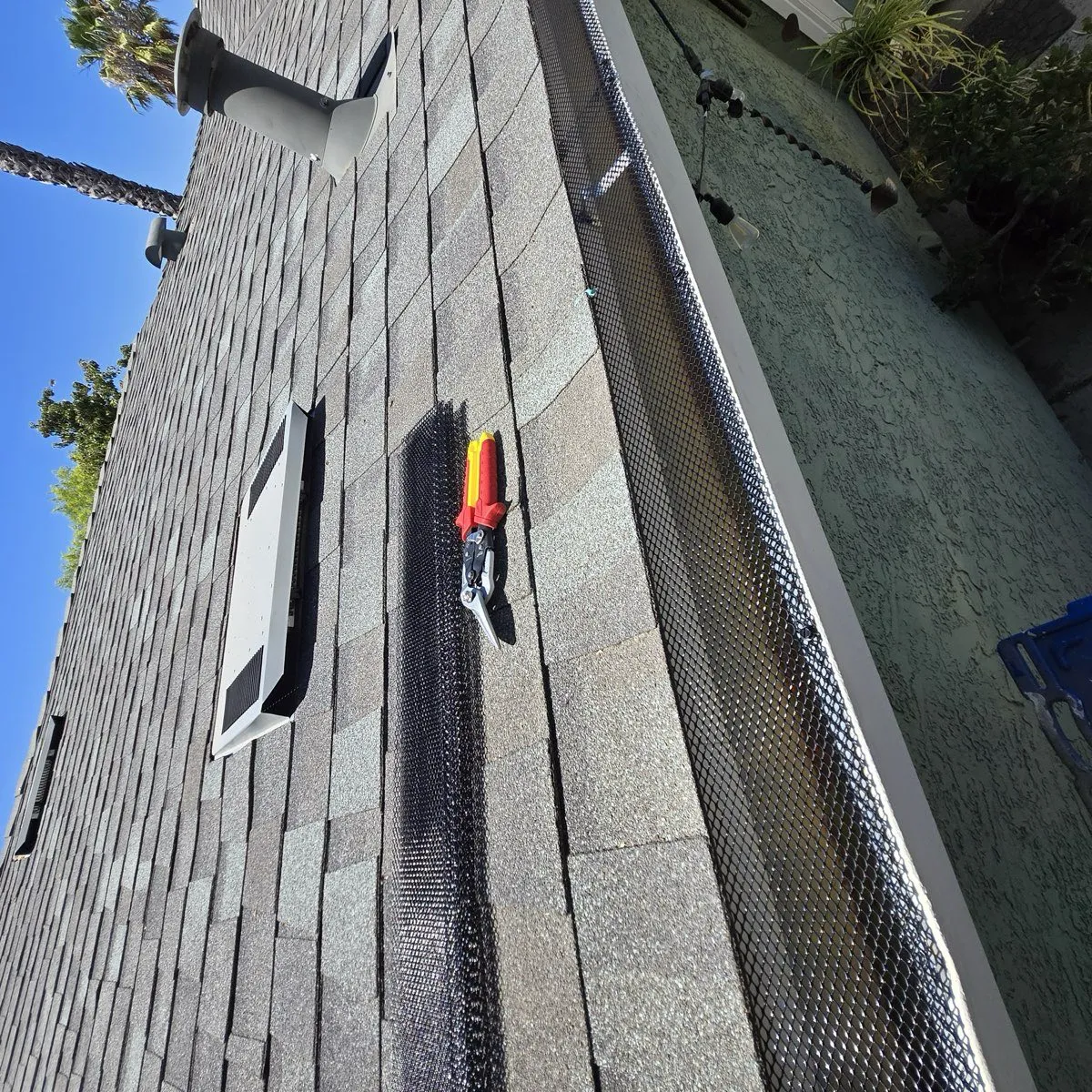
- Stainless steel micro-mesh (1.5–2mm) — The recommended solution. Mesh blocks petals and seed capsules entirely. Honeydew lands on the smooth stainless surface, beads with rainwater, and washes off with normal storms. A single annual rinse with a hose and a soft-bristle brush in mid-September clears the post-bloom residue. Stainless steel doesn’t corrode from oxygen bleach treatments, so deep cleaning is safe if needed.
- Stainless steel micro-mesh (275 micron) — Even finer mesh sold for pine needles and pollen. Works for crepe myrtle but accumulates honeydew film faster on the smaller openings. Not necessary for crepe myrtle alone — the 1.5–2mm range is the sweet spot. Useful if your property has both crepe myrtle and pine needles.
- Powder-coated aluminum micro-mesh — The painted finish on aluminum mesh holds honeydew more aggressively than bare stainless. Sooty mold grows on the painted surface and creates a permanent darkening over 2–3 seasons. For crepe myrtle properties specifically, choose stainless over powder-coated aluminum even if the price is higher.
- Aluminum screen guards (1/8″ and 1/4″) — Block leaves but pass petals and seed capsules through. The screens themselves accumulate sooty mold from honeydew flow. Within one summer, a Curtis Park screen guard turns black on the surface and starts accumulating petals beneath. Standard screens are not a solution for crepe myrtle properties.
- Foam inserts — Catastrophic failure on crepe myrtle properties. The foam pores absorb honeydew, trap petals, and become a saturated sponge of sticky residue and sooty mold within one season. Our foam, brush, and screen guard guide documents why these fail across all Sacramento debris types — crepe myrtle is the worst case.
- Brush guards — Same problem as foam. Petals stick to bristles, honeydew coats the brush base, sooty mold colonizes the entire assembly. Removing a brush guard from a crepe myrtle property after one season requires gloves and patience. Don’t install these on sticky-debris properties.
- Reverse-curve / surface tension guards — The solid hood design works decently against debris but creates a new problem: honeydew runs down the curved surface and pools at the front slot, accelerating sooty mold growth right at the gutter mouth. The exterior of the hood can develop a permanent black band visible from the curb.
How to Clean Sticky Crepe Myrtle Gutters
If your gutters are already coated with crepe myrtle residue, here’s the step-by-step Sacramento-area pros use. This handles the sticky honeydew layer plus the petal mat plus the sooty mold film in one session. For broader cleaning advice across debris types, see our complete gutter cleaning guide.
- Dry-scoop solid debris first. Use a gloved hand or a plastic gutter scoop to remove petal mats, seed capsules, leaves, and any pine needles or oak debris that mixed in. Bag everything — do not let it fall into landscape beds where the seed capsules can sprout.
- Mix the degreaser solution. Combine 1/2 cup oxygen bleach (OxiClean or equivalent) with 1 gallon of warm water in a 5-gallon bucket. Add a tablespoon of Dawn dish soap. Do not use chlorine bleach.
- Apply with a soft-bristle brush. Brush the interior of each gutter section with the solution, paying extra attention to areas with visible black film. Let it sit for 10–15 minutes to break down the honeydew.
- Low-pressure rinse. Use a garden hose with a regular nozzle (not a pressure washer) to flush the loosened residue toward the downspout. High-pressure water can split aluminum seams and force water behind gutters into fascia — see our water-behind-gutters guide for the damage pattern.
- Inspect downspouts. Run the hose into each downspout opening and confirm fast drainage. Crepe myrtle seed capsules are exactly the wrong size for 2x3 downspout reducers. If flow is slow, snake the downspout from the top with a plumber’s drum auger or remove the bottom elbow and rod from below.
- Wash the gutter exterior. If sooty mold streaks are visible on the gutter face or fascia, wipe with the same oxygen bleach solution and a soft cloth. Rinse thoroughly. Avoid pressure washing painted aluminum.
- Document for next year. Note the date and the volume of debris. Curtis Park homes often need this twice a year (mid-July rinse plus October full clean). Most properties need it once in mid-September after bloom drop ends.
This routine takes 2–4 hours for an average single-story Sacramento home with 150–200 linear feet of gutter. Two-story homes or homes with high-pitch roofs are not safe DIY territory — see our two-story gutter cleaning guide for safety considerations and professional pricing.
Long-Term Prevention Strategy for Crepe Myrtle Properties
The sustainable solution for any Sacramento property with mature crepe myrtles is a combined approach: tree-side pest management plus gutter-side micro-mesh guards. Tackling only one side leaves you with persistent sticky issues.
Tree-Side Tactics
Reducing the aphid population at the source reduces honeydew flow into your gutters. The UC IPM program recommends a layered approach for Sacramento-area homeowners.
- • Strong water sprays — Knock aphids off branches with a hose every 7–10 days during peak season. Disrupts the population without chemicals.
- • Beneficial insects — Lady beetles, lacewings, and parasitic wasps prey on crepe myrtle aphids. Avoid broad-spectrum pesticides that wipe out beneficials.
- • Insecticidal soap or horticultural oil — Targeted treatments applied to leaf undersides during early aphid buildup. Less effective once populations explode in July.
- • Selective pruning — Thin the canopy to reduce aphid habitat and improve air circulation. Avoid “crepe murder” topping cuts — light shaping is sufficient.
- • Aphid-resistant cultivars — If you’re planting new crepe myrtles, choose USDA-developed Lagerstroemia x indica hybrids (the “Native American series” cultivars like Natchez, Tuscarora, Tonto) which show meaningful aphid resistance compared to older varieties.
Gutter-Side Tactics
Even with active aphid management, some honeydew will reach your gutters. The gutter-side defense is a 2mm stainless steel micro-mesh installed before the spring aphid buildup begins.
- • Install timing — Best installed in March or April before aphids emerge. Worst time is mid-summer when existing residue must be removed first.
- • Mesh material — Stainless steel only, not powder-coated aluminum. The smooth metal surface releases honeydew during rain instead of holding it.
- • Annual rinse — One mid-September hose-and-brush session clears post-bloom residue. Takes 20–40 minutes for an average home.
- • Downspout strainers — $3–$8 wire baskets at each downspout top catch any seed capsules that slip past damaged mesh sections.
- • Inspect after major heat events — Sacramento heat domes drive honeydew production. After three consecutive 105°F+ days, check for sooty mold buildup and rinse if visible.
Annual Maintenance Cost: Crepe Myrtle Property by Strategy
Annual maintenance cost reflects ongoing labor and rinse expenses, not initial guard install. Sacramento metro pricing 2026.
Curtis Park Bungalow: Before and After
A 1925 Curtis Park bungalow with three mature curbside crepe myrtles was paying for one fall gutter cleaning per year ($175). By August 2024, the owner noticed black streaks running from gutter joints onto the white fascia and a strong sticky-shoe situation on the front sidewalk. Inside the gutters: a continuous 12-foot black mat of compacted petals and sooty mold, with two seed-capsule plugs in the 2x3 downspouts.
Total remediation included a degreaser deep-clean ($375), fascia and gutter exterior wash ($150), and 2mm stainless micro-mesh installation on 145 linear feet ($3,800). Annual maintenance has been a single 30-minute rinse each September since. No more sticky shoes. No more black streaks. Total fall 2024 spend: $4,325. Calculated payback against avoided cleaning costs and one prevented fascia-rot incident: 4 years.
Frequently Asked Questions
Do crepe myrtles clog gutters?
Yes. Crepe myrtle (Lagerstroemia indica) drops three different waves of debris into Sacramento gutters across a six-month window. Tiny petals fall from June through September during bloom, then small seed capsules and dry leaves drop from October through December. The bigger issue is the sticky aphid honeydew that coats the gutter interior all summer. That residue traps petals, dust, and pollen into a glue-like sludge that ordinary screen guards cannot pass. Sacramento crepe myrtles in Curtis Park, Midtown, Land Park, and Roseville street-tree corridors create some of the worst sticky-gutter conditions in the region.
How do you clean sticky gutters in Sacramento?
Sticky gutters from crepe myrtle honeydew or sooty mold need a degreaser-based wash, not just debris removal. Scoop solid debris first, then apply a diluted dish soap or oxygen-bleach solution and let it sit for 10 to 15 minutes to break down the honeydew film. Rinse with low-pressure water (high pressure damages aluminum seams). Avoid chlorine bleach, which corrodes aluminum and zinc components. For black sooty mold staining the gutter exterior, an oxygen bleach plus soft-bristle brush will lift it without harming the paint finish. Most Sacramento homeowners with mature crepe myrtles need this degreaser clean at least once during summer plus a standard fall cleaning.
What causes black mold in gutters?
Black mold inside Sacramento gutters is almost always sooty mold, a non-pathogenic fungus that grows on aphid honeydew. Crepe myrtle aphids, scale insects, and whiteflies excrete a sugary liquid called honeydew onto leaves and branches. Honeydew drips into gutters, where airborne sooty mold spores feed on the sugars and form the characteristic black film. The mold itself is harmless to humans but signals an underlying pest infestation in the tree. The black streaks on aluminum gutter exteriors are also sooty mold, washed down the gutter face during rain. The mold disappears once the honeydew supply stops, but the staining can last for years if not cleaned.
When do crepe myrtles drop debris in Sacramento?
Crepe myrtles drop debris in three overlapping windows in Sacramento. Bloom drop runs from late June through early September, dumping millions of tiny petals (each about 5 to 10mm across) onto roofs and into gutters. Aphid honeydew flow peaks in July and August during the heaviest aphid populations. Seed capsule drop runs October through December as the small woody capsules ripen and fall, often pulled down by winter rain and wind. Leaves drop late, typically November through January. The combined window means crepe myrtle properties have debris and sticky residue accumulating in gutters for roughly six to seven months out of the year.
Are crepe myrtle gutter problems worse in certain Sacramento neighborhoods?
Yes. Crepe myrtle gutter problems are worst in Sacramento neighborhoods that planted crepe myrtle as the dominant ornamental street tree, particularly Curtis Park, Land Park, parts of Midtown, East Sacramento, Carmichael, and the older subdivisions of Roseville and Rocklin. The City of Sacramento and the City of Roseville both included crepe myrtle on their approved street tree lists for decades because of its drought tolerance and showy summer bloom. Lots with two or more mature crepe myrtles directly over the roofline often need summer degreaser cleans plus fall debris cleans. Newer Sacramento subdivisions in Natomas, Elk Grove, and Folsom that planted crepe myrtle as the dominant landscape tree see similar issues.
Will gutter guards stop crepe myrtle debris?
Stainless steel micro-mesh gutter guards (1.5mm to 2mm openings, or finer at 275 microns) stop crepe myrtle petals and seed capsules from entering the gutter, but the sticky honeydew residue still coats the mesh surface. The fix is a guard with a smooth, non-porous mesh (stainless steel, not powder-coated steel or porous foam) that can be hosed off in 15 minutes once a year after bloom drop ends. Foam inserts and brush guards fail completely against crepe myrtle debris because the petals stick to the foam pores and the bristles, then sooty mold grows on the trapped sugars. For Sacramento homes with mature crepe myrtles, a 2mm stainless micro-mesh paired with a yearly post-bloom rinse is the most effective system.
Ready to End the Sticky Black Gutter Problem?
We install 2mm stainless micro-mesh guards and run degreaser deep cleans for crepe myrtle properties across the Sacramento metro. Free on-site assessment, honest product recommendation, and pricing by linear foot. No pressure. No surprises.
Free estimates • Sacramento, Curtis Park, Land Park, Midtown, East Sac, Roseville & surrounding areas
Related Articles
Valley Oak Acorn Gutter Clogs
The 3-week fall window and the 2mm mesh that stops it.
Sweetgum Seed Pod Solutions
Liquidambar gum balls and the guards that actually block them.
Gutter Tiger Stripes
Why aluminum gutters develop black streaks and how to remove them.
Professional Gutter Cleaning Sacramento
What to expect, what to pay, and how to avoid the bad operators.
Eucalyptus Bark, Leaves & Gum Nuts
The fire-risk debris most Sacramento homeowners ignore.
Foam, Brush & Screen Guards
Why cheap DIY gutter guards fail in Sacramento.
Serving Sacramento-Area Crepe Myrtle Neighborhoods
We install 2mm micro-mesh guards and run degreaser cleans across Sacramento’s crepe myrtle corridors — Curtis Park, Land Park, Midtown, East Sacramento, Carmichael, and Roseville — plus the broader metro service area below.