Choosing Gutter Guards in Sacramento: The 2026 Guide
Everything Sacramento homeowners need to know — guard types, costs, what works in atmospheric rivers, what to ask installers, when to skip the upgrade.
Quick answer
Most Sacramento homes benefit from premium micro-mesh gutter guards because they handle pine needles, oak leaves, and shingle grit equally well — and they survive atmospheric river rainfall intensity (3+ in/hr) without overshoot. Foam, brush, and snap-in screen guards consistently underperform in Sacramento conditions and are not worth the cost savings. Expect to pay $8–$14 per linear foot installed for premium micro-mesh — about $1,800–$4,200 for typical Sacramento homes. Most homes break even on guards within 5–8 years of avoided cleaning costs. This guide walks through every guard type, cost driver, installation pitfall, and decision criterion.
Why gutter guards matter more in Sacramento than most US markets
Sacramento sits at the intersection of two conditions that are unusual in American residential markets: year-round debris production from mature urban tree canopy, and highly concentrated winter rainfall delivered in atmospheric river events. Most US cities have one or the other. Sacramento has both.
The debris reality
Valley oaks — Sacramento’s signature street tree — drop small, thick leaves from October through January, followed by heavy acorn loads in late September and October. Blue and gray pines in foothills neighborhoods shed needles continuously, year-round. Sycamores (including London planes, the dominant street tree in midtown Sacramento) drop seed balls and bark strips from late spring through summer. Sweetgum trees produce spiked seed balls that lodge in gutter angles and corners. Shingle grit — granules shed by aging asphalt roofing — accumulates in gutters throughout the year and is one of the hardest debris types for many guard designs to handle.
The result: Sacramento gutters see debris loads that would stress a gutter system in Chicago, Atlanta, or Portland. A homeowner in most US markets can manage with annual cleaning. Sacramento homeowners with significant tree coverage often need two to three cleanings per year without guards — sometimes more.
Atmospheric river rainfall intensity
Atmospheric rivers are narrow corridors of concentrated moisture transport from the Pacific that strike the Sacramento Valley multiple times per winter season. When they arrive, rainfall intensity of 1.5–3+ inches per hour is not unusual at peak delivery. This matters enormously for gutter guard selection: some guard types (reverse-curve in particular) have a fundamental hydraulic failure mode under high-intensity rain where the water sheet overshoots the inlet and the gutter receives nothing. Sacramento’s winter storms are precisely the conditions where inferior guard designs fail first.
Foundation drainage on clay soil
The Sacramento Valley floor is predominantly clay and clay-loam soils with low permeability. When gutters overflow or downspouts discharge too close to the foundation, water pools against the slab or footings rather than soaking away. Repeated saturation and drying cycles cause clay to shrink and swell — the primary driver of foundation movement in Sacramento residential properties. Keeping gutters flowing during winter storms is a direct foundation protection measure, not just a maintenance task.
Ladder safety on two-story homes
A large share of Sacramento’s residential stock — particularly in suburbs built from the 1970s through the 2000s — is two-story construction. Accessing second-floor gutters requires ladder heights and angles that are responsible for a significant share of fall injuries nationally. For two-story homeowners, gutter guards that reduce the frequency of needed cleaning are not just a convenience — they reduce repeated exposure to the risk of ladder falls on uneven driveways, sloped ground, and wet-season surfaces.
The 5 gutter guard types — what each one is, where it shines, where it fails
Every gutter guard sold in the US fits into one of five categories. Understanding how each works — and why each fails — is the foundation of any buying decision. Here is a direct look at each type as it performs in Sacramento conditions.
Micro-mesh gutter guards
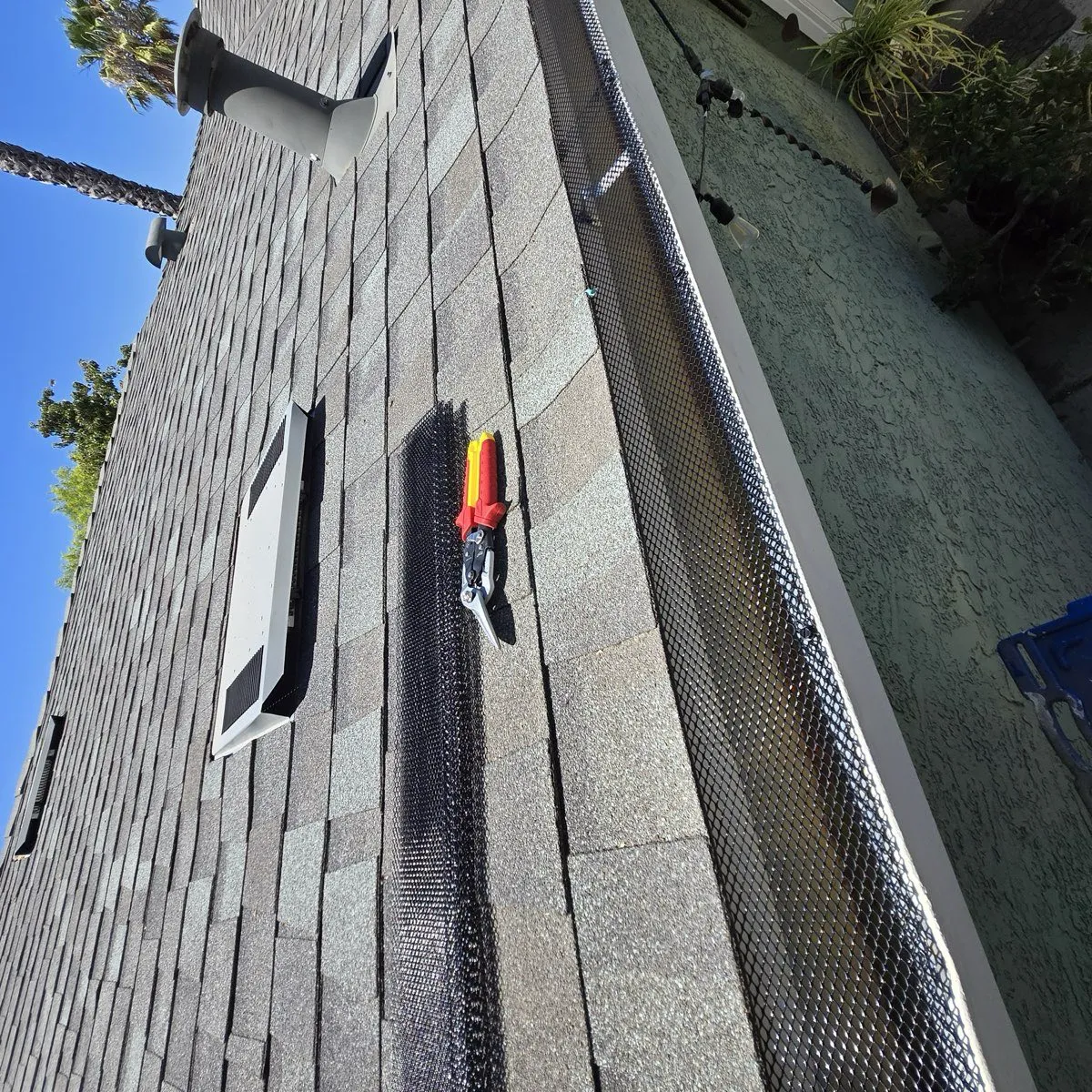
Micro-mesh guards consist of a rigid aluminum or steel frame that spans the gutter opening, with a fine stainless-steel mesh bonded to the top surface. The mesh aperture determines what passes through: 50–80 micron mesh blocks pine needles and shingle granules; 150–300 micron mesh is more flow-permissive but may admit fine debris over time. Premium products use 304 or 316 stainless steel mesh because it resists the UV degradation and corrosion that causes cheaper mesh products to degrade within a few years. Also called “stainless mesh gutter guards” or “fine mesh gutter guards.”
Installation involves sliding the back edge of the guard under the first course of shingles and securing the front edge to the gutter lip or fascia. The design handles high-flow events well because water passes through the mesh rather than around a lip — flow rate under atmospheric river conditions is substantially higher than with reverse-curve designs.
Where it shines: Sacramento’s full debris profile — oak leaves, pine needles, acorns, shingle grit, sweetgum balls — plus high-intensity winter rain. The only category that handles all of these reliably.
Where it fails: Shingle grit accumulation on the mesh surface over time can reduce flow rate if not addressed with annual light brushing. Improperly installed micro-mesh (pitched incorrectly or lifted by wind) can allow water to run behind the guard.
Lifespan: 20–25 years with premium stainless mesh. Cost range: $8–$14/lf installed (professional). DIY options: Yes — several screw-mount products available.
Reverse-curve gutter guards
Reverse-curve (also called surface-tension) guards use water’s adhesion to a curved surface. Rain hits the solid top, flows toward a curved nose, and ideally follows the curve around and drops through a narrow inlet slot at the gutter lip rather than overshooting. The design sheds large flat debris well in moderate conditions.
The Sacramento failure mode: During atmospheric river events — which routinely deliver 1.5–3+ in/hr — water gains enough momentum to overshoot the inlet slot entirely and discharge in a waterfall off the guard edge, bypassing the gutter completely. This is the worst possible outcome: full overflow during the storms that most stress your foundation and drainage system.
Pine needles, shingle grit, and sweetgum balls can enter through the slot or bridge across the curved nose, reducing effective drainage. The solid top also accumulates debris that bakes into a compacted mat during Sacramento summers.
Verdict for Sacramento: Suitable only for homes with minimal tree coverage, no pines, and a roof that does not face valley discharge concentration. Most Sacramento homes do not meet this profile.
Snap-in screen gutter guards
Snap-in screens are flat or slightly curved mesh panels — usually plastic or thin aluminum — that clip onto the gutter lip. They are the lowest-cost rung of the gutter guard market, sold in 2- to 3-foot sections at home improvement stores for a few dollars per section. Also called “gutter screens,” “plastic gutter guards,” or “clip-on gutter screens.”
Mesh aperture on snap-in screens is typically 1/8″ to 1/4″ — large enough for pine needles, shingle grit, and seed pods to pass through and accumulate below. Plastic versions warp and break snap-fit contact in Sacramento’s 100°F+ summer temperatures.
Verdict for Sacramento: Extend cleaning intervals modestly on homes with only large deciduous leaves, but not a substitute for a properly installed system. Warranty claims are rare because there is nothing to warranty. Expected lifespan under Sacramento UV: 2–5 years.
Brush gutter guards
Brush guards look like oversized pipe cleaners — a steel wire spine with polypropylene bristles radiating outward to fill the gutter cross-section. The premise: water flows between the bristles while larger debris sits on top and eventually blows away. Also called “gutter brush inserts” or “bristle gutter guards.”
In practice, the bristle matrix acts as an effective debris trap. Pine needles, seed pods, shingle grit, and decomposed organic matter work their way into the bristle core and stay there. Extraction requires removing each brush section and physically pulling debris from between the bristles — more labor-intensive than simply cleaning the gutter without a guard.
Verdict for Sacramento: Not recommended. The fine-particle debris mix that characterizes Sacramento (pine needles, shingle grit, pollen) is exactly what brush guards trap most aggressively. The cost is low upfront; the cost of removal and deep cleaning within 2–3 years is often higher than the initial savings.
Foam gutter guards
Foam guards are triangular or rounded polyurethane foam inserts that fill the gutter cavity. Water passes through the open-cell foam while debris is supposed to sit on top and blow away. Also called “gutter foam inserts” or “foam gutter filters.” They require no tools to install and cost far less than mesh or solid-cover systems.
Sacramento’s UV index (averaging 8–10 in summer) degrades standard polyurethane foam rapidly. Within one to two seasons, the foam compresses and cracks. Fine debris — pine pollen, shingle grit, seed fluff — gets trapped in the foam cells rather than passing through, and the damp, dark interior promotes mold, algae growth, and insect nesting (particularly bees and wasps). Removal of degraded foam inserts requires extracting debris-laden sections by hand and scrubbing the gutter floor of residue.
Verdict for Sacramento: Avoid. The upfront savings are consumed by accelerated degradation under Sacramento UV and the labor cost of removal within 2–4 years. Most professional contractors will not warranty work on gutters that have had foam inserts.
| Type | Installed cost | Lifespan | Pine needle perf. | AR rain perf. | DIY-friendly |
|---|---|---|---|---|---|
| Micro-mesh | $8–$14/lf | 20–25 yrs | Excellent | Excellent | Yes (some) |
| Reverse-curve | $10–$20/lf | 15–20 yrs | Poor | Poor–Fair | Rarely |
| Snap-in screen | $1–$4/lf | 2–5 yrs | Poor | Fair | Yes |
| Brush | $2–$5/lf | 3–6 yrs | Poor | Fair | Yes |
| Foam | $1–$3/lf | 2–4 yrs | Poor | Fair | Yes |
How much do gutter guards cost in Sacramento? (2026 pricing)
Premium micro-mesh gutter guard installation in Sacramento runs $8–$14 per linear foot all-in for 2026 — materials plus labor, including standard gutter cleaning before installation. Most Sacramento single-family homes fall in the 150–300 linear foot range, putting total project cost at $1,800–$4,200.
What drives cost higher
- Two-story rooflines requiring more setup time and safety equipment
- Tile roofs requiring tile hook bracket installation rather than shingle slide-under
- Roof valley complexity (additional flow and guard fitting work at valley discharge points)
- Fascia repair needed before guard installation — damaged fascia cannot support a guard
- Heavy debris accumulation requiring extended cleaning before guards go on
- Custom colors or specialty materials to match HOA requirements
DIY vs. professional installation cost
DIY-friendly micro-mesh products run $2–$4 per linear foot in materials, dropping the total to $300–$1,200 for a typical home. Labor savings are real — but so are the tradeoffs: DIY installs typically carry shorter product warranties (not lifetime), require the homeowner to clean the gutters first, and on multi-story or tile-roof homes, the safety and alignment risks are material.
For a full breakdown including cost per guard type, see our Sacramento gutter guard cost guide and the pricing page.
Will gutter guards pay for themselves?
For most Sacramento homeowners who hire out gutter cleaning, the break-even math is straightforward. Professional gutter cleaning runs $200–$350 per visit in Sacramento. Two visits per year equals $400–$700 annually. At a $2,000 install cost, you break even in under five years — and every year after that is pure savings.
Heavy tree coverage (three or more oak or pine trees over the roofline) often requires three cleanings per year, which pushes the annual avoidance figure to $600–$1,050 and cuts the break-even to 2–3 years. At the other end, single-story homes with minimal tree coverage where the homeowner cleans their own gutters see a longer break-even — potentially 8–12 years.
The calculation also changes when you factor in the cost of deferred cleaning consequences: one overflow event that saturates a fascia board costs $500–$1,500 to repair. Foundation drainage damage from repeated overflow can run $3,000–$15,000+. These avoided costs are harder to quantify but can dramatically shorten the effective payback period.
Run your specific numbers using the Sacramento gutter guard ROI calculator — enter your current cleaning frequency, cost per visit, and install quote to get a personalized break-even timeline.
7 questions to ask any Sacramento gutter guard installer
Sacramento has a mix of experienced local gutter contractors and out-of-area companies that ramp up during storm season. The questions below separate contractors who know what they are doing from those who don’t — and protect you from warranty gaps and post-install problems.
1. What guard material and brand do you install?
You want to know whether you are getting stainless steel micro-mesh on an aluminum frame (the premium standard) or something cheaper. Ask for the product spec sheet. Look for: stainless mesh grade (304 or 316), mesh aperture in microns, frame material (aluminum preferred), and country of manufacture. A contractor who can’t answer in specifics likely doesn’t install the premium tier.
2. How does this guard handle pine needles specifically?
This is a Sacramento-specific test. The correct answer is a reference to mesh aperture (50–80 micron mesh reliably blocks needles; coarser mesh may not) and a description of how needles shed off the mesh surface. If the contractor is selling reverse-curve or brush guards and cannot explain a mechanism for needle exclusion, that’s a red flag.
3. What's the warranty on the guard? On the installation?
These are separate warranties. Product warranty covers the guard material itself — degradation, mesh failure, frame corrosion. Installation (workmanship) warranty covers improper fitting, separation from the gutter, and clogging after installation. Ask for both in writing and read the exclusion clauses before signing.
4. Do you remove existing gutters or work over them?
A quality installation always starts with clean gutters. The contractor should flush the gutters before installation, inspect for leaks and slope issues, and address any problems before the guard goes on. Guards installed over dirty or improperly pitched gutters will fail faster and the contractor can avoid warranty claims by pointing to the pre-existing condition.
5. How does the guard interact with my roof warranty?
Most major shingle manufacturers permit guards installed by sliding the back edge under the first shingle course — they do not permit nailing, adhesives, or fasteners through shingles. Ask your contractor to describe their installation method relative to the shingles. If the answer involves any attachment to the shingles themselves (other than sliding under), ask for documentation that this method is approved by your shingle manufacturer.
6. What happens if my gutter clogs after installation?
The honest answer is that premium micro-mesh substantially reduces clogs but does not guarantee zero maintenance forever. What you want is a clear process: a defined warranty call-back procedure, a timeline for response, and clarity about what is covered (clogging from debris the guard should have excluded) versus what is not (mineral buildup from water chemistry, act of God debris events).
7. Are you licensed in California (CSLB #)?
California requires a C-43 (Sheet Metal) or B (General Building) license for gutter work. Ask for the CSLB license number and verify it at cslb.ca.gov. Also confirm they carry general liability and workers’ compensation insurance — the latter matters if a worker is injured on your property. For more on contractor vetting, see our guide to choosing a licensed Sacramento gutter contractor.
5 red flags when shopping gutter guards
Sacramento sees an influx of door-to-door and post-storm solicitations for gutter guard installations. Some operations deliver quality work; others rely on high-pressure tactics or structural shortcuts that leave homeowners with a poor-performing system and no recourse. These are the warning signs to watch for.
"Today only" or pressure-sale pricing
Legitimate gutter guard companies provide written quotes that are valid for a reasonable period — typically 30 days. "Call our manager to extend the discount" or "I can only hold this price until I leave your driveway" are sales tactics designed to prevent you from getting competing quotes. Any company that will not give you a written quote to compare is a company you should not hire.
Guard installed over damaged gutters without disclosure
Guards installed over leaking seams, improperly pitched gutter runs, or rotted fascia will fail — and the contractor can blame the pre-existing condition. A professional contractor inspects the gutter system before quoting and discloses any repairs needed. If a company quotes guards without mentioning gutter condition, ask specifically whether they inspected and what they found.
No CSLB license number provided
Any contractor performing gutter work in California for compensation is required to hold a CSLB license. If they cannot provide a license number on the spot, verify at cslb.ca.gov, or are vague about it, walk away. Working with an unlicensed contractor leaves you exposed to liability if a worker is injured on your property and eliminates most formal dispute resolution pathways.
Vague or verbal warranty terms
If the warranty is described verbally ("we stand behind our work") but is not defined in writing with specific terms, exclusion clauses, and response obligations, it effectively does not exist. Require the written warranty document before signing any contract. Read the exclusions: a warranty that excludes any debris accumulation is effectively a warranty on nothing.
Pricing significantly below market ($3–$5/lf total)
Premium micro-mesh installation cannot be profitably delivered at $3–$5 per linear foot all-in with quality materials and properly licensed labor. A quote in this range means one of three things: the guard material is low-grade (likely to fail within a few years), the labor is unlicensed, or the installer is planning to cut corners on the installation itself. The cost to remove and replace poor-quality guards often exceeds the original savings.
For a deeper look at scam patterns in the Sacramento market, see gutter guard scams in Sacramento.
When NOT to install gutter guards
Most Sacramento homes benefit from premium micro-mesh guards. But there are situations where guards are the wrong move — or at least the wrong move right now.
Your gutters need replacement first
Installing guards over gutters that are failing — leaking seams, incorrect pitch, pulling from the fascia — just delays the inevitable and may void the guard warranty. Fix or replace the gutters, then add guards to the new system.
Single-story home with light tree exposure
If you have a single-story home, few or no overhanging trees, and you're comfortable cleaning gutters yourself once a year, the payback period on premium micro-mesh stretches to 10+ years. Cleaning may simply be the better economics in this specific scenario.
You're selling or moving within 3 years
Guards add value and can be a selling point, but they don't pay back in 3 years at Sacramento pricing. Unless the buyer specifically values guards (and some do, particularly in fire-risk areas), you likely won't recapture the full cost in sale price.
Your roof needs replacement within 2 years
Guards installed before a roof replacement typically need to be removed by the roofing contractor and reinstalled. You pay twice for installation labor. Time your guard installation after the roof replacement if a reroofing project is imminent.
Sacramento-specific considerations
Atmospheric river performance
Atmospheric rivers are the defining weather event for Sacramento gutter systems. The National Weather Service has recorded multiple events delivering 3+ inches of rain over 24 hours in Sacramento, with peak hourly intensities exceeding 1.5 in/hr during the most active events. At this intensity, the flow rate from a 2,000 sq ft roof section exceeds 40 gallons per minute — more than most residential downspout configurations can handle at capacity, let alone with any additional guard restriction.
Premium micro-mesh guards with a correctly pitched installation handle atmospheric river flow rates well — the mesh passes water through thousands of openings simultaneously. The key variables are mesh cleanliness (a clogged mesh surface severely reduces flow) and gutter pitch (low spots concentrate flow and can overwhelm any guard design). Read more in our guide to best gutter guards for heavy rain in Sacramento.
Solar panel integration
Sacramento homes with rooftop solar panels have an additional consideration: debris accumulation in gutters below the panels can be heavier than on unobstructed sections, because panels shed fine debris — pollen, dust, shingle grit — that concentrates at the panel edge and washes directly into the gutter below. Micro-mesh guards are particularly valuable on panel-adjacent sections. The interaction between guard installation methods and solar panel racking systems varies by panel brand — confirm with both the guard installer and your solar installer that the installation approach is compatible.
For the full picture, see gutter guards and solar panels in Sacramento.
HOA color and style restrictions
Master-planned communities in Natomas, Granite Bay, Roseville, Rocklin, and Elk Grove often have CC&Rs that specify gutter and guard colors, or prohibit visible changes to the roofline profile. Premium micro-mesh guards are available in a range of anodized aluminum colors (white, bronze, mill finish, black) that typically satisfy HOA requirements. Before committing to a guard product, pull the relevant CC&R sections or submit for HOA approval, particularly for anything visible from the street. For a walk-through of the HOA approval process, see HOA gutter guard approval in Sacramento.
Historic homes (Land Park, Fab 40s, midtown)
Craftsman bungalows and Tudor Revival homes concentrated in Land Park, Curtis Park, Boulevard Park, and the Fab 40s neighborhood often have half-round gutters rather than K-style. Most micro-mesh guard systems are designed for K-style gutters and require a half-round adapter bracket for proper installation. Some half-round guard designs use a different surface-tension mechanism that performs better on the curved profile. If your home has half-round gutters, confirm with the installer that the proposed guard model has a compatible mounting solution.
Homes in designated historic districts may also face design review for exterior modifications. Check with the City of Sacramento’s Historic Preservation Office if your property is in a listed district.
Tile roof mounting
Tile roofs are common in Sacramento’s Natomas, Elk Grove, and Roseville master-planned communities. The standard micro-mesh installation method — sliding the back edge of the guard under the first shingle course — does not work with tile, which cannot be lifted without risk of cracking.
The correct approach for tile roofs uses tile hook brackets that attach to the tile itself and hold the guard frame without roof penetration or tile lifting. This adds modest labor cost and requires a contractor experienced with tile roof guard installations — not all Sacramento gutter companies are. Ask specifically about tile experience before booking.
How we install gutter guards in Sacramento
Sacramento Gutter Guard has been installing guards on Sacramento area homes since 2010. We install premium stainless steel micro-mesh guards on aluminum frames — the same category that performs best in every Sacramento condition this guide describes. We are licensed, bonded, and insured in California, carry workers’ compensation, and every project starts with a full gutter inspection and cleaning before any guard goes on.
We work on shingle roofs, tile roofs, flat-section fascia transitions, and half-round gutter profiles. We install guards on hundreds of Sacramento homes a year — across every tree coverage profile from bare suburban lots to properties ringed by mature valley oaks. Same-day quotes are available and most residential installations complete in one day.
We carry a 5.0-star rating and have maintained a licensed contractor record in California without complaint since 2010.
Frequently asked questions
What's the best gutter guard for Sacramento?
Premium micro-mesh with a stainless steel mesh (50–150 microns) on a rigid aluminum frame. Sacramento's debris profile — valley oak leaves, pine needles, acorns, shingle grit, and sweetgum balls — defeats every other guard type over time. Micro-mesh also handles atmospheric river rainfall intensity (1.5–3+ in/hr) without overshooting.
How much do gutter guards cost in Sacramento?
Premium micro-mesh gutter guards run $8–$14 per linear foot installed in Sacramento for 2026. Most homes fall between $1,800 and $4,200 total. Factors that push cost higher include two-story rooflines, tile roofs, valley complexity, and fascia repair needed before installation.
Do gutter guards work with pine needles?
Premium micro-mesh guards (50–80 micron mesh) are the only category that reliably handles pine needles. Needles slide off the smooth mesh surface. Foam, brush, snap-in screen, and most reverse-curve guards all trap or admit pine needles. If your property has significant pine trees, micro-mesh is the only type worth installing.
Will gutter guards damage my roof or void my warranty?
Properly installed micro-mesh guards should not void a standard asphalt shingle warranty. The installation method — sliding the back edge under the first shingle course without fastening through shingles — is specifically permitted by most major shingle manufacturers. Tile roof installations use tile hook brackets that attach to the tile without roof penetrations.
How long do gutter guards last?
Premium stainless steel micro-mesh guards on aluminum frames typically last 20–25 years under Sacramento conditions. The failure mode that shortens lifespan is shingle grit accumulation on the mesh surface over 10–15 years — addressable with an annual light brushing. Foam and brush inserts typically fail within 2–4 years under Sacramento sun.
Can I install gutter guards myself?
Some micro-mesh guards are designed for DIY installation and cost $2–$4 per linear foot in materials. Single-story homes with straightforward rooflines are manageable for confident DIYers. For two-story homes, tile roofs, or steep pitches, professional installation is the better choice for safety and alignment accuracy.
Do I still need to clean gutters with guards installed?
Premium micro-mesh guards dramatically reduce cleaning frequency — most Sacramento homeowners go from 2–3 cleanings per year to an annual inspection and occasional light debris removal from the mesh surface. The correct expectation is substantially reduced maintenance, not zero maintenance.
Are gutter guards worth it on a single-story home?
On a single-story home with modest tree exposure where you clean your own gutters, the break-even period can stretch to 10+ years. The value proposition is stronger with heavy tree coverage, when you hire professional cleaning, when fire season ember risk is a concern, or when ladder safety is a factor. Use the ROI calculator to run your specific numbers.
Ready for a Sacramento Gutter Guard Quote?
We install premium micro-mesh guards on Sacramento area homes every week. Licensed, bonded, and insured. 5.0 rating across 5.0-star rated. Same-day quotes available.
Since 2010 · Licensed & Bonded & Insured · 5.0 Stars · 5.0-Star Rated