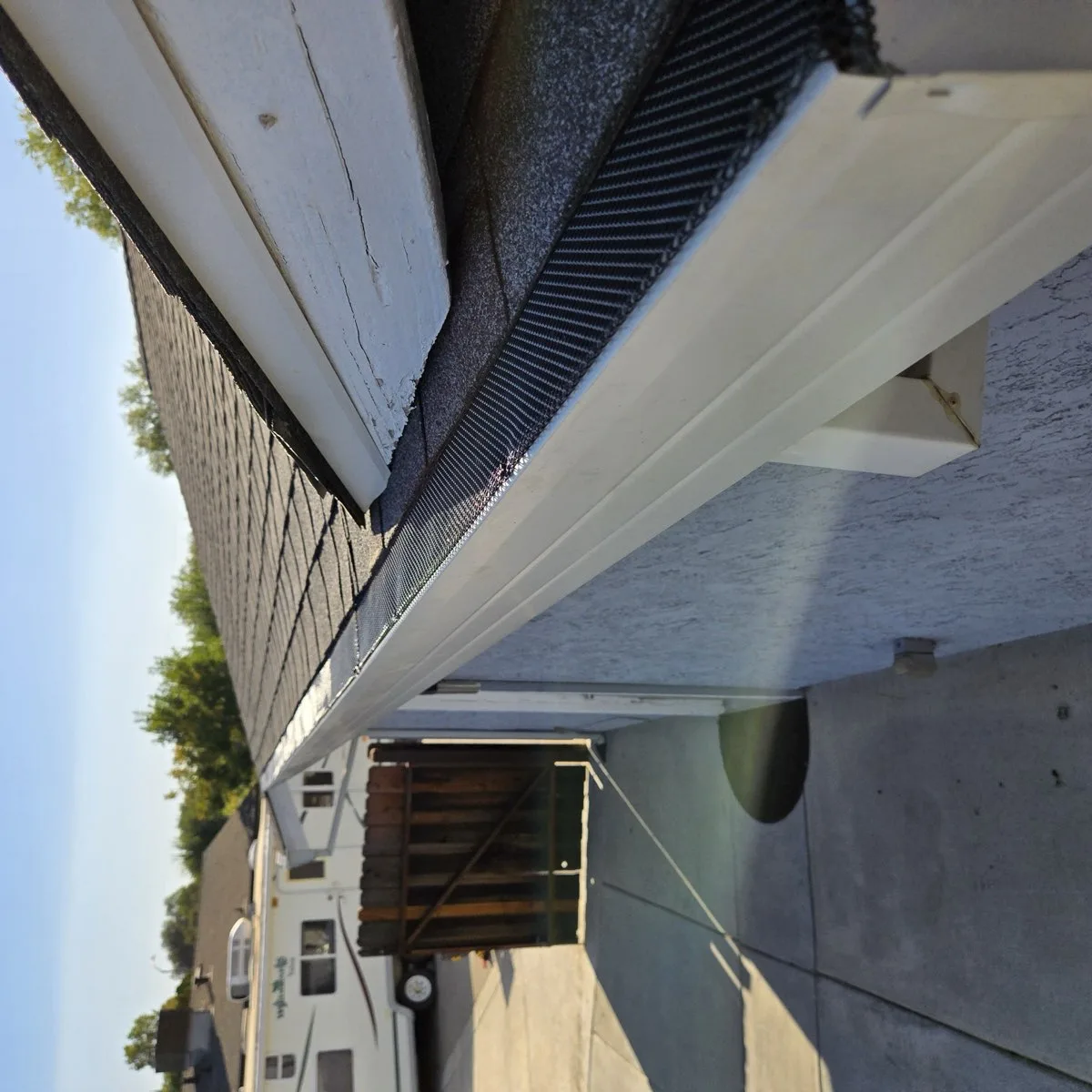
Quick Answer: Do Gutter Guards Work on Metal Roofs?
Yes, but only certain types. Metal roofs in Sacramento create two problems that standard guards cannot handle: high-velocity water runoff and thermal expansion up to 1/2 inch per 20-foot panel in summer heat. Micro-mesh guards with fascia-mounted or clamp-on brackets are the safest, most effective option for both standing seam and exposed-fastener metal roofs.
Table of Contents
- GEO Summary
- Why Metal Roofs Create Gutter Guard Problems
- Standing Seam vs Exposed-Fastener: What Changes
- Water Overshooting on Metal Roofs and How to Fix It
- Bracket Options for Metal Roof Gutter Installation
- Which Gutter Guard Types Work on Metal Roofs
- Thermal Expansion and Why It Matters in Sacramento
- Metal Roof Warranty Considerations
- Installation Process for Metal Roof Gutter Guards
- Common Installation Mistakes to Avoid
- Cost Breakdown for Sacramento Homes
- Sacramento Debris Challenges on Metal Roofs
- FAQ
Gutter guards on metal roofs require specific bracket systems, wider gutters, and guards rated for high-velocity water. In Sacramento, thermal expansion from 110°F summers and atmospheric river downpours make guard selection critical. Micro-mesh guards with clamp-on or fascia-mounted brackets are the most reliable option for both standing seam and exposed-fastener metal panels. (Sources: Metal Roofing Alliance, NRCA Technical Bulletin)
Why Metal Roofs Create Gutter Guard Problems
Metal roofs are gaining popularity in Sacramento suburbs, driven by fire resistance ratings and energy efficiency rebates from SMUD. But homeowners who install gutter guards designed for asphalt shingles discover problems within the first heavy rain. The physics are different on metal panels.
Three factors make metal roofs harder to protect with gutter guards:
- Surface friction is near zero. Water does not slow down as it rolls off a metal panel the way it does on textured shingles. Runoff velocity is 2–3 times faster, which means water can overshoot the gutter entirely.
- Thermal movement is constant. A 20-foot metal panel can expand by roughly 1/2 inch in Sacramento’s summer heat. Guards attached rigidly to both the roof and the gutter will buckle, gap, or pull fasteners loose.
- Panel profiles vary. Standing seam roofs have raised ribs every 12–16 inches. Exposed-fastener roofs have corrugated or ribbed profiles. Each type requires a different mounting strategy for both gutters and guards.
If you already experience overflow during storms, the heavy rain overflow guide covers general causes. This article focuses on the metal-roof-specific fixes.
Standing Seam vs Exposed-Fastener: What Changes
The two main metal roof types installed on Sacramento homes handle gutter guards very differently. Knowing which type you have determines the bracket system, guard mounting method, and warranty implications.
Standing Seam Panels
Raised seams lock panels together without exposed screws. Common on higher-end Sacramento homes and new builds. The seams run vertically from ridge to eave.
- • No penetrations allowed (warranty requirement)
- • Use clamp-on brackets that grip the seam
- • Panels float on clips, allowing thermal movement
- • Higher material and labor cost
Exposed-Fastener Panels
Screws go through the panel face into purlins. Common on agricultural buildings, shops, and budget-friendly residential installs in the Sacramento valley.
- • Panels are fixed, so thermal movement stresses screws
- • Standard fascia-mounted brackets work in most cases
- • Easier to install gutter guards because of simpler edge profile
- • Lower material cost but shorter lifespan
Standing Seam vs Exposed-Fastener: Guard Compatibility
If you are not sure which panel type is on your home, look at the roof edge. Standing seam panels have clean, raised ridges with no visible screws. Exposed-fastener panels show rows of screws across the panel face. If you have a tile roof rather than metal, the gutter installation approach is completely different — see our tile roof gutter installation guide instead.
Water Overshooting on Metal Roofs and How to Fix It
Water overshooting is the most common gutter problem on metal roofs in Sacramento. During an atmospheric river event, smooth metal panels channel rain into high-speed sheets that launch past the gutter lip. The problem is worst at valleys, where two roof planes converge and concentrate flow.
Sacramento receives about 90% of its annual rainfall between October and April, and atmospheric river storms can dump 2–4 inches in a single day. On an asphalt shingle roof, granules slow the water. On metal, nothing does.
Five Fixes for Water Overshooting
- Upgrade to 6-inch gutters. The extra inch of width catches water that a standard 5-inch gutter misses. On steep metal roofs, 7-inch half-round gutters are sometimes necessary.
- Install splash guards at valleys. Sheet metal diverters at valley intersections redirect concentrated flow into the gutter instead of over it.
- Lower the gutter position. The front lip of the gutter should sit below the plane of the roof edge. If the gutter is level with or above the drip line, fast water will overshoot.
- Add a rain diverter strip. A small metal strip fastened along the roof edge breaks the water sheet into droplets before it reaches the gutter. This slows velocity without affecting roof appearance.
- Choose guards with a raised intake angle. Flat-mounted guards catch less water on metal roofs. Guards angled slightly upward at the front intercept fast-moving runoff.
Water Runoff Velocity by Roof Type (Relative Scale)
Pro Tip
If you see staining on the fascia or siding below a valley, water is already overshooting. Mark those spots before calling a contractor so they can prioritize splash guard placement during the install.
Bracket Options for Metal Roof Gutter Installation
The bracket system is where most metal roof gutter installations succeed or fail. Brackets must hold the gutter securely while allowing the roof to move. In Sacramento, where daytime summer temperatures push metal panel surfaces past 150°F, thermal expansion is not optional to plan for — it is guaranteed.
| Bracket Type | Best For | Thermal Movement | Warranty Safe? |
|---|---|---|---|
| Clamp-on seam brackets | Standing seam roofs | Slides with panel | Yes — no penetrations |
| Fascia-mounted hidden hangers | Exposed-fastener roofs | Independent of roof | Yes — mounted to fascia only |
| Roof-strap hangers | No fascia or weak fascia | Limited — straps move with roof | Depends on attachment |
| Through-panel screws | Not recommended | None — fights expansion | No — voids most warranties |
For standing seam roofs, S-5! and SnoBlox are two widely used clamp manufacturers that make non-penetrating seam clamps in multiple sizes. The clamp grips the raised seam and supports a hanger rod or bracket arm for the gutter. This approach preserves the roof warranty and allows the panel to slide freely during thermal cycling.
For exposed-fastener roofs, standard fascia-mounted hidden hangers work well because the gutter is attached to the house structure, not the roof. This is the same mounting approach used on asphalt shingle homes. Read the installation mistakes guide for common hanger errors on any roof type.
Which Gutter Guard Types Work on Metal Roofs
Not every gutter guard design works on metal roofs. The fast water runoff and thermal movement eliminate several popular options. Here is how each major guard type performs on metal roofs based on our Sacramento installations.
Micro-Mesh Guards (Recommended)
Fine stainless steel mesh over an aluminum frame. Handles fast water, blocks pine needles and shingle grit (not a factor on metal roofs, but relevant if you have neighboring shingle roofs shedding granules).
Best choice for Sacramento metal roofs.
Perforated Aluminum Guards
Solid aluminum with punched holes. Handles moderate water flow and works on exposed-fastener roofs. Less effective at blocking small debris like pine needles.
Acceptable for low-debris metal roofs.
Surface-Tension (Reverse Curve)
Relies on water adhesion to curve into the gutter. Fails on metal roofs because water moves too fast to follow the curve. Overshooting is common, especially during storms.
Not recommended for metal roofs.
Foam Inserts & Brush Guards
Sit inside the gutter. They slow water flow but trap debris and deteriorate faster in Sacramento’s UV-intense summers. Metal roof heat accelerates foam breakdown.
Not recommended for metal roofs.
For a deeper comparison of guard materials and performance data, see the gutter guard materials comparison. If you want to evaluate specific products, the best gutter guard brands comparison ranks options by performance and cost. For how different materials hold up in Sacramento weather specifically, the gutter guard materials guide has local performance data.
Thermal Expansion and Why It Matters in Sacramento
Sacramento’s climate is uniquely challenging for metal roofs. Summer surface temperatures on metal panels regularly exceed 150°F, and overnight lows can drop 40–50 degrees. That daily thermal cycle causes expansion and contraction that tears apart rigid attachments.
According to the Metal Roofing Alliance, a steel panel expands approximately 1/8 inch per 10 feet for every 100°F temperature change. Aluminum panels expand about 50% more than steel. In Sacramento, where a summer day can swing from a 60°F morning to a 110°F afternoon, a 20-foot aluminum panel can grow by roughly 1/2 inch.
Thermal Expansion per 20-ft Panel in Sacramento Summer (Daily Cycle)
This is why rigid guard attachments fail in Sacramento. A guard screwed to both the metal panel and the gutter front lip will eventually gap, buckle, or tear out fasteners. The solution is to mount the guard to the gutter only, or use a floating clip system that allows the guard to shift independently.
Pro Tip
If your metal roof panels are aluminum, thermal expansion is the highest of any common roofing metal. Use guards mounted only to the gutter lip — never to the roof panel. If the guard manufacturer says to attach to the roof edge, that product is not designed for metal roofs.
Metal Roof Warranty Considerations
Metal roof warranties are more restrictive than shingle warranties about what you can attach to the roof. Any penetration — drill holes, screws, rivets — through a standing seam panel will void most manufacturer warranties. Adhesive-based attachments also void warranties because they trap moisture and can corrode the coating.
The safe path is clear: mount gutter guards to the gutter, not the roof. If the guard system needs support from the roof edge, use non-penetrating clamp-on brackets designed for the specific seam profile on your panels.
- Standing seam warranties typically cover 30–50 years for the panel and 20–30 years for the paint finish.
- Any unauthorized penetration voids the weathertight warranty — the most valuable part of the coverage.
- Exposed-fastener roofs already have penetrations, so fascia-mounted guard systems do not affect the warranty.
- Keep the installer’s bracket documentation in case of a future warranty claim.
For more on how guards interact with roof warranties of all types, read our gutter guards and roof warranty guide.
Installation Process for Metal Roof Gutter Guards
Installing gutter guards on a metal roof takes more planning than on a shingle roof. The process differs depending on whether you have standing seam or exposed-fastener panels, but the general sequence is the same.
- Roof edge inspection. Identify the panel type, seam profile (if standing seam), and drip edge condition. Note valley locations where overshooting is likely.
- Gutter assessment. Check gutter size, slope, and condition. If gutters are 5-inch, recommend upsizing to 6-inch before adding guards. See 5-inch vs 6-inch gutter comparison.
- Bracket selection and placement. For standing seam: clamp-on brackets at every other seam. For exposed-fastener: verify fascia hanger spacing at 24 inches or less.
- Guard fitting. Cut micro-mesh panels to length, allowing 1/4-inch expansion gap at joints. Attach to gutter lip with self-drilling screws into the front edge of the gutter — not into the roof.
- Splash guard installation. Add diverters at valleys and inside corners where water concentrates.
- Flow test. Run water from a hose at the ridge to verify the guard catches runoff at full speed without overshooting. Adjust gutter position if water bypasses the front lip.
Have a Metal Roof? Get a Guard Assessment.
We inspect the roof type, measure gutter capacity, and recommend the right guard and bracket system for your specific panels. No charge for the assessment.
Request Metal Roof AssessmentCommon Installation Mistakes to Avoid
We see the same mistakes on metal roof gutter guard jobs across Sacramento. Most of them come from treating a metal roof like a shingle roof. Avoid these to protect both the guard investment and the roof warranty.
- Screwing guards into the metal panel. This voids the standing seam warranty and creates leak points. The guard should attach to the gutter only.
- Using surface-tension guards. Reverse-curve guards rely on water clinging to the guard surface. Metal roof water moves too fast for this to work. Water launches over the guard entirely.
- Ignoring expansion gaps. Guard panels placed end-to-end without gaps will buckle or pop off in summer heat. Leave 1/4-inch between sections.
- Keeping 5-inch gutters. Metal roofs deliver more water faster. Installing guards on undersized gutters just moves the overflow point — it does not fix it.
- Skipping splash guards at valleys. Valleys on metal roofs funnel enormous water volume into a small area. Without a diverter, even a 6-inch gutter overflows at the valley.
- Using foam or brush inserts. These degrade fast in Sacramento heat and restrict the already-high water flow on metal roofs.
For general installation errors that apply to all roof types, see the complete gutter guard installation mistakes checklist.
Cost Breakdown for Sacramento Homes
Gutter guard installation on metal roofs costs more than on shingle roofs because of specialized brackets and the need for wider gutters. The type of metal roof has a significant impact on total cost.
Typical Metal Roof Guard Project Cost Breakdown
Notice that brackets and hardware are 20% of the total — significantly more than the 5–10% bracket share on a shingle roof install. Clamp-on brackets for standing seam roofs cost $8–$15 each, and most homes need 25–40 brackets. For a full cost reference across guard types, see the gutter guard cost guide.
Sacramento Debris Challenges on Metal Roofs
Homeowners sometimes assume metal roofs shed debris on their own because the surface is slick. That is partially true — leaves and twigs slide off faster than on shingles. But Sacramento’s dominant tree species create debris that sticks even on smooth metal.
- Valley oak catkins and pollen. In spring, fine catkin debris coats metal roofs and forms a wet mat in gutters. This clogs micro-mesh guards if not rinsed periodically.
- Pine needles. Sacramento’s gray pines and Ponderosa pines drop long needles that wedge into gutter guard mesh. Micro-mesh guards handle this better than perforated guards because the needles sit on top and blow off or wash away.
- Cottonwood fluff. Light and sticky, cottonwood seeds mat onto guard surfaces in late spring. A quick hose-down clears them.
- Moss and algae on north-facing panels. Even metal roofs grow moss on shaded sides, and bits of it wash into gutters during rain.
The key advantage of metal roofs is that debris does not accumulate as fast as on shingle roofs. But “less maintenance” is not “no maintenance.” Plan on inspecting guards once in fall and once in spring. Sacramento Gutter Guard cleans and inspects gutter guard systems as part of our gutter cleaning service.
Need Gutter Guards for Your Metal Roof in Sacramento?
We install micro-mesh gutter guards on standing seam and exposed-fastener metal roofs across the Sacramento metro. Warranty-safe brackets, proper sizing, and splash guards at every valley — no shortcuts.
Frequently Asked Questions
Do gutter guards work on metal roofs?
Yes, but only certain types. Micro-mesh guards with a raised profile perform best because they handle the high-velocity water that metal roofs produce. Surface-tension and reverse-curve guards fail on metal roofs because water moves too fast to follow the curve. The guard must be mounted to the gutter, not the roof panel, to avoid warranty issues and thermal expansion damage.
How do you stop water from overshooting gutters on a metal roof?
Three steps: upgrade to 6-inch gutters, install splash guards at valleys and corners, and position the gutter so its front lip sits below the roof plane. On steep metal roofs, a rain diverter strip along the roof edge breaks up the water sheet before it reaches the gutter. See our overflow troubleshooting guide for general fixes.
What type of gutter guard is best for a metal roof?
Micro-mesh guards with stainless steel mesh over an aluminum frame are the best option. They handle fast-moving water without overshooting, block Sacramento pine needles and oak debris, and tolerate thermal expansion. For a full comparison, see the gutter guard materials comparison.
Do metal roofs need special gutter brackets?
Standing seam metal roofs do. They require clamp-on brackets that grip the raised seams without drilling through the panel. Exposed-fastener metal roofs can use standard fascia-mounted hidden hangers because the gutter attaches to the fascia board, not the roof.
Can gutter guards damage a metal roof warranty?
They can if the installer drills through the panels or uses adhesive attachments. Non-penetrating clamp-on brackets and fascia-mounted systems preserve the warranty. Always check with the panel manufacturer before installation and keep documentation. Our warranty guide covers this in detail.
How much do gutter guards cost on a metal roof in Sacramento?
Professional installation runs $8–$18 per linear foot depending on the roof type and guard system. Standing seam roofs cost more because of specialized clamp-on brackets. A typical Sacramento home with 150–200 linear feet of gutter runs $1,400–$3,200 for full coverage including guards, brackets, and splash guards.