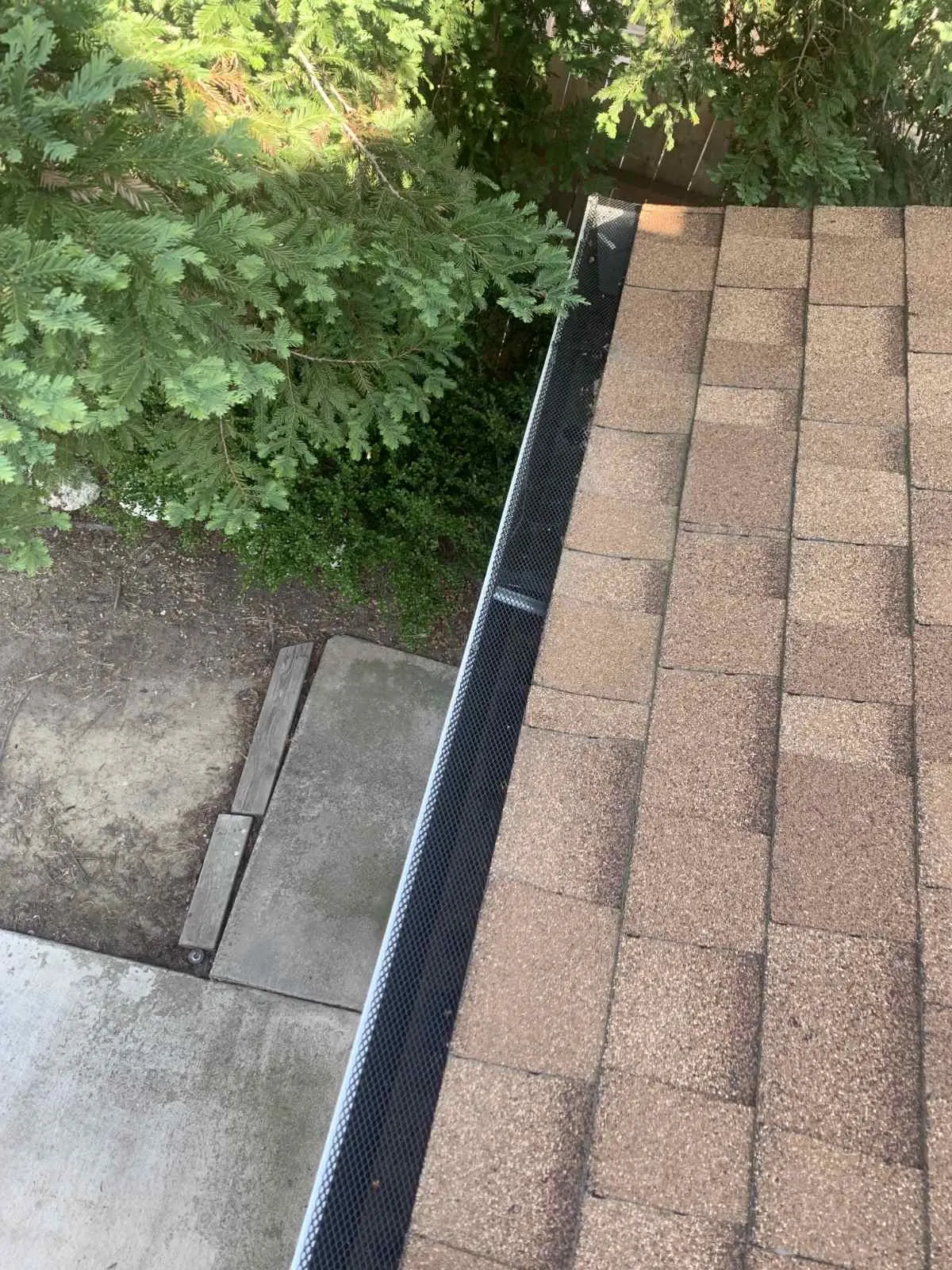
Gutter Guards for Solar Panel Homes in Sacramento
Over 34% of Sacramento homes now have rooftop solar (SMUD). Protecting your gutters on a solar-equipped home requires clip-on installation that never touches your panel hardware or voids your warranty.
5.0 Google Rating · Workmanship Guarantee · Solar-Compatible Installation
Get your free estimate
Free on-site assessment and a fixed written price. No obligation.
- 5.0 rating
- Workmanship guarantee
- No obligation
Solar-equipped homes in Sacramento need gutter guards installed by someone who has done it before. Standard under-shingle guards cannot be used when panel racking occupies the roof edge. The correct solution is a clip-on micro-mesh guard that fastens only to the gutter lip — no roof penetration, no interaction with panel hardware. Cost runs $9–$22 per linear foot, about 20–40% more than a non-solar home, because every foot is worked from a ladder positioned around the array. The result is the same debris-free drainage with no solar warranty exposure.
Why Solar Homes Have a Bigger Gutter Problem
Solar panels do not create gutter problems — they make existing ones harder and more expensive to fix.
Panels Concentrate Debris Into the Gutter
The lower edge of a solar array acts as a dam. Pine needles, oak catkins, eucalyptus bark, and shingle granules all slide down the glass surface and pile up at the panel edge directly above your gutter trough. Gutters on solar homes clog 2–3x faster than those on open roofs.
Water Shoots Off Panel Edges at High Velocity
Rain hits a slick glass panel and accelerates off the bottom edge in a concentrated stream. Instead of dispersing across shingles and dripping into the gutter, it hits the gutter at one point with higher velocity — overshooting it in heavy rain if gutters are not properly sized and clog-free.
Pine Debris Under Panels Is a Fire Risk
Pine needles and dry oak debris that collect along the lower edge of solar arrays and in the gutter below are a direct ember-ignition point during Sacramento fire season. Unlike open gutters, debris trapped under panel edges is shielded from wind and rain — it dries and compacts. Guards block the debris before it reaches that zone.
Sacramento context: More than 34% of single-family homes in Sacramento County carry rooftop solar (SMUD). At that penetration rate, solar-adjacent gutter maintenance is no longer a specialty request — it is standard residential work. Dirty gutters accelerate solar panel soiling through splash-back, and the National Renewable Energy Laboratory (NREL) documents 15–25% output loss from panel soiling on California residential systems. Clog-free gutters are part of protecting that investment.
How We Install Around Solar Panels
A process that protects your array, respects your warranty, and leaves nothing disturbed.
Roof and Racking Assessment
Before quoting, we inspect the clearance between the panel lower edge and gutter lip, identify the racking type, and map wiring conduit runs. This determines which clip-on guard profiles fit and whether any sections require modified bracket spacing.
- Panel clearance measurement
- Racking and conduit mapping
- Guard profile selection
Full Gutter Cleaning First
Every gutter guard installation starts with a thorough clean-out. Sealing debris inside guards is the most common installation error in the industry — and it is worse on solar homes because future access requires the same labor-intensive ladder work. We clear and inspect before a single guard goes in.
- Full debris removal
- Hanger and joint inspection
- Minor repairs addressed before guards go in
Clip-On Installation — Gutter Lip Only
Guards are cut to length on-site and attached to the outer gutter lip using spring clips or self-tapping screws into the gutter face. At no point does the installer step on panels, lean tools against glass, or contact panel racking. All work is done from positioned ladders along the gutter line.
- Gutter-lip attachment only
- No roof penetration near panel mounts
- Panels never contacted or loaded
Water Test and Documentation
After installation we run a water flow test on each section to confirm drainage. You receive dated photos of the completed work — useful for solar warranty documentation and insurance records. If your solar provider requests confirmation that no hardware was disturbed, the photos provide that evidence.
Working with your solar installer: If any panel must be temporarily shifted for edge clearance, we coordinate that directly with your solar provider rather than attempting it ourselves. Most installations do not require panel removal, but when it does come up, the right move is to involve the people who carry the equipment warranty.
Compatible Mounting — No Warranty Impact
Guard type matters as much as installer experience. Not every product works on a solar roof.
Solar-Compatible Guard Types
- ✓Clip-on micro-mesh (recommended) — stainless steel mesh on an aluminum frame that clips to the outer gutter lip. Best filtration performance and widest solar compatibility. No roof contact.
- ✓Screw-in perforated aluminum — lower cost, slightly less debris filtration than micro-mesh. Fastens to the front gutter face with self-tapping screws. Good option for budget-conscious projects with moderate tree exposure.
- ✓Tension-fit mesh inserts — flexible mesh pressed into the gutter trough. Easiest installation, no attachment to roof. Adequate for low-debris zones; may shift in heavy rain.
Guard Types That Conflict With Solar
- ✕Under-shingle micro-mesh — the rear edge slides under the first row of shingles, the same space that solar panel racking mounts. Cannot be installed without removing or lifting panel hardware.
- ✕Reverse-curve (surface tension) guards — require unobstructed roof edge to direct water flow. Solar panels block the path.
- ✕Helmet-style guards — mount under shingles with a curved cover and cannot coexist with panel racking at the roof edge.
Inverter and monitoring system compatibility: Gutter guard installation does not interact with your solar inverter, monitoring hardware, or grid-tie equipment. These components are located in the home's electrical system, not on the roof edge. The only solar hardware near the gutter line is the panel racking and wiring conduit — both of which clip-on guards avoid entirely.
Pricing: Gutter Guards on Solar Homes
Solar-equipped homes cost 20–40% more to install on than standard homes due to increased labor time and clip-on hardware requirements.
| Scenario | Cost / LF | 150 LF Typical Home |
|---|---|---|
| Standard home — no solar | $7–$18 | $1,050–$2,700 |
| Solar-equipped home | $9–$22 | $1,350–$3,300 |
| Solar + critter guard combo | $13–$32 | $1,950–$4,800 |
Small Homes
- ✓ Clip-on micro-mesh guards
- ✓ Solar compatibility assessment
- ✓ Gutter clean-out included
- ✓ Workmanship guarantee
Medium Homes
- ✓ Clip-on micro-mesh guards
- ✓ Solar compatibility assessment
- ✓ Gutter clean-out included
- ✓ Workmanship guarantee
Large Homes
- ✓ Clip-on micro-mesh guards
- ✓ Solar compatibility assessment
- ✓ Gutter clean-out included
- ✓ Workmanship guarantee
Free estimates • Financing available • Every quote includes solar compatibility review at no additional charge
Sacramento's Solar Adoption: Why This Service Matters Here
Sacramento ranks among California's highest-adopting counties for residential solar, driven by SMUD's incentive programs and among the best solar resource in the continental US. That density means gutter contractors who have never worked on a solar roof are the exception, not the standard — but it also means that corners get cut.
The concentrated debris pattern from panel edges, combined with Sacramento's 20+ inches of annual rainfall arriving mostly in a 4-month window, makes gutter function critical. An atmospheric river event that dumps 1.5 inches per hour onto a 2,000 sq ft roof sends over 3,000 gallons of water into your gutters in a single hour. Partially clogged gutters from panel-accelerated debris buildup overflow exactly when overflow causes the most damage — into wet clay soil already saturated against your foundation.
For solar-specific maintenance after guards are installed, the companion service is professional solar panel cleaning. Clean gutters and clean panels together protect the full rooftop investment.
Have Solar Panels? Get a Gutter Guard Quote.
We install gutter guards on solar-equipped homes across Sacramento, Roseville, Folsom, and El Dorado Hills. Every quote includes a solar compatibility assessment at no extra charge.
5.0 Rating · Since 2010 · Licensed & Insured
FAQ
Frequently Asked Questions
Related Services
Solar Panel Cleaning
Guards protect the gutters. Professional panel cleaning protects your energy production. The two services together cover your full rooftop investment.
Gutter Guard Installation
No solar panels? Standard installation with full guard type options starting at $7–$18 per linear foot.
Gutter Cleaning
Already have solar and need a clean-out before guards go in? We clean gutters on solar-equipped homes throughout Sacramento.