Gutter Glossary
Reverse-Curve Gutter Guard
A solid-top guard that uses water's surface tension to direct flow around a curved nose and into the gutter while debris sheds off the edge. Effective in light debris conditions but prone to overshooting in heavy rain and clogging with pine needles.
What is a Reverse-Curve Gutter Guard?
A solid-top guard that uses water's surface tension to direct flow around a curved nose and into the gutter while debris sheds off the edge. Effective in light debris conditions but prone to overshooting in heavy rain and clogging with pine needles. Reverse-curve (also called surface-tension) gutter guards work on the principle that water molecules cling to a curved surface.
Full Definition
Reverse-curve (also called surface-tension) gutter guards work on the principle that water molecules cling to a curved surface. Rain hits the solid top, flows toward the nose of the guard, and ideally curves around and drops into the narrow inlet slot at the gutter lip rather than overshooting. When conditions are ideal — modest rain intensity, large debris that lies flat on the surface — the design can work reasonably well.
The failure modes are well-documented. During high-intensity rainfall (Sacramento atmospheric rivers frequently exceed 1.5 inches per hour), the water sheet gains enough momentum to overshoot the inlet slot and discharge in a waterfall off the edge of the guard, completely bypassing the gutter. Pine needles, shingle grit, and sweetgum balls can enter through the slot or bridge across the nose, reducing effective drainage. Some products accumulate debris along the top surface that hardens in summer heat into a solid mat.
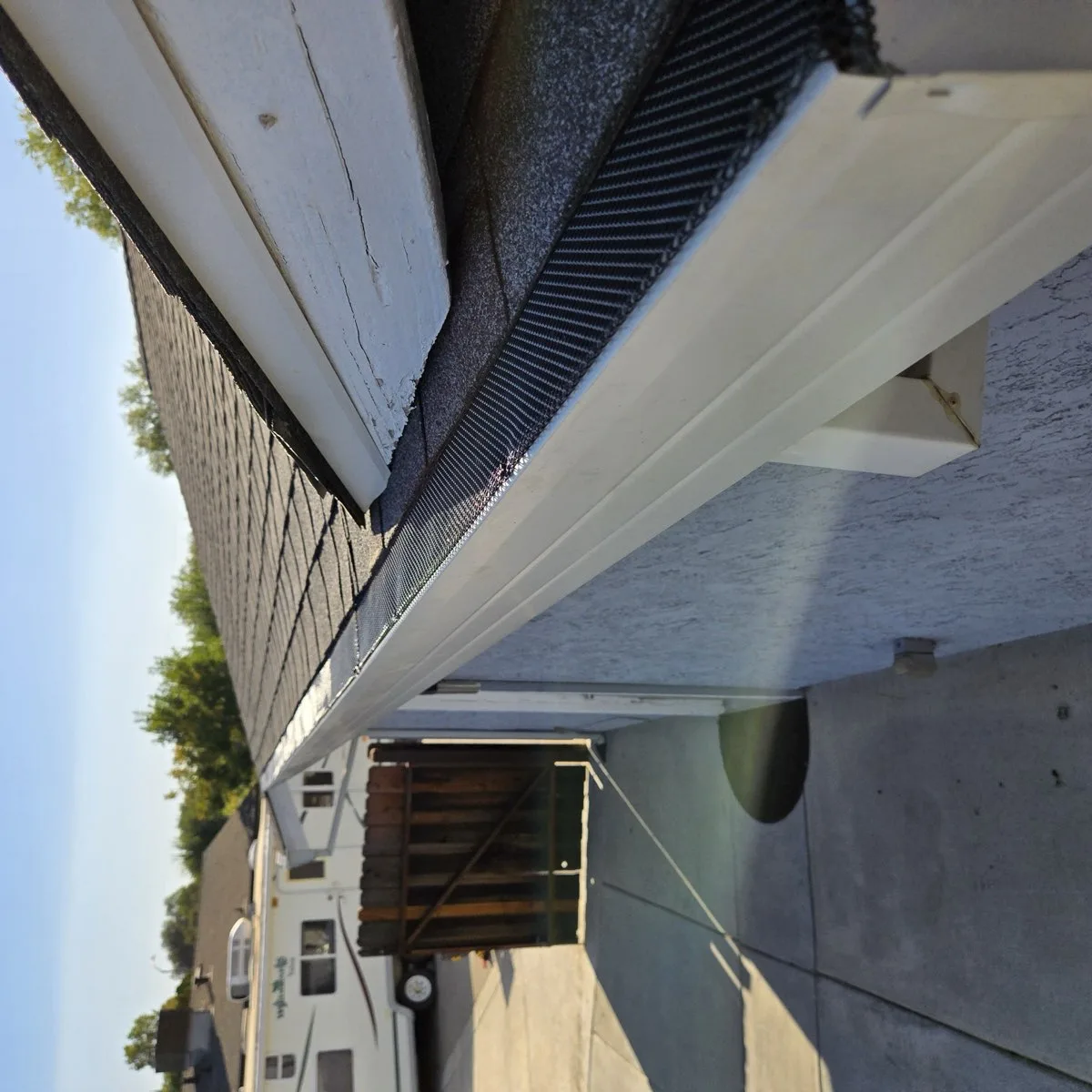
Several nationally marketed brands use reverse-curve technology, which makes it important for Sacramento homeowners comparing quotes to identify which product type they are being offered. Direct comparison testing published by independent sources consistently shows micro-mesh outperforming reverse-curve in debris exclusion and flow rate under high-rain-volume conditions.
Also Known As
- surface tension gutter guard
- curved gutter cover
Related Terms
Micro-Mesh Gutter Guard
A gutter protection product using a fine stainless-steel mesh (typically 50–150 microns) over an aluminum frame that lets water pass while blocking debris as small as pine needles and shingle grit — the top-performing category for Sacramento's mix of debris types.
Snap-In Screen Gutter Guard
Plastic or aluminum mesh screens that snap into or over the gutter opening. A cheap entry-level option that tends to warp in heat, blow off in storms, and let fine debris through — suitable only for very light debris conditions.
Foam Gutter Guard
A porous polyurethane foam insert that fills the gutter cavity and theoretically lets water through while blocking debris on top. Cheap and DIY-friendly but degrades quickly under UV exposure and traps debris within the foam within 1–3 years.
K-Style Gutter
The most common residential gutter profile in the US, with a flat back, decorative ogee-shaped front face, and rectangular cross-section that holds more water per linear foot than half-round gutters of equivalent size.
Roof Valley
The internal V-shaped angle where two sloped roof planes meet, channeling water from a large combined roof area into a single concentrated flow that discharges into the gutter below — often a high-volume stress point requiring oversized downspouts or splash guards.
Related Services
Related Reading
Free Estimate
Got questions about reverse-curve gutter guard?
Talk to a Sacramento Gutter Guard estimator. We serve the full Sacramento metro — most quotes delivered same-day. 5.0 stars on Google, serving since 2010. Licensed, Bonded & Insured.