California’s plumbing and building codes aren’t optional suggestions—they carry legal weight. Under California Plumbing Code Section 1101.12.1, all roof areas must drain through gutters or roof drains sized for a maximum rainfall rate of 1.5 inches per hour (CA Plumbing Code 2022 via UpCodes). Whether you’re replacing old gutters, building new, or just wondering what the law actually says, this guide breaks down every relevant code section for Sacramento County homeowners in 2026.
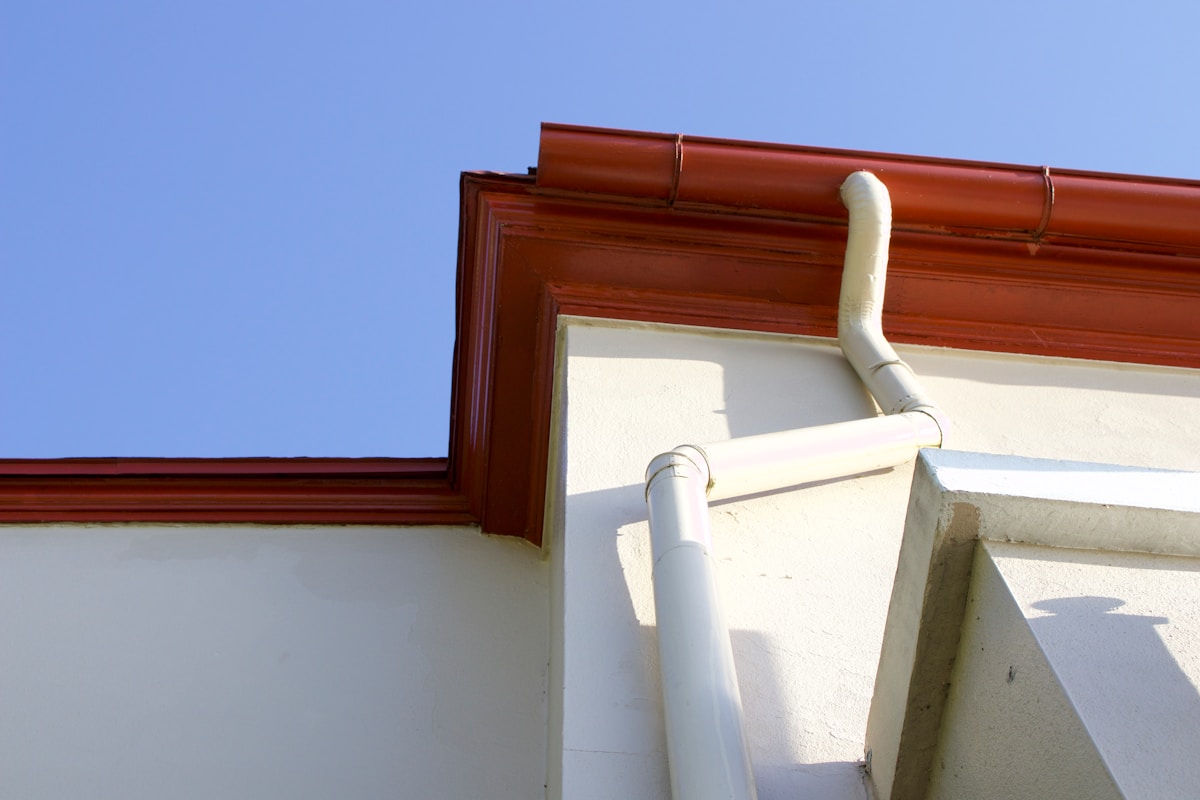
Photo by Taylor Hammersla via Unsplash
TL;DR: Sacramento homes must meet California Plumbing Code drainage standards (sized for 1.5 in/hr rainfall), IRC R903.4’s 5-foot downspout setback from foundations, and—if you’re in a WUI fire zone—CBC Section 705A.4’s mandatory gutter guard requirement. Sacramento County also requires full stormwater mitigation. Codes change, so confirm requirements with your local building department before starting work.
Table of Contents
- Does Sacramento County Require Gutters on Residential Homes?
- What Does the California Plumbing Code Require for Gutters & Drainage?
- How Far Must Downspouts Discharge from Your Foundation?
- Are Gutter Guards Required by Law in Sacramento’s WUI Fire Zones?
- What Stormwater Drainage Rules Apply to Sacramento Homeowners?
- When Do You Need a Permit for Gutter Work in Sacramento?
- How Do You Verify Your Property’s Code Requirements?
- Frequently Asked Questions
Quick Answer: What Codes Apply to Sacramento Gutters?
Three layers of code govern gutters in Sacramento County. The California Plumbing Code (CPC Section 1101.12.1) sets drainage sizing at 1.5 in/hr rainfall capacity. The International Residential Code (IRC R903.4) mandates a 5-foot minimum downspout setback from foundations on expansive soils. And the California Building Code Chapter 7A requires gutter guards in designated WUI fire zones. Sacramento County stormwater ordinances add a fourth layer: all surface drainage impacts must be fully mitigated.
Important
Building codes are updated on regular cycles, and local amendments can differ from state-level standards. This article reflects codes in effect as of early 2026. Always verify current requirements with the Sacramento County Building Permits & Inspection Division or a licensed contractor before beginning any gutter installation, repair, or modification project.
Does Sacramento County Require Gutters on Residential Homes?
Yes, with caveats. California Plumbing Code Section 1101.12.1 states that roof areas must be drained by roof drains or gutters, with primary drainage sized for a rainfall rate of 1.5 inches per hour (CA Plumbing Code 2022 via UpCodes). New construction must comply. Existing homes, however, often predate these requirements.
What does that mean in practice? If you’re building a new home in Sacramento County, gutters (or an equivalent roof drainage system) are mandatory. If you’re replacing gutters on an existing home, the new installation must meet current CPC standards for sizing and drainage capacity. You can’t install undersized gutters just because the old ones were small.
Plenty of older Sacramento homes, especially those built in the 1950s through 1970s, either lack gutters entirely or have systems that don’t meet modern standards. The code doesn’t force you to retrofit gutters on an existing home where none existed—unless you’re doing a major renovation that triggers code compliance. But if your home lacks gutters and sits on Sacramento’s expansive clay soil, you’re inviting foundation damage even if no inspector knocks on your door.
Code reference: California Plumbing Code Section 1101.12.1 requires all roof areas to be drained by roof drains or gutters connected to an approved drainage system, with primary drainage sized for a maximum rainfall rate of 1.5 inches per hour (CA Plumbing Code 2022 via UpCodes).
What Does the California Plumbing Code Require for Gutters & Drainage?
Multiple code sections govern how gutters, downspouts, and drainage systems must perform in California. The California Plumbing Code (CPC) addresses sizing and drainage capacity, while the California Building Code (CBC) Section 1503.4 covers design and installation standards (ICC Digital Codes). Here’s a consolidated reference table.
| Code Section | What It Covers | Key Requirement |
|---|---|---|
| CPC 1101.12.1 | Roof drainage capacity | Primary drainage sized for 1.5 in/hr rainfall rate |
| CBC 1503.4 | Roof drainage design & installation | Must comply with Section 1503 standards |
| IRC R903.4 | Downspout discharge location | Minimum 5 ft from foundation on expansive soils |
| CBC 705A.4 | Gutter debris protection (WUI zones) | Gutters must prevent leaf/debris accumulation |
| CRC R337.5.4 | Gutter guards in fire zones | Debris guards required on all roof gutters in WUI areas |
| Sacramento County Code | Stormwater & surface drainage | All drainage impacts must be fully mitigated |
The 1.5 inches per hour rainfall rate is the design benchmark. For a typical 2,000-square-foot Sacramento home, that translates to roughly 1,870 gallons of water per hour flowing through the gutter system during a code-level storm event. Standard 5-inch K-style gutters handle most residential roofs adequately, but homes with steep pitches, large roof areas, or valley convergences may need 6-inch gutters or additional downspouts to meet the code standard.
In our experience, the most common code-related issue we see in the Sacramento area isn’t missing gutters—it’s undersized gutters paired with too few downspouts. A home built in 1975 might have 4-inch gutters with only two downspouts serving 150 linear feet. That configuration falls short of the CPC’s 1.5 in/hr capacity standard and causes overflow during moderate winter storms.
How Far Must Downspouts Discharge from Your Foundation?
IRC Section R903.4 is explicit: in areas with expansive or collapsible soils, downspouts must discharge to the ground surface not less than 5 feet from foundation walls or connect to an approved drainage system (IRC 2021 via ICC Digital Codes). Sacramento County’s predominant clay soils qualify as expansive, making this rule directly applicable to most local homes.
Why does the 5-foot setback matter so much here? Sacramento sits on what geologists call the Sacramento Valley Formation—layers of alluvial clay deposited over millennia by the Sacramento and American Rivers. This clay expands significantly when wet and contracts when dry. Water dumped at the foundation creates an uneven moisture profile that pushes against one section of your foundation while dry soil contracts elsewhere. The result is differential settling, cracking, and eventually structural failure.
We’ve seen homeowners lose tens of thousands of dollars to foundation repairs that could have been prevented with proper downspout placement. The 5-foot rule isn’t an arbitrary number—it’s the minimum distance needed to keep the soil moisture profile around your foundation reasonably consistent.
How to Meet the 5-Foot Setback Requirement
Downspout Extensions
The simplest approach. Attach rigid or flexible extensions to each downspout that carry water at least 5 feet from the foundation wall. Hinged extensions fold up for mowing.
Underground Drainage Pipe
Connect downspouts to buried PVC pipe that routes water to a pop-up emitter, dry well, or street curb. This counts as an “approved drainage system” under IRC R903.4.
Splash Blocks with Grading
Position splash blocks at each downspout and verify the surrounding grade slopes away from the foundation at a minimum of 6 inches over 10 feet (per IRC R401.3).
For a detailed breakdown of extension options and underground drainage configurations, read our downspout extensions and drainage solutions guide. And for proper downspout positioning strategies specific to Sacramento lots, see our downspout placement guide.
Code reference: IRC Section R903.4 mandates that downspouts in areas with expansive or collapsible soils must discharge to the ground surface not less than 5 feet from foundation walls, or connect to an approved drainage system (IRC 2021 via ICC Digital Codes). Sacramento County’s clay soils are classified as expansive, making this requirement directly applicable.
Are Gutter Guards Required by Law in Sacramento’s WUI Fire Zones?
California Building Code Chapter 7A, Section 705A.4 is direct: “Roof gutters shall be provided with the means to prevent the accumulation of leaves and debris in the gutter” (CBC 2022 Chapter 7A via UpCodes). This applies to all homes in designated Wildland-Urban Interface fire areas. It’s not a suggestion. Gutter guards are the law in WUI zones.
The California Residential Code reinforces this through CRC Section R337.5.4, which requires debris guards on all roof gutters in WUI areas. The intent is clear: dry leaves and pine needles in gutters act as fuel for airborne embers during wildfire events. Guards remove that fuel source and block embers from entering the gutter channel.
Which Sacramento Areas Fall in WUI Zones?
Several Sacramento County and adjacent communities sit within or border WUI fire severity zones. Cal Fire maintains the official Fire Hazard Severity Zone maps, which determine where Chapter 7A applies. Here are the local areas most commonly affected:
High/Very High Fire Severity
- • Eastern Sacramento County foothills
- • Folsom (portions)
- • El Dorado Hills
- • Cameron Park
- • Auburn
- • Grass Valley / Nevada City
- • Granite Bay (portions)
Moderate Fire Severity / WUI-Adjacent
- • Orangevale (portions)
- • Fair Oaks (eastern portions)
- • Rocklin (eastern portions)
- • Lincoln (eastern portions)
- • Loomis
- • Rancho Cordova (eastern edge)
Even if your home sits outside a formally designated WUI zone, gutter guards remain a smart investment for wildfire protection. Ember showers during large fire events can travel miles beyond zone boundaries. And insurance carriers are increasingly factoring home hardening measures into premium calculations across the entire Sacramento region.
Here’s something most code guides won’t tell you: WUI zone boundaries aren’t static. Cal Fire updates its Fire Hazard Severity Zone maps periodically, and SB 63 expanded coverage to more areas within Local Responsibility Areas. A property that wasn’t in a WUI zone five years ago may be in one now. Checking the current map before any gutter project is essential, because non-compliance discovered during a home sale inspection can delay or kill a transaction.
Code reference: California Building Code Chapter 7A, Section 705A.4 requires that “roof gutters shall be provided with the means to prevent the accumulation of leaves and debris in the gutter” for all homes in designated WUI fire areas (CBC 2022 via UpCodes). CRC R337.5.4 reinforces this by mandating debris guards on all roof gutters in WUI zones.
What Stormwater Drainage Rules Apply to Sacramento Homeowners?
Beyond building codes, Sacramento County has its own stormwater ordinance. The county code requires that all stormwater and surface runoff drainage impacts be fully mitigated (Sacramento County Code). In plain language: your property’s drainage system can’t create problems for neighboring properties, public infrastructure, or waterways.
What does “fully mitigated” look like for a typical homeowner? It means your gutter and downspout system must collect roof runoff and direct it to an appropriate outlet—your yard with proper grading, a dry well, an underground pipe to the street, or a rain garden. You cannot channel concentrated water flow onto a neighbor’s property. You cannot discharge directly onto sidewalks or public walkways in a way that creates hazards.
Common Stormwater Compliance Issues
We’ve found that most Sacramento homeowners are already in reasonable compliance without realizing it—gutters collect water, downspouts deposit it on the lawn, and the grading carries it toward the street. Problems tend to emerge when homeowners modify their landscaping, add hardscape (patios, driveways, retaining walls), or reroute drainage without considering downstream effects.
If you’re planning any drainage modifications alongside a gutter project, it’s worth consulting with your contractor about grading, flow paths, and whether an underground drain line makes sense for your property. Our downspout drainage solutions guide covers the most common configurations for Sacramento lots.
When Do You Need a Permit for Gutter Work in Sacramento?
Permit requirements depend on the scope of work. Most straightforward gutter replacements and repairs on existing homes don’t require a permit in Sacramento County. But certain projects cross the threshold, and working without a required permit can create problems when you sell your home or file an insurance claim.
| Project Type | Permit Typically Required? | Notes |
|---|---|---|
| Like-for-like gutter replacement | No | Same size, same location, same material |
| Gutter guard installation | No | Accessory to existing system |
| Gutter repair / section replacement | No | Maintenance and minor repair |
| New gutters on new construction | Yes | Part of overall building permit |
| Rerouting drainage to new location | Maybe | Depends on scope and connection type |
| Underground drain line to street | Yes | Connects to public drainage infrastructure |
| Major re-grading for drainage | Yes | Alters site drainage patterns |
Accessory structures add another layer. According to Permit Sonoma Technical Bulletin B-34, which several California jurisdictions reference, small accessory structures may be exempt from full drainage requirements if their roof discharge extends a minimum of 10 feet from non-exempt structures. Sacramento County may apply different thresholds, so confirm with the building department if your project involves a detached garage, workshop, or ADU.
When in doubt, call the Sacramento County Building Permits & Inspection Division at (916) 875-5296. A five-minute phone call can save you from code violations, fines, or complications during a future home sale. For guidance on choosing a contractor who understands local code requirements, read our guide to choosing a gutter contractor in Sacramento.
How Do You Verify Your Property’s Code Requirements?
Every Sacramento property has a unique set of applicable codes depending on its location, fire zone designation, soil type, and proximity to waterways. IRC R903.4’s 5-foot setback applies broadly here, but WUI requirements under CBC 705A.4 vary by parcel. Verifying what applies to your address takes about 30 minutes.
Steps to Check Your Property’s Requirements
Check Your Fire Hazard Severity Zone
Visit the Cal Fire FHSZ Viewer at egis.fire.ca.gov/FHSZ and enter your address. If your parcel falls in a High or Very High fire severity zone, CBC Chapter 7A gutter guard requirements apply.
Review Your Soil Type
Use the USDA Web Soil Survey at websoilsurvey.nrcs.usda.gov to confirm whether your property has expansive clay soils. Most Sacramento parcels do, which triggers the IRC R903.4 5-foot downspout setback.
Contact the Building Department
Call Sacramento County Building Permits & Inspection at (916) 875-5296 or visit their office at 827 7th Street, Sacramento. Ask whether your planned gutter project requires a permit and whether any local amendments apply.
Hire a Licensed Contractor
A licensed C-43 (sheet metal) or C-5 (concrete) contractor in Sacramento should know local code requirements. Ask them to confirm code compliance as part of their scope of work. See our contractor selection guide.
Don’t skip this verification step. We’ve seen homeowners install gutter systems that looked fine but violated the 5-foot setback rule or missed a WUI gutter guard requirement. These issues surface during home inspections, title transfers, and insurance claims—exactly when you can least afford a surprise. Understanding what applies to your property before you start saves time, money, and headaches.
Need Code-Compliant Gutter Installation?
Our team installs gutter systems that meet all California Plumbing Code, Building Code, and Sacramento County drainage requirements. We verify your property’s fire zone status, soil type, and permit needs before we begin. Free estimates, no obligation.
Frequently Asked Questions
Does Sacramento County require gutters on residential homes?
California Plumbing Code Section 1101.12.1 requires that roof areas be drained by roof drains or gutters connected to an approved drainage system, with primary drainage sized for 1.5 in/hr rainfall capacity. New construction must comply. Existing homes without gutters aren’t forced to retrofit unless a major renovation triggers code compliance, but proper drainage is essential for protecting Sacramento’s clay-soil foundations.
How far must downspouts discharge from the foundation in Sacramento?
IRC Section R903.4 requires a minimum of 5 feet from foundation walls on expansive or collapsible soils, or connection to an approved drainage system. Sacramento’s clay soils are classified as expansive, so this 5-foot rule applies across most of the county. Extensions, underground drain lines, or splash blocks with proper grading all satisfy the requirement.
Do I need gutter guards by law in Sacramento?
Only if your property is in a designated WUI fire zone. CBC Chapter 7A, Section 705A.4 states that gutters must prevent leaf and debris accumulation in WUI areas. CRC R337.5.4 reinforces this with a debris guard mandate. Parts of eastern Sacramento County, Folsom, El Dorado Hills, and Auburn are in WUI zones. Check the Cal Fire FHSZ Viewer for your specific address.
Do I need a permit to install gutters in Sacramento County?
Like-for-like gutter replacement and gutter guard installation typically don’t require permits. New gutter installations on new construction fall under the overall building permit. Underground drain connections to public infrastructure, major drainage rerouting, and significant re-grading usually do require permits. Call the Sacramento County Building Permits & Inspection Division at (916) 875-5296 to confirm.
What is the California Plumbing Code rainfall rate for gutter sizing?
CPC Section 1101.12.1 sets the design standard at 1.5 inches per hour for primary roof drainage. This determines your gutter size, downspout diameter, and downspout spacing. For most Sacramento homes, 5-inch K-style gutters with 2x3-inch downspouts satisfy this requirement. Homes with large roof areas or steep pitches may need 6-inch gutters or additional downspouts.
Are accessory structures like sheds exempt from Sacramento gutter codes?
Some small accessory structures may qualify for exemptions. Permit Sonoma Technical Bulletin B-34, referenced by multiple California jurisdictions, allows exemptions when roof discharge extends a minimum of 10 feet from non-exempt structures. Sacramento County may apply its own thresholds. Contact the local building department to confirm whether your detached garage, shed, or ADU qualifies for an exemption.
Related Articles
Downspout Placement & Foundation Protection
Where to position downspouts to protect your Sacramento home’s foundation from water damage.
Downspout Extensions & Drainage Solutions
Compare extension types, underground drains, and pop-up emitters for Sacramento homes.
Foundation Damage Prevention with Gutters
How proper gutter maintenance prevents costly foundation damage on Sacramento’s clay soil.
Gutter Guards & Wildfire Protection
How metal gutter guards protect Sacramento homes from ember intrusion during wildfire season.
New Gutter Installation: What to Expect
A step-by-step walkthrough of the gutter installation process for Sacramento homeowners.
How to Choose a Gutter Contractor
What to look for in a gutter contractor, including licensing, insurance, and code knowledge.